
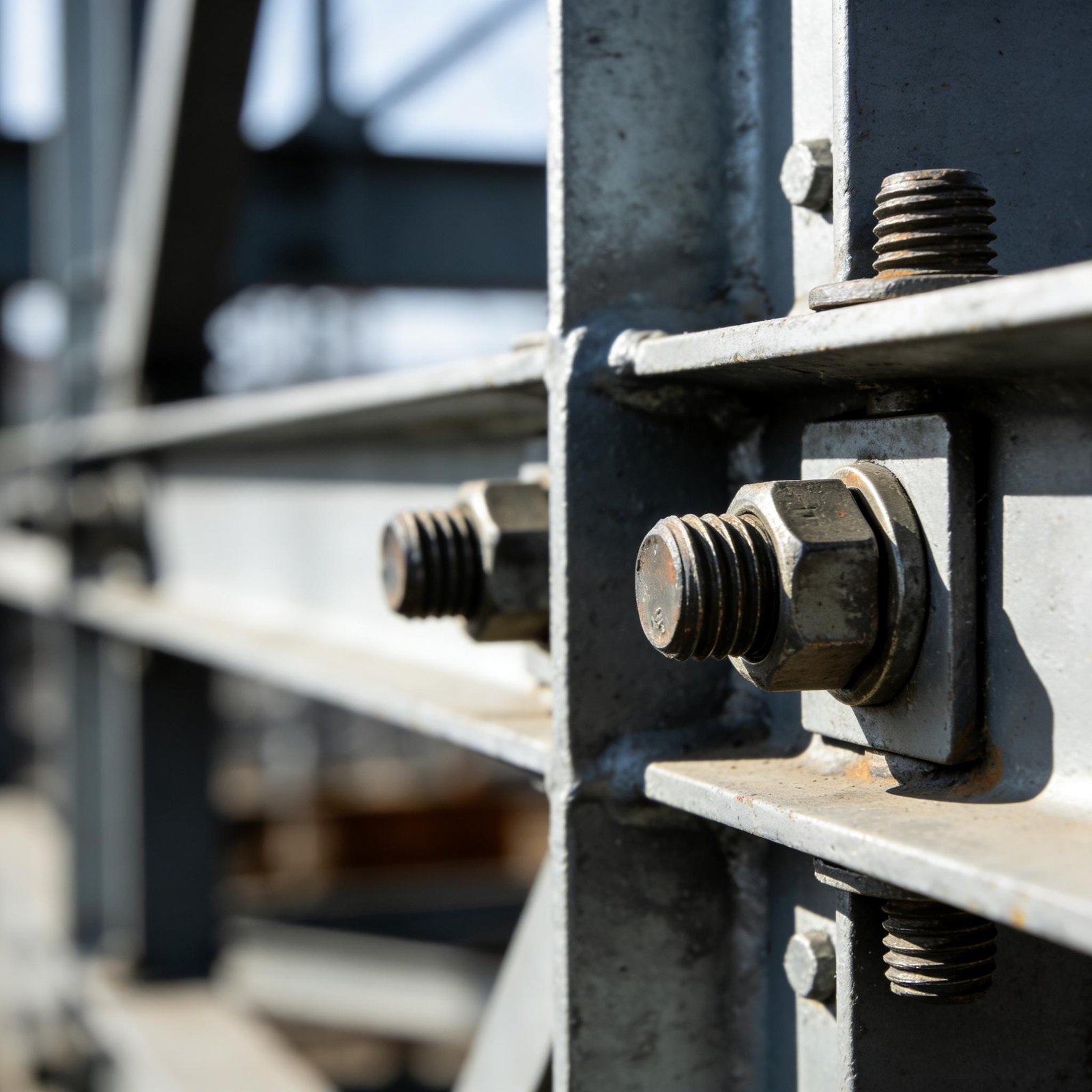
Steel structures are now widely used in many construction fields. Therefore, their design, construction, use, maintenance and other aspects are all interrelated and constitute a complex system project. When talking about steel structure fasteners, the connection forms of steel structures cannot be ignored, especially the connection by fasteners, including ordinary bolts, high-strength bolts, shot nails, self-drilling screws, and riveted bolts.
Steel structure fasteners connections
The connection bolts are classified into 8 grades, namely 3.6, 4.6, 4.8, 5.6, 5.8, 6.8, 8.8, 10.9S (such as 5.6S indicates an anti-tensile strength of 500 MPa and a yield strength ratio of 60%). The latter two grades are high-strength bolts, and the rest are ordinary bolts.
1. Ordinary Bolt Connections
(1) Types and Applications of Ordinary Bolts
Ordinary bolts are classified by their shape: hexagonal bolts, socket head bolts, and anchor bolts.
- Hexagonal Bolts: According to quality and product grade, they are divided into three types: A, B, and C.
Grade A bolts – refined bolts;
Grade B bolts – semi-refined bolts;
Grade C bolts – rough bolts.
Grade A and Grade B bolts are suitable for the installation of important structures where a large shear force needs to be transmitted at the connection points, while Grade C bolts are suitable for temporary fixation in steel structure installation.
- Socket Head Bolts: Also known as studs, they are mostly used for connecting thick plates or places where it is inconvenient to use hexagonal bolts for connection, such as concrete roof trusses, roof beam suspension single-track beam hanging parts, etc.
- Anchor Bolts: They are classified as general anchor bolts, right-angle anchor bolts, hammer head bolts, and anchor fixing anchor bolts. General anchor bolts, right-angle anchor bolts, and hammer head bolts are pre-embedded in the foundation before concrete pouring to fix steel columns; anchor fixing anchor bolts are anchor bolts installed, grouted, and fixed after drilling holes on the formed concrete foundation.
⑵ Construction of Ordinary Bolts
- Connection Requirements:
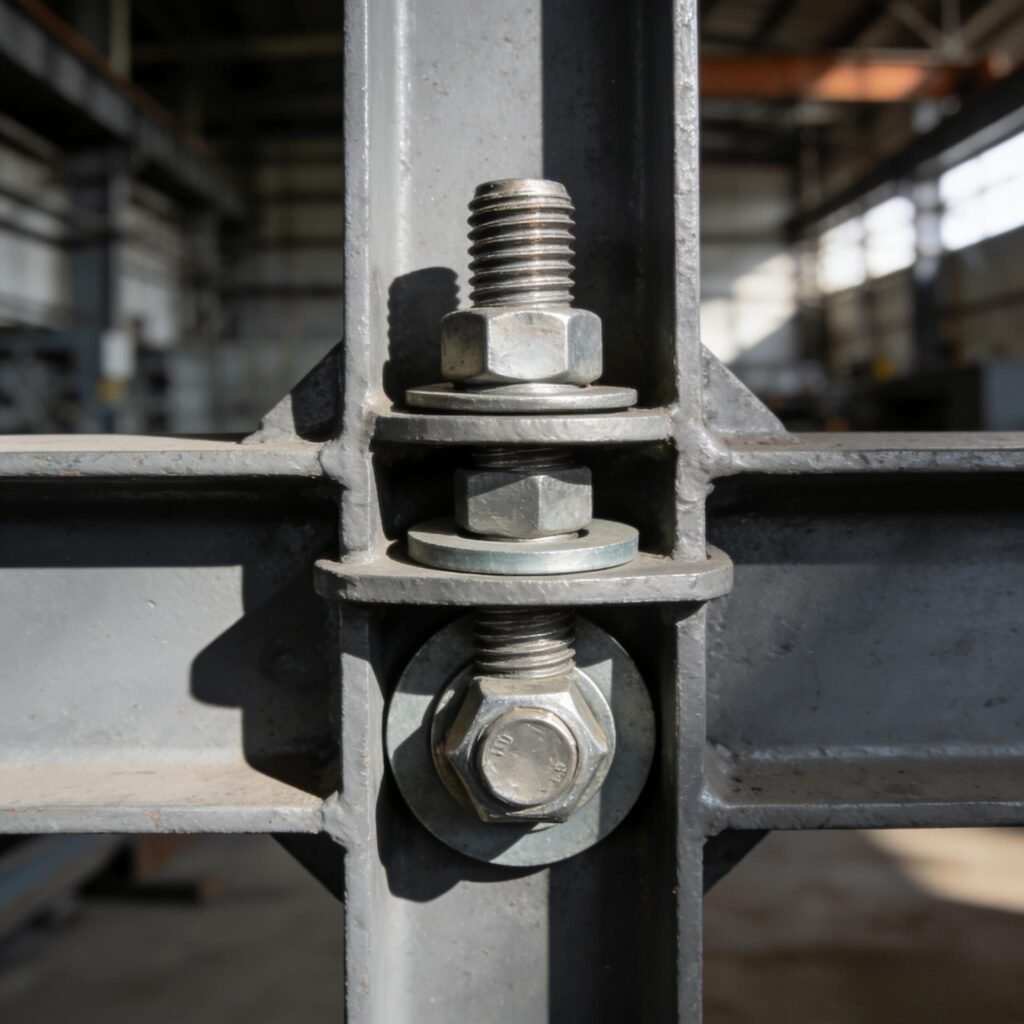
1) Flat washers should be placed under the bolt head and nut. The number of washers under the nut should not exceed 2, and the number of washers under the bolt head should not exceed 1.
2) The bolt head and nut should be tightly attached to the surface of the structural component and the washers.
3) For inclined bolt connections, flat washers should be placed to level the inclined surface.
4) For dynamic loads or important parts, spring washers should be placed.
5) The length of the bolt extending beyond the nut should be no less than the length of two complete threads.
- Tightening Torque
The tightening of bolts must start from the center and be done symmetrically; for large joints, a double tightening method, i.e., the “two-time tightening method”, is adopted. The tightening torque during tightening should not exceed the corresponding regulations. The tightening quality of permanent bolts is inspected by hammering or torque wrench, requiring the bolts not to vibrate or shift, and the authenticity of the tightening is checked with a feeler gauge, and the height difference (unevenness) between the对接 surfaces should not exceed 0.5mm.
2. High-strength Bolt Connections
⑴ Types and Applications of High-strength Bolts
High-strength bolts are high-strength bolts, which are standard components. They are a new type of steel structure connection method following riveting and are currently the main means of steel structure connection.
High-strength bolts can be classified by their appearance as torsion-shear type high-strength bolts and large hexagon head high-strength bolts.
⑵ Construction Tools for High-strength Bolts
- Manual Torque Wrench
When using a manual torque wrench to tighten high-strength bolts, a wrench with a specified torque value should be used to apply the torque to ensure the specified torque and shear force values of the high-strength bolt connection pair. Common manual torque wrenches include pointer type, audible type, and torsion-shear type.
- Electric Wrench
Torque-controlled and angle-controlled electric wrenches are suitable for tightening large hexagon head high-strength bolts and can automatically control the torque and angle. They are suitable for the initial tightening, final tightening, and initial tightening of torsion-shear type high-strength bolts in the installation of large hexagon head high-strength bolts in steel structure bridges and factory buildings.
Torsion-shear type electric wrenches are suitable for final tightening of torsion-shear type high-strength bolts. Common torsion-shear type electric wrenches include 6922 type and 6924 type.
⑶ Storage and On-site Re-inspection of High-strength Bolts
- Storage of High-strength Bolts
During the packaging, transportation, and on-site storage of high-strength bolts, their original state should be maintained until the installation and use. To prevent changes in the torque coefficient (K) of the connection pair, this is an important aspect of high-strength bolt storage.
- On-site Sampling Re-inspection of High-strength Bolts
For torsion-shear type high-strength bolts and large hexagon head high-strength bolts, inspection reports for torque coefficient and tightening axial force (pre-tension) should be included in the box when they leave the factory.
Sliding coefficient of the connection surface re-inspection: For high-strength bolts, 3 sets of test pieces should be taken from each acceptance batch;
Pre-tension re-inspection: For torsion-shear type high-strength bolts, 8 sets should be taken from each acceptance batch;
Torque coefficient re-inspection: For large hexagon head high-strength bolts, 8 sets should be taken from each acceptance batch.
⑷ Construction Key Points of High-strength Bolts
- Inspection before Tightening
Before tightening the bolts, checks should be conducted on the position of the bolt holes, the displacement of the connected components, the unevenness, non-perpendicularity, and smooth tightness of the mating, the treatment of the friction surface at the plate joint, the connection gap, the concentricity of the holes, and the placement of temporary bolts.
- Tightening Construction
The tightening sequence should be carried out from the center of the node to the edge. During tightening, it should be done in two stages: initial tightening and final tightening. For large nodes, initial tightening, re-tightening, and final tightening can be carried out. The axial force for initial and re-tightening should be 60-80% of the standard axial force, and the final tightening axial force should be the standard axial force.
For bolts installed on the same day, they should be fully tightened on the same day to prevent the threads from being contaminated and rusted, which may cause changes in the torque coefficient value.
- Inspection after Tightening
For large hexagon head high-strength bolts: whether there is missed tightening and the construction torque value.
The inspection of the construction torque value should be conducted 1 hour after the final tightening is completed and within 48 hours.
Sampling rate: 5% of each working team and the total number of final tightening completed each day. The number of unqualified items should be less than 10% of the sampled quantity and less than 2, and it is considered qualified. Otherwise, double sampling should be conducted. If still unqualified, all bolts that were fully tightened on the same day should be re-inspected.
When inspecting the twist-shear high-strength bolts, if you observe that the tail of the bolt has been removed, it can be determined that the final tightening of the bolt is qualified. For cases where it is impossible to use a dedicated electric wrench to remove the flower head due to certain reasons, the inspection method for high-strength hexagonal head bolts can be referred to, and the final tightening can be carried out using the torque method or the angle method and marked.
3. Self-tapping screws, steel rivets, and shoot nail fasteners
The self-tapping screws, steel rivets, and shot-blasting fasteners used for connecting thin steel plates have specifications and sizes that match those of the steel plates being connected. They are securely fastened and closely attached, and the spacing and edge distance comply with the design requirements.
If you are looking for suitable bolts and nuts, please visit us here https://hktl-fastener.com/bolts-and-nuts/.