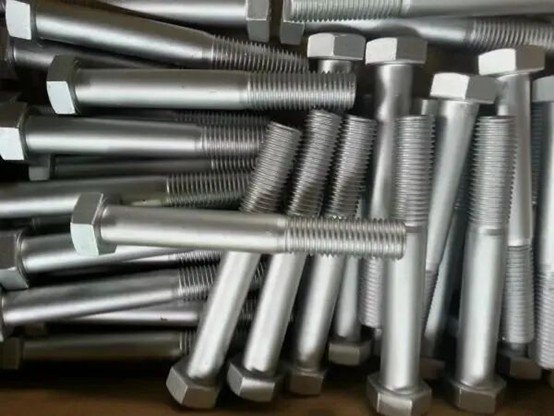
Key Learnings
HS large‑hex high‑strength structural bolts follow GB/T 1228‑1231 / ISO 7412. A complete assembly consists of one bolt, one nut and two washers. Material selection is size‑dependent: 20MnTiB for M16‑M24; 35VB for larger M27‑M30. Matched surface treatments stabilise torque‑coefficient for controlled pre‑load. Strict torque calculation, anti‑loosening and batch acceptance testing are mandatory for building‑, bridge‑ and heavy‑plant structural safety.
| Item | Key Technical Information |
|---|---|
| Assembly set | Large‑hex bolt + matching nut + double washers |
| Common sizes | M16‑M30; special‑project extension up to M36; length 55‑150 mm (head excluded) |
| Material M16‑M24 | 20MnTiB alloy‑steel; quenched‑tempered; tensile 1040‑1240 MPa, yield ≥940 MPa |
| Material M27‑M30 | 35VB special high‑strength steel;‑20 ℃ impact toughness ≥60 J |
| Auxiliary‑parts | Nut: 10B21/35K; washer: 45# medium‑carbon steel |
| Standard surface finish | Bolt: black‑oxide; nut / washer: phosphating; stabilises torque‑coefficient 0.155‑0.187 |
| Corrosive‑environment upgrade | Hot‑dip galvanizing or Dacromet; avoid dissimilar‑metal contact |
Material & mechanical‑performance
- 20MnTiB (M16‑M24): Good hardenability, cold‑heading and fatigue‑resistance. After quenching‑and‑tempering surface hardness 33‑39 HRC, elongation ≥10 %.
- 35VB (M27‑M30): Improved notch‑impact‑resistance for dynamic‑load scenarios such as wind‑tower‑flanges and offshore‑platform nodes.
- Supporting components must match strength‑grade; washers adopt 45# steel with hardness 35‑45 HRC.
Surface‑treatment matching rules
- Bolt: black‑oxide (thin Fe₃O₄ film), stable friction for pre‑load control.
- Nut & washer: phosphating treatment, controls friction‑coefficient deviation ≤15 % per EN standard.
- For salt‑spray / coastal service, switch to hot‑dip‑galvanizing or Dacromet; prevent galvanic corrosion from mixed dissimilar metals.
Construction‑and‑acceptance points
- Tightening torque calculated by formula (T = K·F·d); calibrate electric‑wrenches regularly.
- Vibration‑prone joints: double‑nuts or Nord‑Lock pre‑load washers for anti‑loosening.
- Acceptance: batch‑sampling wedge‑load test; magnetic‑particle inspection to detect surface cracks.
Typical‑application matrix
| Scenario | Size | Material | Surface‑treatment |
|---|---|---|---|
| General steel‑structure workshop | M16‑M24 | 20MnTiB | Black‑oxide + phosphating |
| Cross‑sea bridge | M22‑M30 | 35VB | Hot‑dip galvanizing |
| Heavy‑duty anchor‑bolt | M30‑M36 | 35VB +10B21 | Dacromet |
I. Overview
HS bolts (High-Strength Hexagon Head Bolts) are key fasteners used in high-load connections in steel structure engineering, named for their large hexagonal head design.
Their core features include high tensile strength, excellent shear resistance, and reliable control of axial preload. They are widely applied in areas with extremely high requirements for structural safety, such as bridges, high-rise buildings, and heavy industrial plants.
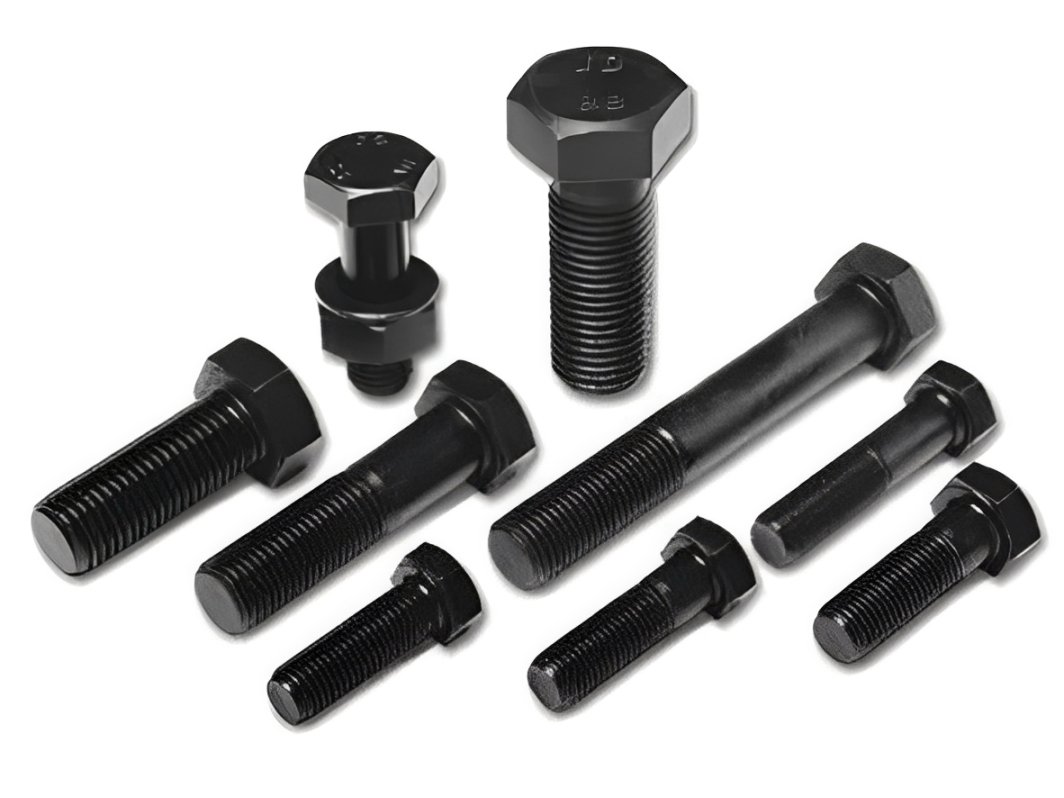
II. Structural Composition
The HS bolt connection assembly consists of the following components:
1. Bolt: With a large hexagonal head design, it provides a larger contact surface for wrenching, ensuring the stability of the installation torque.
2. Nut: A matching hexagonal nut that precisely fits the bolt thread.
3. Double washers: One each on the top and bottom, their functions include:
– Distributing the contact surface pressure to reduce indentation on the connection plate caused by the bolt head/nut.
– Preventing preload loss due to surface roughness.
– In some designs, the washers have chamfers to guide the bolt into proper alignment during installation.
III. Specification Parameters
– Diameter range: M16 – M30 (common specifications), can be extended to M36 for special projects.
– Length range: 55mm – 150mm (excluding head length).
– Applicable standards: Refer to Chinese GB/T 1228-1231 or international ISO 7412 standards.
IV. Materials and Manufacturing Processes
1. Bolt Materials (M16-M24):
– 20MnTiB Alloy Steel: A high-performance material that replaces the traditional 20CrMnTi.
– Performance Advantages:
– Hardenability: Critical quenching diameter in oil is 14-27mm, ensuring uniform core hardness for large cross-section bolts.
– Machinability: Excellent cutting performance after normalizing, and high cold heading forming efficiency.
– Fatigue Strength: Outstanding resistance to cyclic loads after carburizing, reducing notch sensitivity.
– Heat Treatment Process:
– Quenching + Tempering (Quenching and Tempering), surface hardness 33-39HRC.
– Tensile strength 1040-1240MPa, yield strength ≥940MPa, elongation ≥10%.
2. Nut material:
– 10B21/35K cold heading steel: low carbon alloy steel, with hardness of 98HRB-32HRC after heat treatment.
– Design requirement: Ensure matching strength grade with the bolt (such as grade 8.8, grade 10.9).
3. Gasket material:
45# medium carbon steel: After heat treatment, the hardness is 35-45HRC, combining hardness and toughness.
V. Mechanical Performance Indicators
| Parameter | Bolt (20MnTiB) | Nut (10B21) | Washer (45#) |
| Tensile Strength | 1040-1240MPa | ≥1040MPa | – |
| Yield Strength | ≥940MPa | – | – |
| Surface Hardness | 33-39HRC | 98HRB-32HRC | 35-45HRC |
| Wedge Load | 255-304kN | – | – |
| Elongation | ≥10% | – | – |
VI. Surface Treatment Technology
1. Bolts: Black Oxide
– Forms a Fe₃O₄ protective film with a thickness of approximately 0.5-1.5 μm, providing moderate rust resistance.
– The surface friction coefficient is stable, which is beneficial for controlling the preload.
2. Nuts and washers: Phosphating
– A phosphate crystalline layer (such as zinc-based/manganese-based phosphating) is formed, with a thickness of 5-20 μm.
– Functions:
– Enhance rust resistance.
– By adjusting the roughness of the phosphating film, a friction coefficient deviation of ≤15% (EN standard) is achieved when used with blackened bolts.
3. Matching Principle:
– The national standard GB/T 1231 stipulates the standard value of the fastener’s tightening axial force as 0.155 – 0.187 (in the absence of lubrication).
– Differentiated surface treatment ensures the stability of the torque coefficient (\( K = T/(F·d) \)), preventing the dispersion of preload.
VII. Special Specification Requirements (M27 – M30)
– Material Upgrade: Utilize 35VB steel (high-strength bolt dedicated steel).
Performance Characteristics:
Tensile strength ≥ 1200 MPa, impact toughness ≥ 60 J (-20°C).
High notch sensitivity resistance, suitable for dynamic load environments.
Hot-rolled annealed state processing, improving cold heading formability.
Typical Applications: Wind turbine towers, offshore platform nodes, heavy-duty railway bridges.
VIII. Selection and Construction Points
1. Torque Control: Installation torque should be calculated using the formula \( T = K \cdot F \cdot d \), and the accuracy of the electric wrench should be regularly verified.
2. Anti-loosening Measures: Double nuts or preloaded washers (such as Nord-Lock) should be used in vibrating environments.
3. Corrosion Protection:
– In high humidity/salt spray environments, upgrade to hot-dip galvanizing or Dacromet coating.
– Avoid contact between dissimilar metals (such as stainless steel and carbon steel washers).
4. Acceptance Criteria:
– Randomly sample and conduct wedge load tests in batches to ensure no necking or fracture.
– Perform magnetic particle inspection to detect surface cracks.
IX. Comparison of Application Scenarios
| Scene | Recommended Size | Material Selection | Surface Treatment |
| General steel structure workshop | M16-M24 | 20MnTiB | Blackening + Phosphating |
| Cross-sea bridge | M22-M30 | 35VB | Hot-dip Galvanizing |
| Heavy machinery anchor bolt | M30-M36 | 35VB + 10B21 | Dacromet Coating |
Through the above technical analysis, the design of HS bolts fully embodies the collaborative optimization of material science, mechanical properties and process control, and is an indispensable “safety guard” in steel structure engineering. In practical applications, design specifications must be strictly followed to ensure the reliability of structural connections.
FAQ
Q: What materials are HS bolts made of, and what strength do they achieve?
A: For M16–M24 sizes, bolts use 20MnTiB alloy steel with quenching and tempering, achieving tensile strength of 1040–1240MPa, yield strength ≥940MPa, surface hardness 33–39HRC and elongation ≥10%. For larger M27–M30 sizes, material upgrades to 35VB dedicated high-strength steel with tensile strength ≥1200MPa and impact toughness ≥60J at -20°C. Nuts use 10B21/35K cold heading steel and washers use 45# medium carbon steel, all matched to the bolt’s strength grade (8.8 or 10.9).
Q: What surface treatment do HS bolts use, and is it suitable for coastal environments?
A: Standard HS bolts use black oxide on bolts (0.5–1.5μm Fe₃O₄ film) and phosphating on nuts and washers, which provides moderate rust resistance and a stable torque coefficient for preload control. For high humidity or salt spray environments such as cross-sea bridges, upgrade to hot-dip galvanizing or Dacromet coating, and avoid contact between dissimilar metals (such as stainless steel and carbon steel washers).
Q: How should HS bolts be tightened, and what anti-loosening measures are recommended?
A: Installation torque should be calculated using the formula T = K·F·d (torque = torque coefficient × preload × diameter), and electric wrench accuracy should be regularly verified. In vibrating environments, use double nuts or preloaded washers such as Nord-Lock. For acceptance, randomly sample batches for wedge load tests to ensure no necking or fracture, and perform magnetic particle inspection to detect surface cracks.
HKTL Fastener supplies high-strength steel structure hexagon bolts in 20MnTiB and 35VB materials with matched nuts and washers, delivering tensile strengths up to 1240MPa with reliable preload control for bridges, high-rise buildings and heavy industrial plants.
If you are looking for suitable bolts and nuts, please visit us here https://hktl-fastener.com/bolts-and-nuts/.