Principal Findings
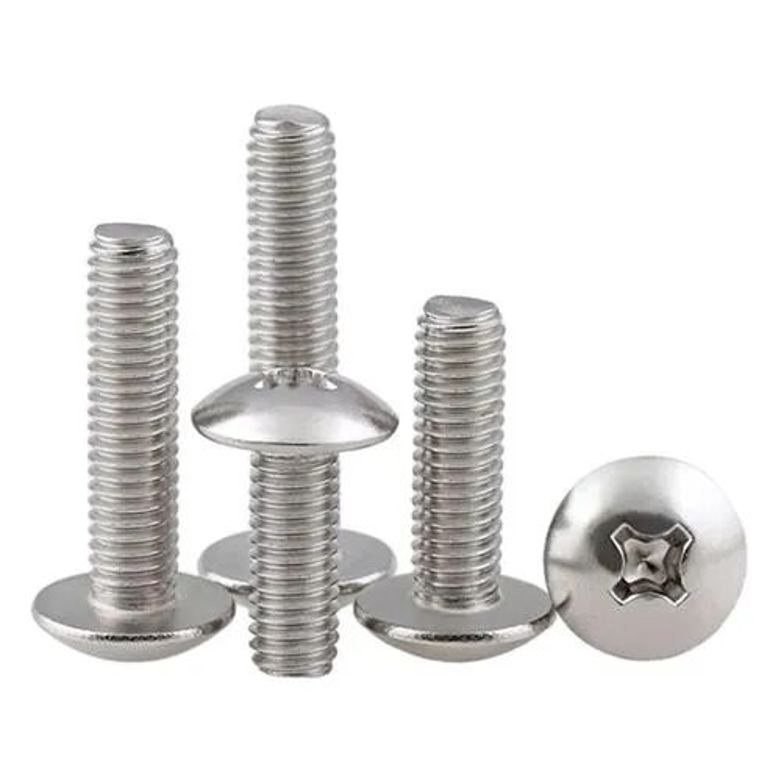
Flat‑head double‑slot (Phillips/slotted combo‑drive) corrugated‑roofing screws feature an enlarged flat head and dual‑drive slot. They suit thin‑soft substrates including corrugated sheets, wood and plastics, with self‑tapping / self‑drilling / machine‑thread options. Proper selection of head‑style, drive‑type, material‑coating and correct length calculation, plus awareness of regional market differences and torque‑controlled installation, help prevent substrate damage and fastener failure.
| Selection Item | Key Guidance |
|---|---|
| Product advantages | Large‑diameter flat head prevents substrate puncture; dual‑slot fits both Phillips and slotted drivers; multiple‑thread types remove need for pre‑drilling in many cases. |
| Head‑style | Large flat‑head(2.0‑2.5×nominal dia): for corrugated board, wood, plastic. Avoid pan‑head / countersunk‑head for fragile thin substrates. |
| Drive type | Combo‑drive: construction‑site / field emergency work. Pure Phillips: automated mass assembly. Pure slotted: only legacy‑equipment maintenance. |
| Material & surface finish | Indoor light‑duty:4.8 carbon‑steel, zinc‑plate. Ordinary outdoor:304 stainless‑steel passivation. Coastal / corrosive:316 stainless‑steel passivation. Steel‑purlin heavy‑duty:8.8 carbon‑steel with Dacromet / hot‑dip galvanizing. |
| Screw‑length rule | Total substrate thickness plus sufficient thread engagement: ≥2×nominal‑diameter into metal; ≥3×nominal‑diameter into wood; not merely adding pitch multiples. |
Main application scenarios
- Construction: fasten corrugated roof sheets, gypsum‑board, outdoor advertising signboards.
- Outdoor timber: fences, decking, wooden‑house exterior panels; large head avoids sinking into wood.
- Manufacturing & maintenance: automotive‑interior plastic parts, wooden‑pallet reinforcement, on‑site emergency repairs.
Regional‑market differences
- China: Main‑demand from construction; mostly 4.8 galvanized carbon‑steel; double‑slot are mostly custom‑export variants; low reuse‑rate.
- Europe: Dominated by outdoor‑timber; double‑slot as mainstream; enforce high salt‑spray requirements; high reusability; comply with DIN / NF standards and RoHS.
- North‑America: Large demand for logistics wooden‑pallets; mostly single‑cross truss‑head screws; follow ASTM hot‑dip‑galvanizing specifications; well‑developed DIY retail‑kit market.
Installation pitfalls & tips
- Torque control: M4:1.5‑2.5 N·m; M6:3‑5 N·m; use adjustable‑torque electric screwdriver, prevent over‑tightening‑caused slot‑stripping or panel deformation.
- Tool priority: use matching Phillips bit; slotted bit only for emergency backup.
- Cross‑border substitution: EU‑NF and GB screw‑head dimensions are mostly interchangeable; EU‑export must comply with RoHS, ban hexavalent‑chromium plating.
- Vibration‑prone joints: adopt nylon lock‑nuts or anaerobic thread‑locking adhesive against loosening.
I. Core Product Positioning
The flat-head double-slot (slotted/cross) corrugated roofing screw is a versatile fastener specifically designed for securing soft or thin materials. Its key advantages include:
1. The head diameter is over 40% larger than standard pan-head screws, providing greater bearing area and preventing puncturing of fragile substrates such as corrugated panels, plastic, or wood.
2. Dual-slot design compatible with both Phillips and slotted screwdrivers—no special tools required—making it ideal for complex environments like construction sites and outdoor maintenance.
3. Thread options include self-tapping, machine-threaded, and self-drilling types, enabling direct installation into wood or thin metal without pre-drilling, increasing installation efficiency by more than 50% compared to conventional fasteners.

II. Core Application Scenarios
2.1 Construction Industry
1. Securing roof corrugated sheets such as color-coated steel, PVC, and asbestos tiles to purlins—standard fasteners for factory buildings, storage sheds, and sunrooms;
2. Connecting gypsum boards and calcium silicate boards in prefabricated buildings to light steel studs, ensuring a smooth surface after installation without damaging the decorative finish;
3. Fixing outdoor advertising banners, signage, and supports, offering superior wind resistance compared to standard round-head screws.
2.2 Outdoor Wood Structures
1. Joining pressure-treated wood fences, deck flooring, and landscape boardwalks—the large head resists embedding into wooden substrates, improving anti-loosening performance by 30%;
2. Attaching exterior wall panels of wooden houses and mobile cabins—easily removable and reusable, with lower overall cost than dedicated rivets.
2.3 Manufacturing and Maintenance
1. Assembling plastic components in automotive interiors and household appliance casings—prevents cracking of plastic parts due to hard heads, reducing defect rates by 60%;
2. Reinforcing wooden pallets and wooden packaging boxes—replacing conventional round-head nails, minimizing damage to boards during unpacking;
3. Temporary emergency fixes and field equipment maintenance—high versatility, no need for specialized tools in advance.

III. Selection Comparison Guide
3.1 Head Type Comparison
| Head Type | Head Diameter Ratio (Relative to Nominal Diameter) | Applicable Scenarios | Inapplicable Scenarios |
| Large Flat Head | 2.0~2.5 times | Corrugated board, plastic, wood and other soft/thin materials | Scenarios requiring full surface flush, high-strength torque connection |
| Pan Head | 1.5~1.8 times | General mechanical connection, equipment assembly | Soft materials (easy to indent) |
| Countersunk Head | 1.5~1.8 times | Furniture panels, door and window hardware and other appearance parts | Thin materials (easy to crack), scenarios requiring large bearing surfaces |
| Hex Flange Head | 1.8~2.2 times | Steel structure, high torque connection | Soft materials (easy to crack), scenarios with high appearance requirements |
Selection Principle: Whenever working with fragile base materials such as corrugated sheets, plastics, or wood, prefer the flat head type, which reduces material damage by over 60% compared to standard round heads.
3.2 Slot Type Selection Comparison
| Drive Type | Tool Compatibility | Anti-slip Capability | Applicable Scenarios |
| Phillips/Slotted Combo Drive | Compatible with both Phillips and slotted screwdrivers | Close to that of pure Phillips drive | Construction sites, outdoor maintenance, emergency scenarios, occasions with unfixed tools |
| Pure Phillips Drive | Only compatible with Phillips screwdrivers/bits | Good | Mass automated assembly, fixed tool scenarios |
| Pure Slotted Drive | Only compatible with slotted screwdrivers | Poor, easy to slip | Old equipment maintenance, specific traditional scenarios |
Selection Principle: For manual installation and non-fixed operation scenarios, choose the combo drive; for automatic production lines and mass assembly, pure Phillips drive is sufficient.
3.3 Material and Surface Treatment Selection
| Scenario Type | Thread Type | Recommended Material | Surface Treatment | Cost Grade |
| Indoor general decoration, temporary fixing | Self-tapping thread | Class 4.8 carbon steel | White zinc plating / colored zinc plating | ★ (Lowest) |
| Outdoor wooden structure, ordinary roof corrugated sheet fixing | Self-tapping thread | 304 stainless steel | Passivation | ★★ |
| Coastal / high-corrosion environments, chemical factory buildings | Self-tapping / self-drilling thread | 316 stainless steel | Passivation | ★★★★ |
| Steel structure purlin connection, thick metal sheet fixing | Self-drilling thread / machine thread + nut | Class 8.8 carbon steel | Dacromet / hot-dip galvanizing | ★★★ |
| Precision equipment, electronic and electrical assembly | Machine thread | Carbon steel / copper alloy | Nickel plating | ★★★ |
3.4 Specification Selection Formula
Screw length = Total thickness of base materials + 2–3 times the pitch length
Example: Fixing a 0.5 mm color-coated steel sheet and a 2 mm angle steel purlin. For an M4 screw with 0.7 mm pitch, initial calculation: 0.5 + 2 + 2×0.7 ≈ 4 mm? Incorrect. Actual consideration must include thread engagement depth. Correct method: self-tapping screws require at least 2 times nominal diameter penetration into metal, and at least 3 times nominal diameter into wood. Therefore, in this scenario, selecting an M4×16 specification is the most reliable choice.

IV. Differences in Usage Between Domestic and International Markets
4.1 China Market
1. 60% of demand is concentrated in the construction sector, with mid-to-low-end products primarily made of galvanized carbon steel grade 4.8; the unit price for M4×20 specifications ranges from 0.03 to 0.05 RMB per piece.
2. Double-slot designs are mostly non-standard custom models, mainly used for export orders; standard domestic models are predominantly single cross-recessed types.
3. These screws are often used as disposable fasteners, with a reuse rate below 20%, prioritizing procurement cost.
4.2 European Market
1. 50% of demand comes from outdoor wooden structures, strictly adhering to regional standards such as NF E25-129 (France) and DIN 7985 (Germany); double-slot types are the mainstream general-purpose specification.
2. Outdoor applications require mandatory use of 304/316 stainless steel or chrome-free Dacromet coating, with a minimum salt spray test requirement of 1,000 hours; the unit price for M4×20 specifications ranges from 1.1 to 1.5 RMB, approximately 20–30 times higher than domestic prices.
3. Emphasis is placed on removability—reusability rates exceed 60% in wooden structure applications, and some building codes require screws to be disassembled and reinstalled at least five times.
4.3 North American Market
1. 45% of demand is focused on reinforcing wooden pallets and packaging boxes in logistics and warehousing, dominated by “Truss Head Screws” under ANSI standards, mostly featuring single cross-recessed heads.
2. Industrial applications require compliance with ASTM A153 hot-dip galvanizing standards, with salt spray testing requirements exceeding 720 hours; the unit price for M4×20 specifications ranges from 0.55 to 0.8 RMB, about 10–15 times higher than domestic prices.
3. The DIY market is well-developed, with retail sales commonly offered in combination kits, frequently stocked in households for routine maintenance tasks.
V. Installation Tips to Avoid Common Mistakes
1. Torque Control: For M4 screws, recommend a torque of 1.5–2.5 N·m; for M6 screws, 3–5 N·m. Over-tightening may damage the head slot, deform the panel, or cause screw breakage. It is recommended to use an electric screwdriver with adjustable torque.
2. Tool Selection: Prioritize using a cross-head screwdriver or bit matching the screw size. Use一字 (slotted) tools only as emergency backups, which can effectively reduce the risk of stripping.
3. Cross-Standard Replacement: The head dimensions of European NF standard screws and Chinese GB standard screws differ by ≤0.5 mm, allowing equivalent substitution in most cases. However, for products exported to the EU, compliance with RoHS environmental regulations is required—avoid using zinc-plated products containing hexavalent chromium.
4. Anti-Loosening Measures: In vibrating environments, use nylon lock nuts or thread-locking anaerobic adhesives to prevent loosening or detachment due to prolonged vibration.