
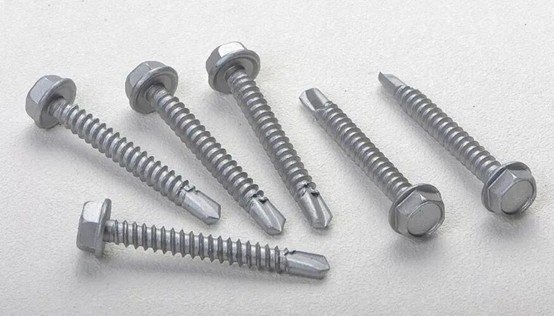
Introduction: How fine does a thread have to be to be called a fine thread?
A master with over 30 years of experience explains it this way: Coarse thread can be defined as standard thread; while fine thread is in contrast to coarse thread. Under the same nominal diameter, the number of threads per inch is different, that is, the pitch is different.
Coarse Thread and Fine Thread
The pitch of coarse thread is larger, while that of fine thread is smaller. For example, for the two specifications of 1/2-13 and 1/2-20, the former is coarse thread and the latter is fine thread. Therefore, they are expressed as 1/2-13UNC and 1/2-20UNF respectively.
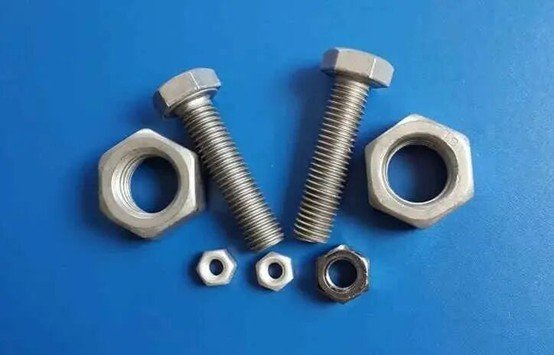
Since there are two different thread specifications for the same nominal diameter, how should the coarse and fine threads be selected?
Coarse thread
So-called coarse thread actually refers to standard thread. Unless otherwise specified, the stainless steel screws and other fasteners we generally purchase are all coarse thread.
The characteristics of coarse thread are high strength, good interchangeability and there are standards to refer to. Generally speaking, coarse thread should be the best choice.
Compared with fine thread, due to the larger pitch, the helix angle of the thread is also larger, and its self-locking property is poor. In a vibrating environment, anti-loosening washers, self-locking devices, etc. need to be installed. The advantages are that it is easy to disassemble and assemble, the standard parts that match it are complete, and it is easy to be interchangeable.
When marking coarse thread, the pitch does not need to be indicated, such as M8, M12-6H, M16-7H, etc. It is mainly used as a connecting thread.
Fine thread
Fine thread is exactly the opposite of coarse thread. It is defined to meet the special application requirements that coarse thread cannot satisfy. Fine thread also has a pitch series.
The pitch of fine thread is smaller, so its characteristics are that it is more conducive to self-locking and anti-loosening, and has more threads, which can reduce the leakage effect and achieve a sealing effect. In some precision occasions, fine thread stainless steel screws are more convenient for precise control and adjustment.
The disadvantage is that the tensile value and strength are lower than those of coarse thread, and the thread is prone to damage. It is not recommended to disassemble and assemble it multiple times. The accompanying nuts and other fasteners must be equally precise. Even a slight error in size can easily cause both the screw and the nut to be damaged.
Fine-pitch threads are mainly used in metric pipe fittings of hydraulic systems, mechanical transmission parts, thin-walled parts with insufficient strength, in-machine parts subject to space limitations, and on shafts with high self-locking requirements, etc. When marking fine-pitch threads, the pitch must be indicated to distinguish them from coarse-pitch threads.
To determine whether a thread is coarse or fine, first roughly judge its application. If you are unsure, measure the length of n pitches with a caliper, divide it by n, and then check the thread table.
How to Select Coarse and Fine Threaded Screws
Both coarse-thread and fine-thread screws are used for fastening.
Fine-threaded screws are generally used to fasten thin-walled parts and those with high anti-vibration requirements. Fine-threaded screws have good self-locking performance, thus they have strong anti-vibration and anti-loosening capabilities. However, due to the shallow depth of the thread teeth, their ability to withstand greater tensile force is inferior to that of coarse-threaded screws.
When no anti-loosening measures are taken, fine thread screws have a better anti-loosening effect than coarse thread ones. They are generally used in thin-walled parts and parts with high anti-vibration requirements.
When used for adjustment, fine thread has more advantages. The disadvantages of fine thread: it is not suitable for application on materials with overly coarse structure and poor strength. When the tightening force is too large, it is prone to stripping.
1. Application scenarios of coarse thread
The coarse thread series (M/UNC/UNRC) is generally used in the mass production of threaded fasteners, such as bolts, screws, and nuts. It has unique advantages in scenarios where quick assembly or disassembly is required and in some rough operations that are prone to rust and damage. However, its self-locking property is not as good as that of fine and extra-fine threads.
2. Applications of Fine Thread
The fine thread series (MF/UNF/UNRF) is typically used in situations where higher strength of fasteners is required. Due to the shallower thread and larger minor diameter of fine threads compared to coarse threads of the same nominal specification, their thread strength is higher. Additionally, fine threads can be used in fine-tuning applications.
3. Application scenarios of ultra-fine thread
The ultra-fine thread series (UNEF/UNREF) is particularly suitable for scenarios requiring fine adjustment, such as adjusting screws, etc.
If you are looking for quality screws, please visit us here https://hktl-fastener.com/screws/.