
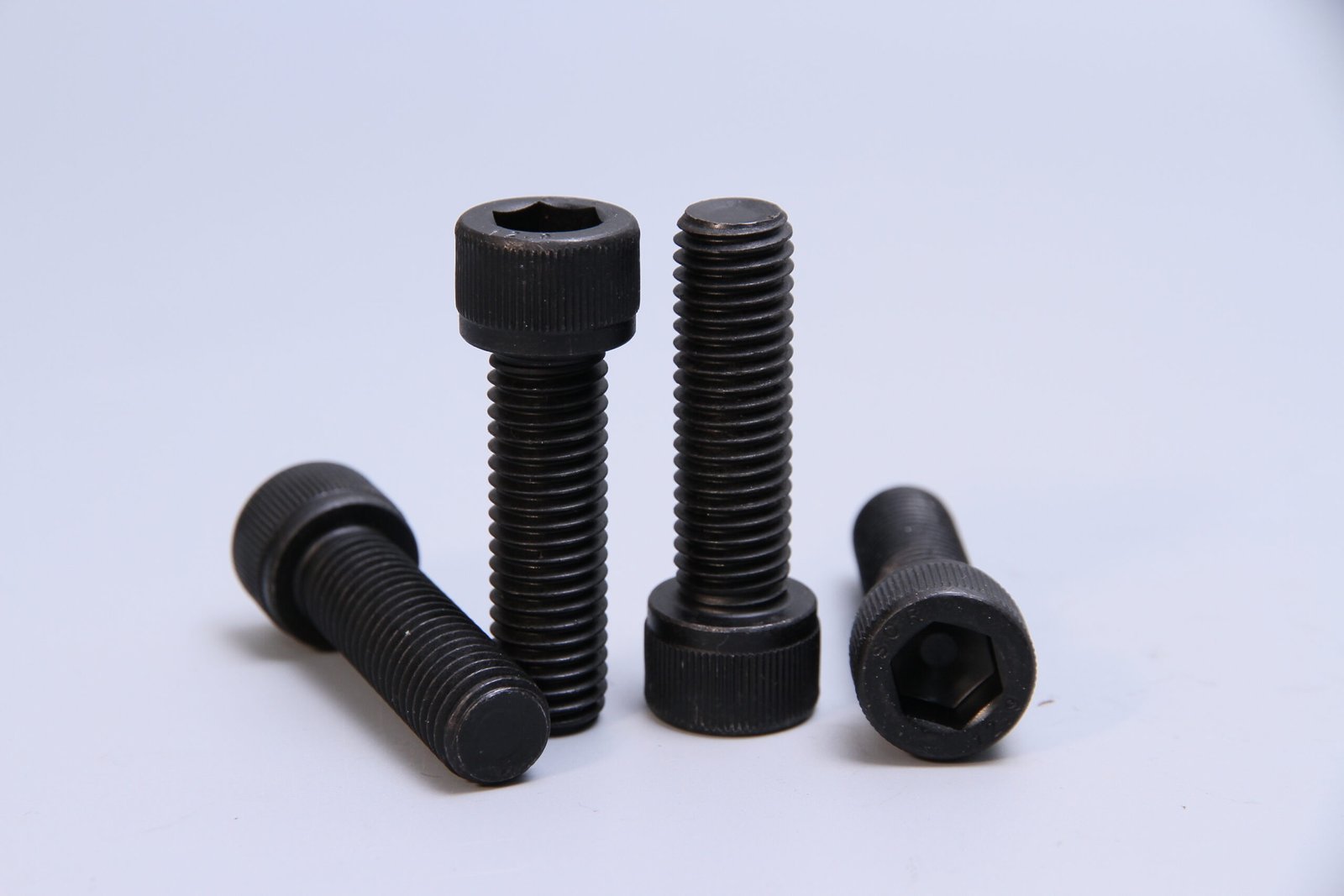
Ultra-high-strength fasteners can reduce their own size under the same clamping force to lower weight and increase installation space. Therefore, they can optimize the function and volume of the connected components, thereby achieving the overall weight reduction and performance optimization of the equipment.
So, what is a high-strength bolt? Where does its strength lie? How to improve the fatigue strength of bolts? Let’s take a look together.
01 What is a high-strength bolt?
A high-strength bolt (High-Strength Friction Grip Bolt), directly translated into English as “high-strength friction grip bolt”, is abbreviated as HSFG. It can be seen that the term “high-strength bolt” used in Chinese construction is a short form of “high-strength friction grip bolt”. In daily communication, the words “friction” and “grip” are simply omitted, which has led to many engineering technicians misunderstanding the basic definition of high-strength bolts.
Misconception 1:
Is a bolt with a material grade higher than 8.8 considered a “high-strength bolt”?
The core difference between high-strength bolts and ordinary bolts does not lie in the strength of the materials used, but in the form of force they bear. The essence is whether a preload is applied and static friction force is utilized to resist shear.
In fact, in the British standard and American standard, the high-strength bolts (HSFG BOLT) mentioned only come in two grades: 8.8 and 10.9 (BS EN 14399 / ASTM-A325 & ASTM-490), while common bolts include grades such as 4.6, 5.6, 8.8, 10.9, and 12.9 (BS 3692 Table 2). From this, it can be seen that the material strength is not the key factor in distinguishing high-strength bolts from common bolts.
02 Where does the high strength of high-strength bolts lie?
Under the same grade, the design values of tensile strength and shear strength of ordinary bolts are both higher than those of high-strength bolts.
So where does the “strength” of high-strength bolts lie?
To answer this question, it is necessary to start from the design working conditions of the two types of bolts, study the laws of their elastic-plastic deformation, and understand the ultimate state at the time of design failure.
Design ultimate limit state under destruction
For common bolts: The bolt shank undergoes plastic deformation beyond the design allowance, or the bolt shank is sheared off.
For a common bolt connection, relative slippage occurs between the connection plates before the shear force is borne. Then, the bolt shank comes into contact with the connection plates, and elastic-plastic deformation takes place, thus bearing the shear force.
For high-strength bolts, when the static friction force between the effective friction surfaces is overcome and the two steel plates undergo relative displacement, it is considered a failure in design terms.
In high-strength bolt connections, the friction force first bears the shear force. When the load increases to the point where the friction force is insufficient to resist the shear force, the static friction force is overcome, and the connection plates undergo relative sliding (limit state). However, even though the connection is damaged at this point, the bolt shank and the connection plates come into contact, and the shear force can still be borne by utilizing their own elastic-plastic deformation.
Misconception Two:
High load-bearing capacity means high-strength bolts?
From the calculation of a single bolt, it can be known that the design strength of high-strength bolts in tension and shear is lower than that of ordinary bolts. The essence of its high strength is that during normal operation, no relative slippage is allowed at the node, that is, the elastic-plastic deformation is small and the node stiffness is large.
It can be seen that, under the given design node load, the node designed with high-strength bolts does not necessarily save the number of bolts used, but it has small deformation, high stiffness and high safety reserve. High-strength bolts are suitable for main beams and other positions where the node stiffness is required to be large, which conforms to the basic seismic design principle of “strong nodes and weak members”.
The strength of high-strength bolts does not lie in their own design bearing capacity, but is manifested in the large stiffness of the designed nodes, high safety performance, and strong resistance to damage.
03 Comparison between High-Strength Bolts and Ordinary Bolts
Due to the different force-bearing principles in their designs, ordinary bolts and high-strength bolts have significant differences in their construction inspection methods.
The mechanical performance requirements of common bolts of the same grade are slightly higher than those of high-strength bolts in all aspects, but high-strength bolts have an additional acceptance requirement of impact energy compared to common bolts.
The marking of common bolts and high-strength bolts is the basic method for on-site identification of bolts of the same grade. Since the values taken for calculating the torque of high-strength bolts in British and American standards are not the same, it is also necessary to identify bolts of the two standards.
It can be seen that the price of common bolts is approximately 70% of that of high-strength bolts. Considering the comparison of their acceptance requirements, it can be concluded that the premium part should be for ensuring the impact energy (toughness) performance of the material.
04 How to Improve the Fatigue Strength of Bolts
No matter what complex loads are applied, the common failure mode of high-strength bolts is fatigue failure. As early as 1980, experts studied 200 cases of bolt connection failures, and more than 50% of them were fatigue failures. Improving the fatigue resistance of high-strength bolts is of vital importance.
The fatigue fracture of bolts has the following characteristics:
- The maximum stress at fatigue fracture is much lower than the ultimate strength of the material under static stress, and even lower than the yield limit.
- The fatigue fracture surface is a brittle fracture without obvious plastic deformation.
- Fatigue fracture is the result of the accumulation of microscopic damage to a certain extent.
For bolts, the main failure modes are plastic deformation of the threaded section and fatigue fracture of the shank. Among them:
- 65% of the failures occur at the first thread in contact with the nut;
- 20% of the failures occur at the transition between the threaded section and the smooth shank;
- 15% of the failures occur at the fillet where the bolt head meets the shank.
1) Optimize design to reduce stress concentration
Strictly control the end dimensions of bolts to eliminate stress concentration:
a. Use larger transition fillets
b. Cut relief grooves
c. Cut back-off grooves at the end of the thread
d. Optimizing the head angle of the bolt can also effectively reduce stress concentration
e. Use reinforced threads. The main difference between reinforced threads and ordinary threads lies in the minor diameter d1 of the external thread and the root transition fillet R. The main feature of reinforced threads is that the minor diameter d1 is larger than that of ordinary threads, and the root transition fillet radius R is larger, reducing the stress concentration of the bolt. There are specific requirements for R: R+ = 0.18042P, Rmin = 0.15011P, where P is the pitch. Ordinary threads have no such requirements and can even be straight sections.
2) Improve Manufacturing Process
Strengthening the control of heat treatment and surface treatment processes during the manufacturing of bolts can effectively enhance the fatigue resistance of bolts.
a. Heat treatment: Bolts are heat-treated before thread rolling. This generates significant residual compressive stress within the bolt, which slows down the formation and development of cracks, thereby increasing the fatigue strength of the bolt. During heat treatment, decarburization should be prevented. The fatigue strength of bolts with and without surface decarburization should be compared.
The decarburized layer, due to the oxidation of carbon, has fewer cementite structures than normal structures, resulting in lower strength or hardness in mechanical properties. Generally, the fatigue strength of bolts with surface decarburization decreases by 19.8%.
b. Phosphating: The surface phosphating treatment of bolts is for rust prevention and stabilizing friction during assembly. However, phosphating also has a lubricating effect. It reduces the friction between the thread rolling wheel and the bolt thread during thread rolling, which positively affects the stress distribution on the bolt thread after rolling and reduces the surface roughness of the thread.
3) Set Appropriate Preload
In a common bolt connection, the tensile force on the bolt shank is mainly borne by the first three engaged threads. When the initial preload is sufficiently large, it can cause local plastic deformation at the root of some threads and generate residual stress at these thread roots. The residual compressive stress at the thread roots can enhance the fatigue strength of the threads.
At the same time, the plastic deformation of the threads can also improve the force distribution on the threads, reducing the contact pressure on the thread flanks. This further increases the fatigue strength of the threads.
The greater the preload, the greater the resistance of the bolt connection to separation and the stronger its resistance to preload relaxation. At the same time, the actual effective fatigue strength of the bolt connection also increases.
Therefore, increasing the preload of the bolt connection is beneficial for enhancing its resistance to fatigue failure under cyclic external loads, reducing the risk of fatigue failure under vibration, shock, and limited overloading.
If you are looking for suitable bolts and nuts, please visit us here https://hktl-fastener.com/bolts-and-nuts/.