

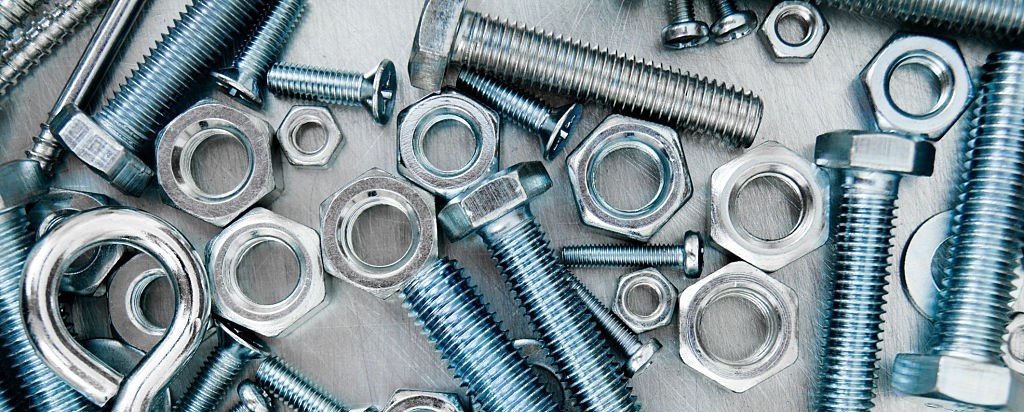
How to select suitable fasteners

I. Determine the Category
Standard fasteners are classified into ten major categories. When selecting them, the application scenarios and functions of standard fasteners should be determined.
① Bolt: A bolt is generally used in conjunction with a nut (usually with one or two washers added) in situations where connection and fastening are required.
② Nut: A nut is used in conjunction with a bolt.
③ Screws: Screws are usually used individually (sometimes with washers) and generally serve to fasten or secure.
④ Stud: A stud usually has threads at both ends (a single-ended stud has threads at one end only). Typically, one end of the thread is firmly screwed into the body of a component, while the other end is mated with a nut. It serves to connect and secure, but to a large extent, it also functions to maintain a certain distance.
⑤ Washers: Washers are used between the bearing surfaces of bolts, screws, nuts, etc. and the process bearing surfaces to prevent loosening and reduce the stress on the bearing surfaces.
Self-tapping screws: The threaded holes in the workpieces that match self-tapping screws do not need to be tapped in advance. When the self-tapping screws are screwed in, the internal threads are formed at the same time.
⑦ Rivet: One end of a rivet has a head and the shank is not threaded. When in use, insert the shank into the hole of the connected parts, and then rivet the end of the shank tightly to achieve the purpose of connection or fastening.
⑧ Pin: A pin is inserted into a workpiece when in use and usually serves to connect or position.
⑨ Retaining ring: A retaining ring is usually placed on an axle or in a hole to restrict the axial movement of a workpiece.
⑩ Wood screws: Wood screws are used to be screwed into wood, serving to connect or fasten.
II. Determine Standards and Varieties
Principles for variety selection:
(1) Considering the efficiency of processing and assembly, the variety of standard parts used in the same machinery or project should be reduced as much as possible.
(2) From an economic perspective, commercial standard parts should be given priority in selection.
(3) The type of standard parts to be selected should be determined based on the expected usage requirements, including form, mechanical properties, precision and thread, etc.
2. Type:
⑴ Bolts:
① General-purpose bolts: There are many varieties, including hexagonal head and square head bolts, as specified in national standards GB5780—GB5790, etc.
② Set screws: When in use, they are tightly fitted into reamed holes to prevent workpiece misalignment, as specified in GB27, etc.
③ Non-rotating bolts: They are divided into square neck and conical types, as specified in GB12—15, etc.
④ Special-purpose bolts: Such as T-slot bolts, as specified in GB37; swivel bolts, as specified in GB798; anchor bolts, as specified in GB799, etc.
⑤ High-strength bolt connection sets for steel structures: Generally used in friction-type connections of steel structures in buildings, bridges, towers, pipe supports, and lifting machinery, etc., as specified in GB3632, etc.
⑵ Nuts:
① General-purpose nuts: mainly hexagonal nuts, and there are also square nuts. There are many varieties, see GB41, GB6170-6177, etc.
② Slotted nuts: mainly hexagonal slotted nuts, which are processed with slots on the top of the hexagonal nuts. They are used in conjunction with bolts with holes and cotter pins to prevent relative rotation between the bolt and the nut, see GB6178-6181, etc.
③ Locking nuts: nuts with locking functions, including nylon insert hexagonal locking nuts, see GB889, GB6182, GB6183, and all-metal hexagonal locking nuts, see GB6184-6187.
④ Special-purpose nuts: such as disc nuts, see GB62; ring nuts, see GB63; cover nuts, see GB802, GB923; knurled nuts, see GB806, GB807; and insert nuts, see GB809, etc.
⑶ Screws:
① Machine screws: They are classified into many types based on different head shapes and slot types. Head shapes include cylindrical head, pan head, countersunk head and semi-countersunk head, and the slot types are slotted (flat head) and cross-slotted. See GB65, GB67-69 and GB818-820, etc.
② Set screws: Set screws are used to prevent relative movement between parts and to transmit small torques by means of their tail ends. See GB71, GB73-75, GB77, GB78, etc.
③ Hexagon socket screws: Hexagon socket screws are suitable for applications where the installation space is limited or the screw head needs to be buried. See GB70, GB6190, GB6191 and GB2672-2674, etc.
④ Special purpose screws: Such as locating screws, see GB72, GB828, GB829; non-protruding screws, see GB827-839, GB948, GB948; and eye bolts, see GB825, etc.
⑷ Studs:
① Unequal-length double-ended studs: Applicable in situations where one end is screwed into the component body to serve as a connection or fastening. See GB897—900, etc.
② Equal-length double-ended studs: Applicable when both ends are matched with nuts to serve as a connection or to maintain a certain distance. See GB901, GB953, etc.
⑸ Washers:
① Flat washers: They are used to overcome the unevenness of the workpiece support surface and increase the stress area of the support surface. See GB848, GB95-97 and GB5287.
② Spring (elastic) washers: Spring washers are specified in GB93, GB859, etc., and elastic washers are specified in GB860, GB955, etc.
③ Retaining washers: There are internal tooth locking washers, see GB861; external tooth locking washers, see GB862; single ear stop washers, see GB854; double ear stop washers, see GB855; round nut stop washers, see GB858, etc.
④ Bevel washers: To adapt to the slope of the workpiece support surface, bevel washers can be used. For I-beams, use square bevel washers, see GB852; for channel steel, use square bevel washers, see GB853.
(6) Self-tapping screws:
① Common self-tapping screws: The thread conforms to GB5280 (thread for self-tapping screws), with a large pitch, suitable for use on thin steel plates or copper, aluminum, and plastic. See GB845-847, GB5282-5284, etc.
② Self-tapping locking screws: The thread conforms to the common metric coarse thread, suitable for use in vibration-resistant applications. See GB6560-6564.
⑺ Rivets:
① Hot-forged rivets: Generally of larger specifications, they are mostly used in locomotives, ships and boilers, etc. The head is usually formed by hot forging. See GB863—866.
② Cold-headed rivets: Generally with a diameter specification of ≤16mm, the head is usually formed by cold heading. See GB867—870, GB109, etc.
③ Hollow and semi-hollow rivets: Hollow rivets, see GB976; semi-hollow rivets, see GB873—875, etc.
④ Special-purpose rivets: There are headless rivets, see GB1016; tubular rivets, see GB975; nameplate rivets, see GB827, etc.
⑤ Blind rivets: They belong to single-sided rivets and are a new type of rivets widely used in recent years. They have the characteristics of rapidity, safety and convenience, and also have the advantages of water-proofing and leak-proofing.
⑻ Pins:
① Cylindrical pins: include cylindrical pins without threads (see GB119), cylindrical pins with internal threads (see GB120), cylindrical pins with external threads (see GB878), elastic cylindrical pins (see GB879), and cylindrical pins with holes (see GB880), etc.
② Taper pins: include taper pins without threads (see GB117), taper pins with internal threads (see GB118), taper pins with threaded ends (see GB881), and open-end taper pins (see GB877).
③ Split pins: are generally used in conjunction with threaded rods with holes and slotted nuts to prevent bolts and nuts from loosening. See GB91.
(9) Retaining rings:
① Elastic retaining rings: Retaining rings for holes, see GB893; retaining rings for shafts, see GB894 and open retaining rings for shafts, see GB896.
② Wire retaining rings: Retaining rings for holes made of wire, see GB895.1; retaining rings for shafts made of wire, see GB895.2 and wire lock rings, see GB921.
③ Locking retaining rings for shaft parts: Retaining rings locked by taper pins, see GB883; retaining rings locked by screws, see GB884, GB885, etc.
④ Shaft end retaining rings: Shaft end retaining rings fastened by screws, see GB891 and shaft end retaining rings fastened by bolts, see GB892.
⑽ Wood screws:
They are classified into many types due to different head shapes and slot types. The head shapes include round head, countersunk head, and semi-countersunk head, etc. The slot shapes on the head are slotted (single slot) and cross-slotted. See GB99—101, GB950—952, etc.
III. Determine Specifications
① The diameter specifications should preferably be selected from the first series of values. The values within parentheses in the product standard size table and the specifications not recommended in the specification table should be avoided as much as possible.
② The length specifications generally should not be outside the range specified in the product standard. When bolts or nuts are connected, it is advisable for the thread end to protrude by a length of (0.2 – 0.3)d.
③ For the specifications where the diameter and length are matched, the specifications within the commercial range should be given priority.
If you are looking for quality fasteners, please visit us here https://hktl-fastener.com/.

