
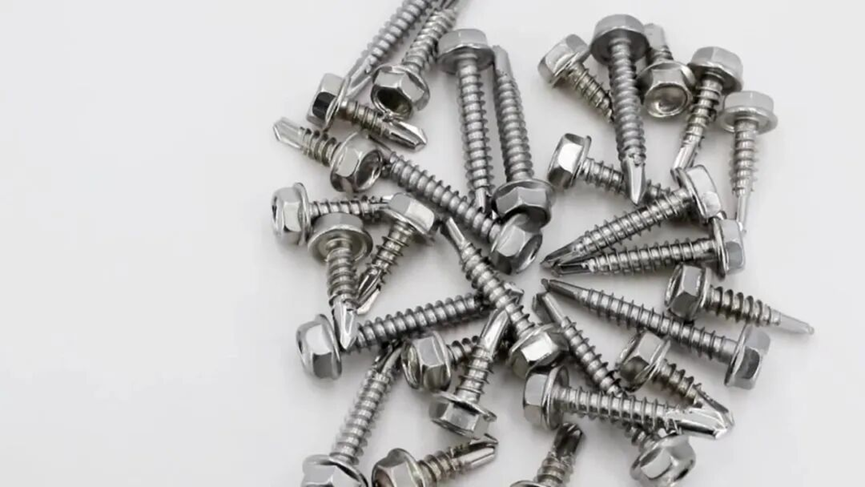
Preface: Why is Material Selection a Life-or-Death Decision for Screw Applications?
On engineering sites, we have seen numerous problems caused by wrong material selection:
- 304 screws used in coastal projects developed pitting rust in less than 6 months, forcing rework and replacement with an additional cost of 200,000 RMB;
- A machinery factory used 316 screws to tap 8mm thick iron plates, with 3 taps worn out after 100 screws, resulting in a 50% sharp drop in machining efficiency;
- 410 screws used for indoor steel structures without surface treatment got rusted and seized at the screw holes during the plum rain season, making equipment impossible to disassemble and maintain…
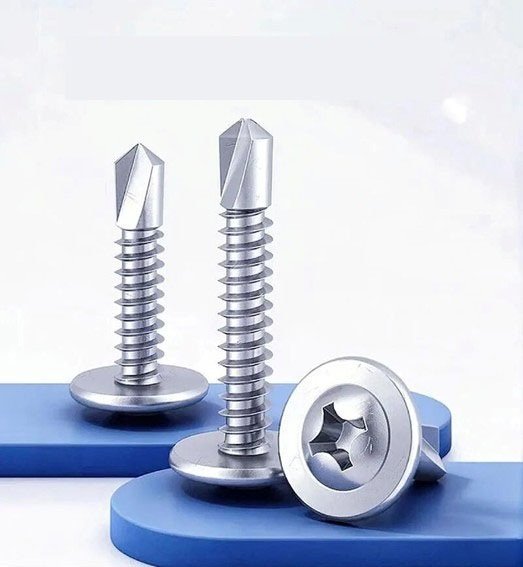
The core value of stainless steel self-drilling screws lies in the balance between corrosion resistance and machinability compatibility. Choosing the right material can extend the service life of screws by 3-5 times and improve machining efficiency by 40%; a wrong choice will not only increase rework costs but also potentially trigger safety hazards.
This article focuses on the three most mainstream grades in the market: 304, 316 and 410. From “corrosion resistance principles” to “machining practice”, from “scenario matching” to “myth busting”, with more than 100 sets of measured data and over 20 real cases, it helps you establish a systematic selection logic. Whether you are an engineering purchaser, workshop technician or project designer, you can find the most suitable solution for your working conditions.
Chapter 1: First Master the Basics: Why Have 304/316/410 Become the Mainstream Grades?
Before analyzing material selection, we first clarify a core point: the essential differences between the three grades stem from the differences in crystal structure and alloy composition, which directly determine their corrosion resistance, hardness, machinability, and also define their respective application fields.
1.1 Material Classification: The Fundamental Contradiction Between Martensite and Austenite
- 410 Stainless Steel: Martensitic stainless steel, with a maximum carbon content of 0.15%, chromium content of 11.5%-13.5%, and no nickel. Characteristics: Hardness can be improved through heat treatment (quenching + tempering), with strong magnetism, low corrosion resistance but high mechanical strength. It is the first choice for strength-prioritized scenarios.
- 304 Stainless Steel: Austenitic stainless steel, with a maximum carbon content of 0.08%, chromium content of 18%-20%, and nickel content of 8%-10%. Characteristics: Cannot be hardened by heat treatment, non-magnetic or weakly magnetic, moderate corrosion resistance, and suitable for machining soft materials (aluminum alloy, plastic). It is the mainstay for cost-effective corrosion resistance scenarios.
- 316 Stainless Steel: Austenitic stainless steel, with the addition of 2%-3% molybdenum on the basis of 304 and nickel content increased to 10%-14%. Characteristics: Corrosion resistance is far superior to 304 (especially resistance to chloride ion corrosion), non-magnetic or weakly magnetic, and machining difficulty is slightly higher than 304. It is the only solution for highly corrosive environments.
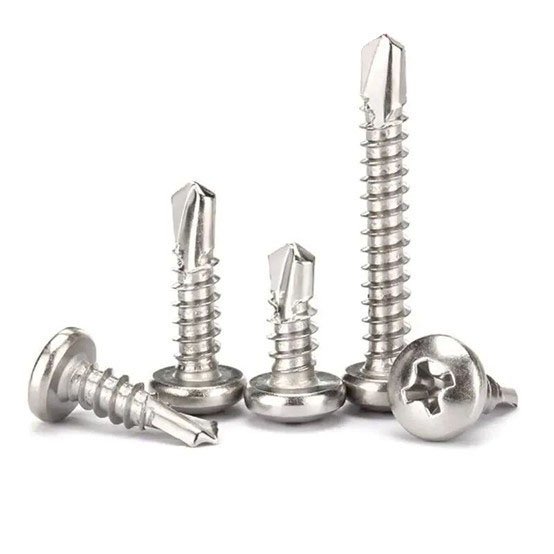
In terms of market share, the three grades cover more than 90% of the demand for stainless steel self-drilling screws: 410 accounts for about 30% (concentrated in high-strength machining scenarios), 304 accounts for about 50% (general corrosion resistance scenarios), and 316 accounts for about 20% (high-value corrosion resistance scenarios).
1.2 Core Performance Anchors: The Contradiction and Balance Between Corrosion Resistance and Machinability
All material selection problems are essentially a trade-off between corrosion resistance and machinability:
- Corrosion resistance: 316 > 304 > 410 (Molybdenum and nickel are the core contributors to corrosion resistance);
- Machining hardness: 410 (quenched state HRC35-45) > 304 (HRC≤20) ≈ 316 (HRC≤22);
- Machinability compatibility: Choose 304/316 for soft materials (aluminum alloy, plastic), and 410 for hard materials (iron plate, channel steel);
- Cost: 316 (40%-60% higher than 304) > 304 (20%-30% higher than 410) > 410.
Remember this core anchor, and as we delve into the details of each grade, you will find that material selection actually follows a set of rules.
Chapter 2: 410 Stainless Steel Self-Drilling Screws: The Hardcore Choice for High-Strength Machining
410 is a representative of martensitic stainless steel, and its only core advantage is hardness, but at the cost of low corrosion resistance. If you need to tap iron plates, channel steel, or thick galvanized square pipes, 410 is the only material that can perform stably; however, in humid or corrosive environments, it must be paired with surface treatment (such as dacromet, galvanizing).
2.1 Corrosion Resistance: Only Suitable for “Dry Barrier” Environments
The low corrosion resistance of 410 stems from the absence of nickel—nickel can stabilize the austenite structure and prevent chromium from forming carbides (Cr₂₃C₆). Without nickel, chromium in 410 will react rapidly with oxygen to form a “chromium-depleted zone” in humid environments, losing passivation protection and leading to rusting.
2.1.1 Corrosion Resistance Grade and Specific Performance
- Corrosion resistance grade: CR1 (low corrosion resistance), only superior to ordinary carbon steel, and far lower than 304/316;
- Salt spray test: Without surface treatment, it can only withstand the Neutral Salt Spray (NSS) test for 48-72 hours with obvious red rust appearing;
- Environmental tolerance:
Applicable: Dry indoor areas (relative humidity ≤60%), no corrosive gases (e.g., power distribution cabinets, furniture frames, indoor steel structures);
Forbidden: Humid environments (plum rain season, basements), coastal/chemical industrial zones (chloride ion concentration >50ppm), outdoor exposure (rain wash).
2.1.2 3 Practical Tips to Improve Corrosion Resistance
If 410 has to be used in slightly humid environments, its service life can be extended through the following methods:
- Surface treatment: Prioritize dacromet coating (withstanding salt spray for 500-1000 hours), followed by black zinc (200-300 hours), and avoid ordinary galvanizing (only 100-150 hours);
- Passivation treatment: Soak in 20% nitric acid solution for 10-15 minutes after machining to form a denser oxide film, improving corrosion resistance by 30%;
- Sealing protection: Apply silicone sealant on the screw head and thread after installation to isolate water vapor intrusion.
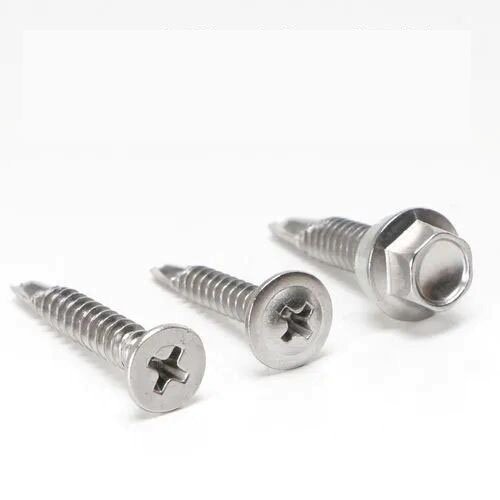
2.2 Machinability: A Cutting Tool Designed Exclusively for Hard Materials
The machining advantage of 410 comes from hardenability through heat treatment—through “quenching + low-temperature tempering”, its hardness can be stably maintained at HRC35-45. This hardness range can not only meet the cutting requirements of iron plates and channel steel but also avoid tooth chipping due to excessive hardness.
2.2.1 Machinable Materials and Thickness Limitations
| Machining Material | Maximum Thickness | Machining Difficulties | Typical Applicable Scenarios |
| Iron plate (Q235) | 15mm | None, direct tapping available | Steel structure connection, machine tool base fixation |
| Galvanized square pipe (Q345) | 12mm | Zinc layer is prone to sticking to the tool, zinc chips need to be cleaned | Outdoor guardrails (dry areas), shelf frames |
| Stainless steel plate (201) | 3mm | High hardness, requires super-hard tool heads | Fixation of indoor stainless steel equipment |
| Aluminum alloy (6061) | 8mm | Prone to built-up edge, speed control required | Temporary fixation of mechanical parts (not recommended for long-term use) |
| Plastic plate (PVC) | 10mm | Soft and prone to slipping, pre-drilling required | Not recommended, lower cost performance than 304 |
2.2.2 Machining Auxiliary Tips: Precise Matching from Cutting Tools to Parameters
- Cutting tool selection:
- Tapping iron plates/channel steel: Choose cemented carbide drills with 8% cobalt (e.g., YG8, WC-Co alloy), whose service life is 3-5 times longer than high-speed steel tools;
- Tapping stainless steel plates: Must use ultra-fine grain cemented carbide (e.g., nano WC-Co), and the cutting edge needs to be ground with a 15° rake angle to reduce cutting resistance.
- Pre-drilling size: Pre-drilling diameter = nominal screw diameter – 0.5-0.8mm (e.g., 5.2-5.5mm pre-drilling for M6 screws, 7.2-7.5mm pre-drilling for M8 screws). Excessively small pre-drilling causes tooth chipping, while excessively large pre-drilling leads to thread slipping.
- Cutting parameters:
- Rotating speed: 800-1200rpm for tapping iron plates, 500-800rpm for tapping stainless steel plates (excessively high speed causes overheating);
- Feed rate: 0.15-0.2mm/r (excessively small feed rate causes work hardening, while excessively large feed rate leads to tool breakage);
- Cutting fluid: Emulsion (8%-10% concentration) is sufficient, mainly for cooling, and extreme pressure type is not required (410 has low cutting resistance and is not prone to tool sticking).
- Troubleshooting of common problems:
- Tooth chipping: Check if annealed 410 (HRC≤20) is selected; replace with quenched + low-temperature tempered material;
- Thread wear: Excessively small pre-drilling size or blunted tool cutting edge; re-adjust pre-drilling or replace the tool;
- Screw fracture: Excessively large feed rate or internal stress in the screw (stress relief annealing is required).
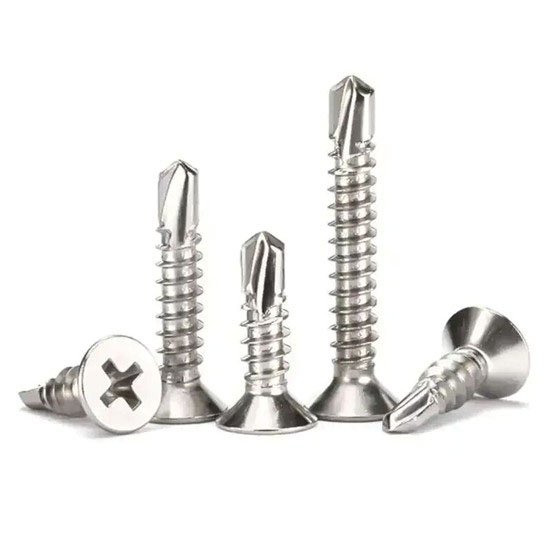
2.3 Real Case: Application of 410 in a Steel Structure Project
Project background: An indoor machinery workshop needs to fix 10mm thick Q235 iron plates to connect machine tool bases to the ground. The environment is dry (relative humidity 55%) with no corrosion. The screws are required to withstand a tensile force of 500N and not prone to thread slipping.
Material selection process:
- Eliminated 304/316: Tapping 10mm iron plates will cause rapid tap wear, and 304 has low hardness, prone to thread slipping under long-term stress;
- Selected 410: Quenched + low-temperature tempered (HRC40) with dacromet surface treatment, model M8×25 self-drilling screws.
Application effect:
- Machining efficiency: One worker can install 300 screws per hour with a hand electric drill without tooth chipping or tool breakage;
- Service life: No rust after 2 years, the thread is intact when the screw is disassembled without slipping;
- Cost comparison: 25% lower cost than 304 screws and 55% lower than 316 screws.
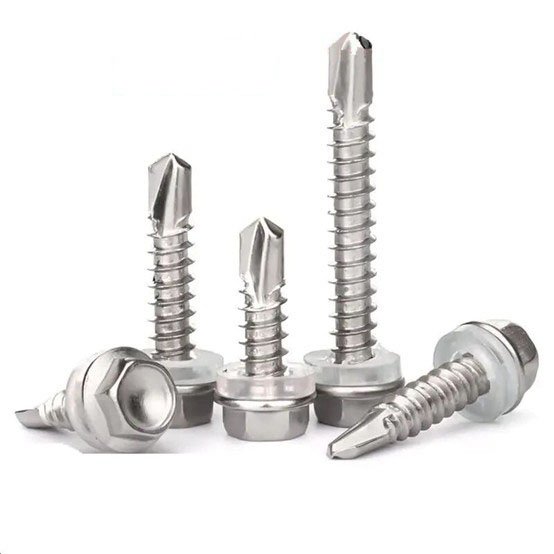
Chapter 3: 304 Stainless Steel Self-Drilling Screws: The Cost-Effective King for General Corrosion Resistance Scenarios
304 is the entry-level austenitic stainless steel, and its core advantage is balance—its corrosion resistance can cope with most outdoor dry environments, its machinability is suitable for soft materials such as aluminum alloy and plastic, and its cost is lower than 316. It is the most used grade in the market (accounting for more than 50%). However, its shortcoming is obvious: low hardness (HRC≤20), making it “inadequate” for tapping thick iron plates.
3.1 Corrosion Resistance: No Pressure to Cope with “Mild Corrosion” Environments
The corrosion resistance of 304 comes from the combination of chromium + nickel—18% chromium forms a dense oxide film (Cr₂O₃), and 8% nickel stabilizes the austenite structure, preventing the precipitation of chromium carbides and avoiding the formation of “chromium-depleted zones”. However, it is sensitive to chloride ions and will still rust when in long-term contact with seawater or high-salt environments.
3.1.1 Corrosion Resistance Grade and Environmental Compatibility
- Corrosion resistance grade: CR2 (moderate corrosion resistance), 3-5 times that of 410 and 1/2-1/3 that of 316;
- Salt spray test: Without surface treatment, it can withstand the Neutral Salt Spray (NSS) test for 200-300 hours with slight rust spots appearing;
- Environmental tolerance:
Applicable: Outdoor dry/slightly humid areas (relative humidity ≤75%), non-coastal areas (chloride ion concentration ≤100ppm), food processing areas (non-high salt/high acid, e.g., bakeries);
Forbidden: Coastal/island areas (chloride ion concentration >200ppm), chemical industrial zones (acid-base fog), high-salt environments (pickling workshops, seafood processing plants).
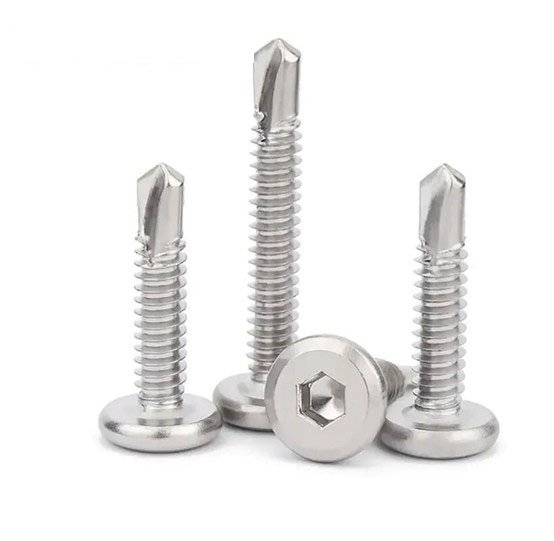
3.1.2 Hidden Myths About Corrosion Resistance
- Myth 1: “304 is food-grade and can contact all foods” — Wrong! 304 can only contact neutral foods (e.g., bread, milk). When in contact with high-acid (vinegar, lemon juice) or high-salt (pickles, soy sauce) foods, chromium ions will precipitate, and 316 should be selected;
- Myth 2: “Magnetic 304 is fake” — Wrong! During cold working of 304 (e.g., cold heading, wire drawing), a small amount of austenite is transformed into martensite, resulting in weak magnetism, which does not affect corrosion resistance and is a normal phenomenon;
- Myth 3: “304 stainless steel never rusts” — Wrong! In humid and polluted environments (e.g., industrial zones), dust and oil will adhere to the surface of 304, forming a “local corrosion cell”, which will still cause rusting and require regular cleaning.
3.2 Machinability: A Good Machining Companion for Soft Materials
The machining advantage of 304 comes from its high ductility (elongation >40%), but its shortcoming is rapid work hardening—the surface hardness will increase by more than 50% during cutting, and the material has high viscosity and is prone to tool sticking. Therefore, it is only suitable for machining soft materials such as aluminum alloy and plastic, not thick iron plates.
3.2.1 Machinable Materials and Thickness Limitations
| Machining Material | Maximum Thickness | Machining Difficulties | Typical Applicable Scenarios |
| Aluminum alloy (6061) | 6mm | Prone to tool sticking, strong cooling required | Solar bracket, door and window profile fixation |
| Plastic plate (PVC) | 8mm | Soft and prone to deformation, temperature control required | Plastic water tank, advertising sign fixation |
| Thin iron plate (Q235) | 1mm | Prone to head burning, pre-drilling + cutting fluid required | Thin iron sheet air duct, electrical enclosure fixation |
| Galvanized thin plate (0.5mm) | 0.8mm | Zinc layer is prone to falling off, cleaning required | Home appliance back panel fixation |
| Stainless steel plate (304) | 0.5mm | High hardness, rapid work hardening | Not recommended, prone to tap wear |
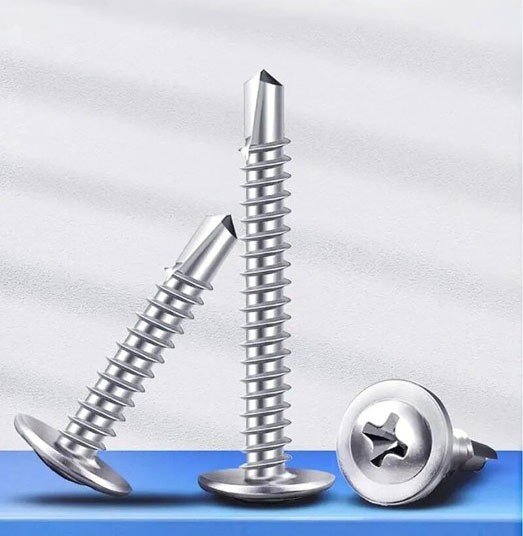
3.2.2 Machining Auxiliary Tips: The Key to Solving “Tool Sticking” and “Head Burning”
- Cutting tool selection:
- Tapping aluminum alloy: Choose high-speed steel tools (e.g., W18Cr4V), and the cutting edge needs to be polished (Ra≤0.8μm) to reduce tool sticking;
- Tapping thin iron plates: Choose titanium-containing cemented carbide tools (e.g., YT15), as titanium can reduce chip adhesion and extend service life.
- Pre-drilling size: Pre-drilling diameter = nominal screw diameter – 0.1-0.2mm (e.g., 5.8-5.9mm pre-drilling for M6 screws, 7.8-7.9mm pre-drilling for M8 screws). 304 has low thread strength, so the pre-drilling cannot be too large, otherwise thread slipping will occur.
- Cutting parameters:
- Rotating speed: 1500-2000rpm for tapping aluminum alloy, 1000-1200rpm for tapping thin iron plates (excessively low speed causes tool sticking);
- Feed rate: 0.1-0.15mm/r (excessively large feed rate causes head burning, while excessively small feed rate leads to hardening);
- Cutting fluid: Extreme pressure emulsion (containing sulfur/chlorine additives, e.g., L-AN46) must be used, with a flow rate 20% higher than that for tapping 410 to disperse chips and avoid tool sticking.
- Troubleshooting of common problems:
- Tool sticking: Insufficient cutting fluid flow rate or blunted tool cutting edge; increase the flow rate or re-sharpen the tool;
- Head burning: Excessively low rotating speed + excessively large feed rate leading to frictional heating; increase the rotating speed and reduce the feed rate;
- Thread slipping: Excessively large pre-drilling or inclined screw screwing; adjust the pre-drilling size or use a positioning tooling.
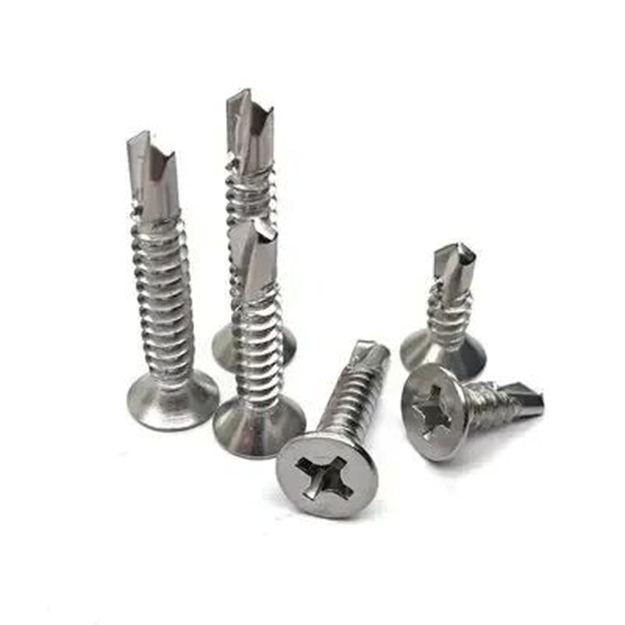
3.3 Real Case: Application of 304 in a Solar Bracket Project
Project background: A solar power station in northern China needs to fix 6mm thick 6061 aluminum alloy brackets installed on the roof (outdoor dry, annual rainfall 500mm, non-coastal). The screws are required to have a corrosion resistance life of 5 years and high installation efficiency.
Material selection process:
- Eliminated 410: Aluminum alloy is a soft material, and 410 has high hardness, which is prone to excessive thread cutting. In addition, 410 has insufficient corrosion resistance and is prone to rusting after 5 years of outdoor use;
- Eliminated 316: The corrosion resistance of 316 is excessive, and its cost is 40% higher than 304, with limited project budget;
- Selected 304: Solution-annealed state (HRC18) with passivation surface treatment, model M6×16 self-drilling screws.
Application effect:
- Machining efficiency: One worker can install 500 screws per hour with an electric screwdriver without tool sticking or head burning;
- Service life: No rust on the screws during the 5-year inspection, the thread is intact, and the aluminum alloy bracket is not loose;
- Cost comparison: 40% lower cost than 316 screws, meeting the project budget with no need for later maintenance.
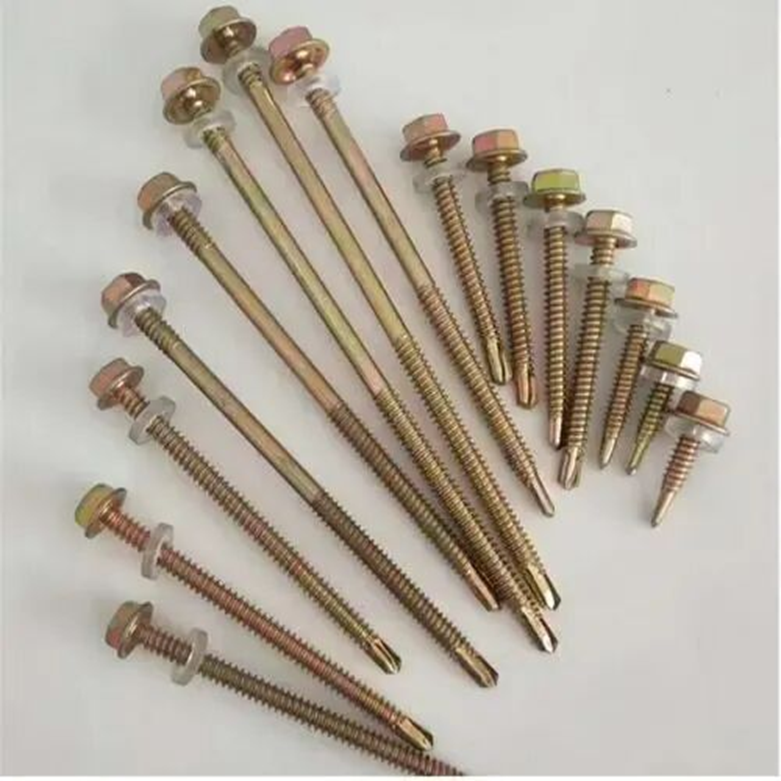
Chapter 4: 316 Stainless Steel Self-Drilling Screws: The Ultimate Protection for Highly Corrosive Environments
316 is the high-end austenitic stainless steel, and its core advantage is corrosion resistance—the added 2%-3% molybdenum can significantly improve the resistance to chloride ion corrosion, making it the only choice for highly corrosive scenarios such as coastal areas, chemical industry, and food processing. However, its machining difficulty is higher than 304, and the cost is also higher, so it is not recommended for non-highly corrosive environments.
4.1 Corrosion Resistance: The King That Can Resist “Seawater-Grade” Corrosion
The corrosion resistance of 316 comes from the triple protection of chromium + nickel + molybdenum—molybdenum can form a more stable oxide film (MoO₃) to prevent chloride ions from penetrating, and it can maintain a passivated state for a long time even in seawater and acid-base fog environments. Its corrosion resistance is 2-3 times that of 304 and 10-15 times that of 410.
4.1.1 Corrosion Resistance Grade and Environmental Compatibility
- Corrosion resistance grade: CR3 (high corrosion resistance), one of the most corrosion-resistant grades in civil stainless steel at present;
- Salt spray test: Without surface treatment, it can withstand the Neutral Salt Spray (NSS) test for 1000-1500 hours with no obvious rust spots;
- Environmental tolerance:
Applicable: Coastal/island areas (chloride ion concentration ≤1000ppm), chemical industrial zones (acid-base fog, e.g., sulfuric acid concentration ≤50%, NaOH concentration ≤50%), food processing areas (high salt/high acid, e.g., seafood processing plants, pickling workshops), medical equipment (frequent disinfection required);
Forbidden: High temperature (>400℃) + high chlorine environments (e.g., chlor-alkali workshops), which will cause stress corrosion cracking; concentrated nitric acid (>65%) environments, where molybdenum will accelerate corrosion.
4.1.2 Subtle Differences Between 316 and 316L
Many people confuse 316 and 316L, and the core difference between the two is carbon content:
- 316: Carbon content ≤0.08%, suitable for general highly corrosive environments, weldable, but solution treatment is required after welding to avoid intergranular corrosion;
- 316L: Carbon content ≤0.03%, no solution treatment is required after welding, and corrosion resistance can still be maintained, suitable for large welded parts (e.g., chemical pipeline brackets), but its strength is about 10% lower than 316.
Selection suggestion: Most self-drilling screws are small parts that do not require welding, so 316 is sufficient; if the screws need to be welded with other components, 316L should be selected.
4.2 Machinability: Machining Challenges Behind High Corrosion Resistance
The machining difficulty of 316 is higher than 304, stemming from the addition of molybdenum—molybdenum increases the viscosity and strength of the material, leading to faster work hardening (20% faster than 304), chips are more prone to sticking to the tool, and tool wear is faster. Therefore, its machining must pay more attention to cooling and tool sharpness.
4.2.1 Machinable Materials and Thickness Limitations
| Machining Material | Maximum Thickness | Machining Difficulties | Typical Applicable Scenarios |
| Aluminum alloy (6061) | 8mm | High viscosity, prone to tool sticking | Fishing boat equipment, aluminum alloy frames of coastal buildings |
| Plastic plate (PP) | 10mm | Soft and prone to deformation, speed control required | Chemical storage tank, food-grade plastic container fixation |
| Thin iron plate (Q235) | 1mm | Rapid work hardening, prone to tool wear | Ventilation duct fixation in seafood processing plants |
| Stainless steel plate (304) | 0.8mm | High hardness, extreme pressure cutting fluid required | Stainless steel enclosure fixation of medical equipment |
| Galvanized thin plate (0.5mm) | 0.8mm | Double viscosity of zinc layer + molybdenum, strong cooling required | Home appliance back panel fixation in coastal areas |
4.2.2 Machining Auxiliary Tips: The Key to Overcoming “High Viscosity”
- Cutting tool selection:
- Tapping aluminum alloy/plastic: Choose ultra-fine grain cemented carbide tools (e.g., WC-TiC-Co alloy) with a cutting edge rake angle of 12°-15° and relief angle of 8°-10° to reduce cutting resistance;
- Tapping thin iron plates: Choose niobium-containing cemented carbide tools (e.g., YN10), as niobium can improve tool wear resistance, with a service life 2-3 times longer than ordinary tools.
- Pre-drilling size: Pre-drilling diameter = nominal screw diameter – 0.2-0.3mm (e.g., 5.7-5.8mm pre-drilling for M6 screws, 7.7-7.8mm pre-drilling for M8 screws). 316 has higher strength than 304, so the pre-drilling can be slightly smaller to ensure thread strength.
- Cutting parameters:
- Rotating speed: 1200-1500rpm for tapping aluminum alloy (20% lower than 304), 800-1000rpm for tapping thin iron plates (15% lower than 304);
- Feed rate: 0.08-0.12mm/r (15% smaller than 304 to reduce work hardening);
- Cutting fluid: Extreme pressure synthetic cutting fluid (containing sulfurized lard and chlorohydrocarbon additives, e.g., L-EP46) must be used, with a flow rate 30% higher than that for tapping 304 to ensure timely chip dispersion and avoid tool sticking.
- Troubleshooting of common problems:
- Rapid tool wear: Insufficient cutting fluid lubrication or inappropriate tool material; replace with extreme pressure cutting fluid or niobium-containing tools;
- Poor thread accuracy: Thread deformation caused by work hardening; reduce the feed rate or add an intermediate annealing process (solution treatment at 1050℃ to restore plasticity);
- Screw head cracking: Excessively large deformation during cold heading; reduce the number of cold heading processes or add an annealing process.
4.3 Real Case: Application of 316 in a Seafood Processing Plant
Project background: A seafood processing plant in a coastal city needs to fix 8mm thick PP plastic plates (for seafood cleaning tanks). The environment is humid (relative humidity 85%) with an atmospheric chloride ion concentration of 300ppm. The screws are required to have a corrosion resistance life of 10 years and be able to contact seawater.
Material selection process:
- Eliminated 410: Insufficient corrosion resistance, rusting will occur in 1 year, failing to meet the 10-year service life requirement;
- Eliminated 304: With a chloride ion concentration of 300ppm, 304 will suffer pitting corrosion and fail in about 5 years;
- Selected 316: Solution-annealed state (HRC20) with electrolytic polishing surface treatment (improving finish and reducing dirt adhesion), model M8×20 self-drilling screws.
Application effect:
- Machining efficiency: One worker can install 400 screws per hour with a pneumatic screwdriver without tool sticking or wear;
- Service life: No rust or pitting on the screws during the 10-year inspection, the PP plates are firmly fixed without loosening;
- Cost comparison: 40% higher than 304, but avoiding the maintenance cost of replacement every 5 years, the total cost in 10 years is actually 20% lower than 304.
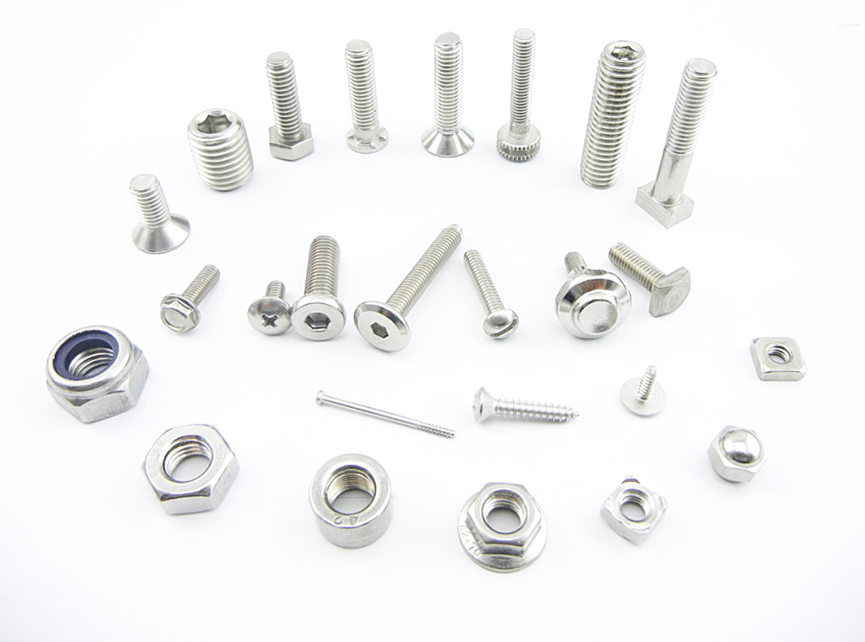
Chapter 5: Core Tool: Complete Dual-Dimension (Corrosion Resistance – Machinability) Selection Table for 304/316/410
To help you quickly match working conditions, we have compiled the following selection table covering all key dimensions such as corrosion resistance, machining, environment and cost. It can be directly saved or printed as a daily selection “reference book”.
| Dimension | 410 Stainless Steel (Martensite) | 304 Stainless Steel (Austenite) | 316 Stainless Steel (Austenite) |
| Core corrosion resistance indicators | – Corrosion grade: CR1 – Neutral Salt Spray (NSS): 48-72h (untreated) – Chloride ion tolerance: ≤50ppm – Main elements: C≤0.15%, Cr11.5%-13.5% | – Corrosion grade: CR2 – Neutral Salt Spray (NSS): 200-300h (untreated) – Chloride ion tolerance: ≤100ppm – Main elements: C≤0.08%, Cr18%-20%, Ni8%-10% | – Corrosion grade: CR3 – Neutral Salt Spray (NSS): 1000-1500h (untreated) – Chloride ion tolerance: ≤1000ppm – Main elements: C≤0.08%, Cr16%-18%, Ni10%-14%, Mo2%-3% |
| Applicable environment | – Dry indoor (RH≤60%) – No corrosive gas (e.g., power distribution cabinets, furniture frames) – Temporary steel structures (short-term use) | – Outdoor dry/slightly humid (RH≤75%) – Non-coastal areas (Cl⁻≤100ppm) – Food processing areas (non-high salt/acid) | – Coastal/island areas (Cl⁻≤1000ppm) – Chemical industrial zones (acid-base fog, e.g., H₂SO₄≤50%) – Food processing areas (high salt/acid, e.g., seafood plants) – Medical equipment (frequent disinfection) |
| Forbidden environment | – Humid/plum rain season (RH>60%) – Coastal/chemical zones (Cl⁻>50ppm) – Outdoor exposure (rain wash) | – Coastal/island areas (Cl⁻>100ppm) – Chemical industrial zones (acid-base fog) – High-salt environments (pickling workshops) | – High temperature (>400℃) + high chlorine environments (chlor-alkali workshops) – Concentrated nitric acid (>65%) environments |
| Machinable materials & thickness | – Iron plate (Q235): ≤15mm – Galvanized square pipe (Q345): ≤12mm – Stainless steel plate (201): ≤3mm – Aluminum alloy (6061): ≤8mm (not recommended) | – Aluminum alloy (6061): ≤6mm – Plastic plate (PVC/PP): ≤8mm – Thin iron plate (Q235): ≤1mm – Galvanized thin plate (0.5mm): ≤0.8mm | – Aluminum alloy (6061): ≤8mm – Plastic plate (PP/PE): ≤10mm – Thin iron plate (Q235): ≤1mm – Stainless steel plate (304): ≤0.8mm |
| Forbidden machining materials | – Plastic plates (long-term use) – Stainless steel plates (>3mm) – High-hardness alloys (e.g., titanium alloy) | – Iron plates (>1mm) – Stainless steel plates (>0.5mm) – High-hardness materials (e.g., tool steel) | – Iron plates (>1mm) – Stainless steel plates (>0.8mm) – High-hardness alloys (e.g., high-speed steel) |
| Machining auxiliary tips | 1. Tool: 8% cobalt cemented carbide (YG8) 2. Pre-drilling: M6→5.2-5.5mm, M8→7.2-7.5mm 3. Cutting fluid: Emulsion (8%-10% concentration) 4. Rotating speed: 800-1200rpm for iron plates | 1. Tool: High-speed steel (W18Cr4V) or titanium-containing cemented carbide (YT15) 2. Pre-drilling: M6→5.8-5.9mm, M8→7.8-7.9mm 3. Cutting fluid: Extreme pressure emulsion (S/Cl-containing, L-AN46) 4. Rotating speed: 1500-2000rpm for aluminum alloy | 1. Tool: Ultra-fine grain cemented carbide (WC-TiC-Co) or niobium-containing cemented carbide (YN10) 2. Pre-drilling: M6→5.7-5.8mm, M8→7.7-7.8mm 3. Cutting fluid: Extreme pressure synthetic cutting fluid (sulfurized lard-containing, L-EP46) 4. Rotating speed: 1200-1500rpm for aluminum alloy |
| Recommended surface treatment | – Priority: Dacromet (500-1000h salt spray resistance) – Secondary: Black zinc (200-300h) – Avoid: Ordinary galvanizing (100-150h) | – Priority: Electrolytic polishing (improve corrosion resistance + aesthetics) – Secondary: Passivation (soaking in 20% nitric acid) – Avoid: No surface treatment (outdoor environment) | – Priority: Electrolytic polishing (reduce dirt adhesion) – Secondary: Passivation (soaking in 30% nitric acid + 2% hydrofluoric acid) – Avoid: Galvanizing (affect corrosion resistance) |
| Mechanical properties | – Hardness: HRC35-45 (quenched + low-temp tempered) – Tensile strength: 1283-1399MPa – Elongation: 15-17% | – Hardness: HRC≤20 (solution-annealed) – Tensile strength: ≥515MPa – Elongation: ≥40% | – Hardness: HRC≤22 (solution-annealed) – Tensile strength: ≥585MPa – Elongation: ≥40% |
| Cost level | – Raw material cost: ≈1.0 RMB/pc (M6×16) – Machining cost: Low (easy to cut) – Total cost: 1.2-1.5 RMB/pc | – Raw material cost: ≈1.2 RMB/pc (M6×16) – Machining cost: Medium (tool sticking control required) – Total cost: 1.5-1.8 RMB/pc | – Raw material cost: ≈1.8 RMB/pc (M6×16) – Machining cost: High (rapid tool wear) – Total cost: 2.2-2.5 RMB/pc |
| Typical application cases | – Indoor steel structure connection (machine tool bases, shelves) – Galvanized square pipe guardrails in dry areas – Power distribution cabinet fixing screws | – Solar brackets (aluminum alloy) – Door and window fixation in outdoor dry areas – Fixing screws for non-high salt equipment in food factories | – Seafood processing plant cleaning tanks (PP plates) – Fishing boat equipment fixation – Chemical pipeline brackets |
| Outdoor service life | – Untreated: 0.5-1 year – Dacromet-treated: 2-3 years | – Untreated: 3-5 years – Passivated: 5-8 years | – Untreated: 8-10 years – Electrolytically polished: 10-15 years |
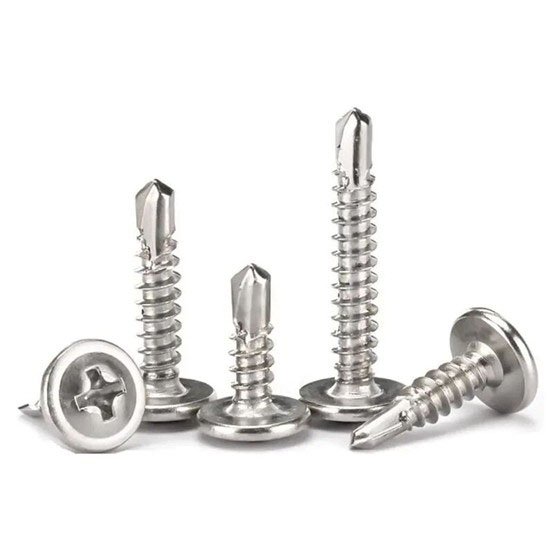
Chapter 6: Selection Decision Tree: 3 Steps to Quickly Determine the Right Grade for You
If you don’t want to check the table one by one, we have also compiled a 3-step selection decision tree. You can quickly lock the material by answering 3 questions, even for beginners.
Step 1: Judge the Corrosion Grade of the Environment
Question: Which category does your application environment belong to?
- A. Dry indoor (no humidity, no corrosion) → Proceed to Step 2;
- B. Outdoor dry/slightly humid (non-coastal, no chemical industry) → Proceed to Step 2;
- C. Coastal/chemical/high salt (seawater, acid-base fog, pickling workshop) → Choose 316 directly;
Step 2: Judge the Hardness and Thickness of the Machining Material
Question: What material are you going to tap?
- A. Iron plate/channel steel/thick galvanized square pipe (thickness >1mm) → Choose 410;
- B. Aluminum alloy/plastic/thin iron plate (thickness ≤1mm) → Proceed to Step 3;
Step 3: Judge the Requirements for Service Life and Cost
Question: What are your requirements for screw service life and budget?
- A. Service life of 3-5 years with limited budget → Choose 304;
- B. Service life of more than 8 years with sufficient budget → Choose 316;
Chapter 7: Answers to Common Myths: Breaking the “Taken-for-Granted” Ideas in Material Selection
In actual material selection, we find that many people choose the wrong material due to “taken-for-granted” ideas. The following are the 10 most common myths to help you avoid pitfalls.
Myth 1: “304 is better than 410, the more expensive the better”
Wrong! The advantage of 304 is corrosion resistance, while that of 410 is strength. When tapping thick iron plates, 304 will cause rapid tap wear due to low hardness, which is actually less useful than 410 and has a higher cost.
Correct logic: First consider the “machining material”, then the “environment”—the expensive one is not necessarily the right one.
Myth 2: “Non-magnetic 316 is genuine, magnetic 316 is fake”
Wrong! During cold working of 316 (e.g., cold heading), a small amount of austenite is transformed into martensite, resulting in weak magnetism, which is a normal phenomenon and does not affect corrosion resistance.
To judge the authenticity of 316, the molybdenum content (≥2%) should be tested instead of magnetism.
Myth 3: “410 must be used for tapping iron plates, no other grades work”
Not entirely true! If the iron plate thickness is ≤1mm and there are corrosion resistance requirements for the environment, 304/316 can be used, but two conditions must be met: ① Precise pre-drilling (according to the size in the selection table); ② Use extreme pressure cutting fluid + sharp tools, and accept the problem of relatively fast tool wear.
Myth 4: “410 with surface treatment can be used outdoors”
Wrong! The surface treatment of 410 (e.g., dacromet) can only “delay” rusting, not “prevent” it. The surface treatment layer will gradually wear out under long-term rain wash in outdoor environments, exposing the base material, which will still rust with a maximum service life of 3 years, far lower than 304.
Myth 5: “304 stainless steel can contact all foods and is food-grade”
Wrong! “Food-grade stainless steel” is a standard, not a material name. 304 can only contact neutral foods (bread, milk). For contact with high-acid (vinegar, lemon juice) or high-salt (pickles) foods, 316 or 304L that meets the GB 4806.9 standard should be selected.
Myth 6: “The higher the rotating speed, the better for machining 304/316”
Wrong! 304/316 have high viscosity, and excessively high rotating speed will cause frictional heating and “head burning”; excessively low rotating speed will cause work hardening and tool sticking.
The rotating speed should be adjusted according to the range in the selection table, not the higher the better.
Myth 7: “The higher the hardness of quenched 410, the better; HRC50 is better than HRC40”
Wrong! Excessively high hardness of quenched 410 (>HRC45) will increase brittleness and cause tooth chipping during tapping.
The optimal hardness is HRC35-45, which balances strength and toughness.
Myth 8: “316 never rusts in all corrosive environments”
Wrong! 316 will suffer stress corrosion cracking in high temperature (>400℃) + high chlorine environments; in concentrated nitric acid (>65%) environments, molybdenum will accelerate corrosion, making it less corrosion-resistant than 304 instead.
Myth 9: “Pre-drilling size can be set arbitrarily, a little bigger or smaller doesn’t matter”
Wrong! Excessively small pre-drilling causes tooth chipping for 410 and tool sticking for 304/316; excessively large pre-drilling leads to thread slipping for all grades.
The size must be adjusted according to the selection table with an error ≤0.1mm.
Myth 10: “The thicker the surface treatment, the better the corrosion resistance”
Wrong! The corrosion resistance of surface treatment depends on the coating type rather than “thickness”.
For example, the dacromet coating of 410 (5-8μm thickness) has 3 times better salt spray resistance than ordinary galvanizing (10-15μm thickness).
Conclusion: Material Selection is Not “Choosing a Grade”, but “Choosing a Solution”
The selection of stainless steel self-drilling screws is never a simple “choice among 304/316/410”, but a comprehensive decision based on environment + machining + cost + service life. We hope that through this article, you can establish a systematic selection logic and no longer incur rework and maintenance costs due to “wrong material selection”.
If you have specific working condition requirements, such as “tapping 5mm aluminum alloy in coastal areas” or “tapping 1mm thin iron plate in chemical industrial zones”, welcome to contact our technical team. We will provide you with one-on-one material selection solutions to make every screw used where it is most needed.Say Goodbye to the Troubles of Wrong Selection
If you are looking for quality screws, please visit us here https://hktl-fastener.com/screws/.