
01 General Provisions
For the fasteners that are necessary to ensure the dedicated explosion-proof type or to prevent contact with exposed live parts, they can only be loosened or removed with tools (such as keys, screwdrivers or wrenches).
If the fastener material is suitable for the housing material, the fastening screws for housings containing aluminium, magnesium, titanium or zirconium can be made of aluminium, magnesium, titanium, zirconium or non-metallic materials.
For the screw holes for fastening the covers that need to be opened during operation for adjustment, inspection or other operations, the screw holes can only be tapped in the enclosure material when the thread shape is suitable for the enclosure material.
02 Special fasteners
When special fasteners are required in the dedicated standards for explosion-proof types, the special fasteners shall meet the following requirements:
The thread should comply with the requirements of GB/T 9144 for coarse-pitch metric threads, and the tolerance grade should conform to 6g/6H as specified in GB/T 197 and GB/T 2516.
Bolts or nuts shall comply with the requirements of GB/T 5782, GB/T 5783, GB/T 6170 or GB/T 70.1, GB/T 70.2, GB/T 70.4 or GB/T 2672. For hexagon socket set screws, they shall conform to the requirements of GB/T 77, GB/T 78, GB/T 79 or GB/T 80.
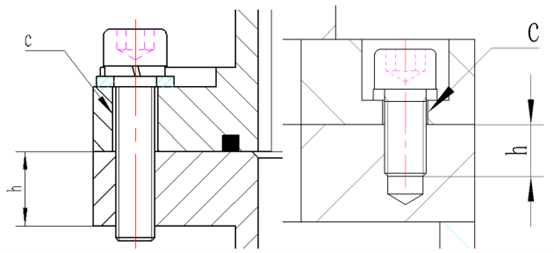
The thread depth h of the special fastener holes that allow thread engagement should be at least equal to the outer diameter of the fastener thread.
The internal thread tolerance shall comply with grade 6H of GB/T 197 and GB/T 2516, and the allowable clearance of the hole under the bolt head shall not exceed “medium series: H13” as per GB/T 5277 (see Figure 1).
Thread engagement marking number explanation: h – Thread engagement ≥ Outer diameter of the fastening bolt’s thread: c ≤ Maximum clearance allowed in “Medium Series: H13” of GB/T 5277.
03 Common Types of Fasteners
A bolt is a type of fastener consisting of a head and a shank (a cylindrical body with external threads). It needs to be used in conjunction with a nut to fasten and connect two parts with through holes.
This connection form is called a bolt connection. If the nut is unscrewed from the bolt, the two parts can be separated, so the bolt connection is a detachable connection.
Stud: A type of fastener without a head, featuring external threads at both ends. During connection, one end must be screwed into a part with an internal threaded hole, while the other end passes through a part with a through hole, and then a nut is tightened to firmly connect the two parts into a single unit.
This connection method is called stud connection and is also a detachable connection. It is mainly used in situations where one of the connected parts is relatively thick, a compact structure is required, or frequent disassembly is necessary, making bolt connection unsuitable.
Screws: They are also a type of fastener composed of a head and a shank. According to their uses, they can be classified into three types: machine screws, set screws, and special-purpose screws.
Machine screws are mainly used for the fastening connection between a part with a threaded hole and a part with a through hole, without the need for a nut (this connection form is called screw connection and also belongs to the detachable connection; they can also be used with nuts for the fastening connection between two parts with through holes).
Set screws are mainly used to fix the relative position between two parts. Special-purpose screws, such as eye bolts, are used for hoisting parts.
Nut: It has an internal threaded hole and is generally in the shape of a flat hexagonal prism, but can also be in the shape of a flat square prism or a flat cylindrical prism. It is used in conjunction with bolts, studs or machine screws to fasten and connect two parts, making them into one integral piece.
Washers: A type of fastener in the shape of a flat circular ring. They are placed between the supporting surface of bolts, screws or nuts and the surface of the connected parts, serving to increase the contact surface area of the connected parts, reduce the pressure per unit area, and protect the surface of the connected parts from damage; another type of elastic washers can also prevent nuts from loosening.
Retaining ring: It is used in the slot of the shaft or the slot of the hole on the machine or equipment, and its function is to prevent the parts on the shaft or in the hole from moving left and right.
Pins: Mainly used for positioning parts left and right. Some can also be used for connecting parts, fixing parts, transmitting power or locking fasteners.
Component and connection sets: A combination part is a type of fastener supplied in combination, such as a certain type of machine screw (or bolt, self-tapping screw) supplied together with a flat washer (or spring washer, lock washer); a connection set refers to a type of fastener supplied in combination, such as a high-strength large hexagon head bolt connection set for steel structures, which includes a certain type of special bolt, nut and washer.
04 Explosion-proof Requirements for Fasteners
The fasteners required for assembling the flameproof enclosure components from the outside shall:
For Class I equipment, special fasteners that comply with the requirements of GB/T 3836.1, with a protective ring or countersunk head, or protected intrinsically by the equipment structure (the purpose is to prevent the head of the fastener from being impacted);
For Class II equipment, special fasteners that comply with the requirements of GB/T 3836.1 shall be used. Fasteners made of plastic or light alloys are not permitted. During type testing, the bolts and nuts specified by the manufacturer shall be used.
The performance grade of the bolts or nuts used during the test, or the yield strength and type of the bolts and nuts, shall be marked on the equipment or specified in the relevant explosion-proof certificate, and the symbol “X” shall be added after the explosion-proof certificate number. (For information on the mechanical properties of bolts and nuts, see Table 2)
The double-ended studs shall comply with the requirements of Table 2 and shall be securely fastened, that is, they shall be permanently fixed to the enclosure by welding, riveting or other equivalent methods.
Fasteners should not penetrate the wall of the flameproof enclosure, unless they form a flameproof joint with the enclosure wall and cannot be separated from the enclosure, for example, by welding, riveting or other equivalent methods.
For screw holes or double-ended bolt holes that do not penetrate the flameproof enclosure wall, the remaining thickness of the flameproof enclosure wall should be at least one-third of the diameter of the bolt or double-ended bolt, with a minimum of 3mm.
When the bolt without a washer is fully screwed into the blind hole of the flameproof enclosure wall, there should be at least one full thread allowance retained at the bottom of the hole.
Except for the openings used for introducing devices, other openings may be provided on the flameproof enclosure wall for the installation of optional devices (such as buttons).
If the optional devices are not installed at the time of manufacture, these openings should be sealed with appropriate devices to maintain the flameproof performance of the enclosure.
Threaded doors or covers shall be additionally fixed by means of an Allen set screw or equivalent method.
05 Mechanical Performance Requirements for Special Fasteners
The fasteners required for assembling the flameproof enclosure components from the outside of flameproof equipment should be special fasteners that meet the requirements of GB/T 3836.1. The fasteners should have sufficient mechanical strength to prevent the bolts from breaking when an explosion occurs inside the flameproof enclosure.
Therefore, the standard requires that during the pressure resistance test of the enclosure, the bolts and nuts specified by the manufacturer should be used.
If you are looking for quality fasteners, please visit us here https://hktl-fastener.com/.