
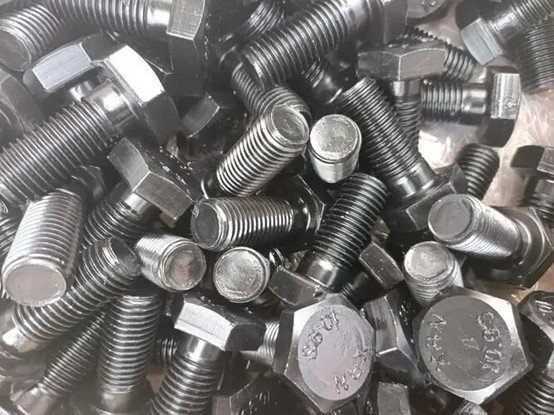
Hot-dip galvanizing, also known as hot-dip zinc coating, is a method of obtaining a metal coating on steel components by immersing them in molten zinc.
In recent years, with the rapid development of high-voltage power transmission, transportation and communication industries, the requirements for the protection of steel parts have become increasingly higher, and the demand for hot-dip galvanizing has also been continuously increasing.
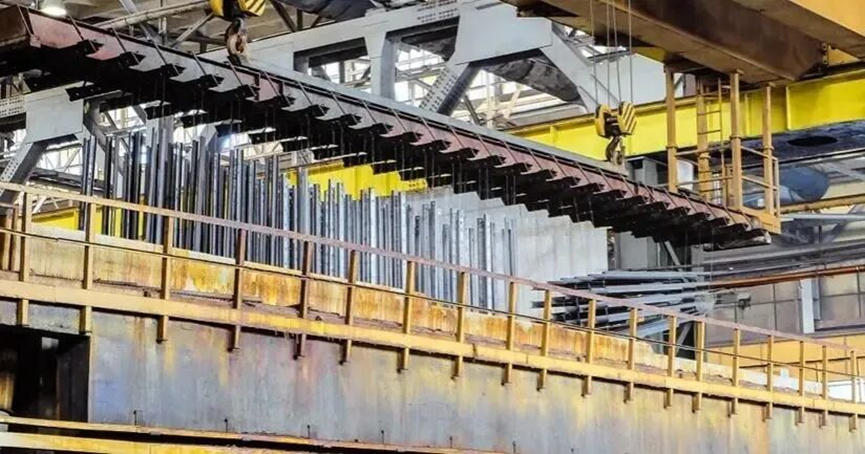
1. The protective performance of hot-dip galvanized coating
The thickness of electro-galvanized coating is usually 5 to 15 μm, while that of hot-dip galvanized coating is generally over 65 μm, and can even reach up to 100 μm. Hot-dip galvanizing has good covering power, and the coating is dense without any organic impurities.
It is well known that the mechanism of zinc’s resistance to atmospheric corrosion involves mechanical protection and electrochemical protection. Under atmospheric corrosion conditions, there are protective films of ZnO, Zn(OH)2 and basic zinc carbonate on the surface of the zinc layer, which to a certain extent slow down the corrosion of zinc. When this protective film (also known as white rust) is damaged, a new film layer will form.
When the zinc layer is severely damaged and threatens the iron substrate, zinc provides electrochemical protection to the substrate. The standard potential of zinc is -0.76V, and that of iron is -0.44V. When zinc and iron form a microcell, zinc acts as the anode and dissolves, while iron acts as the cathode and is protected.
Obviously, hot-dip galvanizing has better resistance to atmospheric corrosion for the base metal iron than electro-galvanizing.
2. The formation process of hot-dip galvanized coating
The formation process of the hot-dip galvanized coating is the process of forming an iron-zinc alloy between the iron substrate and the outermost pure zinc layer. When the workpiece is hot-dip galvanized, an iron-zinc alloy layer is formed on the surface of the workpiece, which enables a good bond between the iron and the pure zinc layer.
This process can be simply described as follows: when the iron workpiece is immersed in the molten zinc bath, a solid solution of zinc and α-iron (body-centered) is first formed at the interface. This is a crystal formed by the iron substrate metal dissolving zinc atoms in the solid state. The two metal atoms are fused, and the attraction between the atoms is relatively small.
Therefore, when zinc reaches saturation in the solid solution, the atoms of zinc and iron diffuse mutually. The zinc atoms that diffuse into (or penetrate into) the iron matrix migrate in the matrix lattice and gradually form an alloy with iron, while the iron that diffuses into the molten zinc liquid forms the intermetallic compound FeZn13 with zinc and sinks to the bottom of the hot-dip galvanizing pot, which is the zinc dross.
When the workpiece is removed from the zinc bath, a pure zinc layer is formed on the surface, which is a hexagonal crystal. Its iron content is no more than 0.003%.
3. Hot-Dip Galvanizing Process and Related Explanations
3.1 Process Flow
Workpiece → Degreasing → Water Washing → Pickling → Water Washing → Immersion in Pre-dip Solution → Preheating in Oven → Hot-dip Galvanizing → Finishing → Cooling → Passivation → Rinsing → Drying → Inspection
3.2 Process Description
(1) Degreasing
Chemical degreasing or water-based metal degreasing cleaning agents can be used until the workpiece is completely wetted by water.
(2) Pickling
Pickling can be carried out using 15% H2SO4 and 0.1% thiourea at 40-60°C, or 20% HCl and 1-3g/L hexamethylenetetramine at 20-40°C. Adding corrosion inhibitors can prevent excessive corrosion of the base material and reduce hydrogen absorption by the iron base. Poor degreasing and pickling can result in poor adhesion of the coating, inability to zinc plate or zinc layer peeling.
(3) Dipping in flux
Also known as a binder, it can maintain the activity of the workpiece before hot-dip galvanizing to enhance the adhesion of the coating to the base material. NH4Cl 15%-25%, ZnCl2 2.5%-3.5%, 55-65°C, 5-10 minutes. Glycerol can be added appropriately to reduce the evaporation of NH4Cl.
(4) Preheating
To prevent deformation of the workpiece due to sudden temperature increase during hot-dip galvanizing and to remove residual moisture to prevent zinc explosion and splashing, the preheating temperature is generally 120-180°C.
(5) Hot-dip galvanizing
The temperature of the zinc bath, the immersion time, and the speed of removing the workpiece from the zinc bath should be well controlled.
If the temperature is too low, the zinc bath has poor fluidity, resulting in thick and uneven coatings, easy to cause sagging, and poor appearance quality; if the temperature is too high, the zinc bath has good fluidity, but the zinc bath is prone to detach from the workpiece, reducing sagging and wrinkling, with strong adhesion, thin coating, good appearance, and high production efficiency;
However, if the temperature is too high, the iron loss of the workpiece and the zinc pot is severe, generating a large amount of zinc dross, affecting the quality of the hot-dip galvanized layer, and high zinc consumption, even making galvanizing impossible.
At the same temperature, a longer immersion time results in a thicker coating. When the same thickness is required at different temperatures, a longer immersion time is needed at higher temperatures. Generally, manufacturers use 450-470°C and 0.5-1.5 minutes to prevent workpiece deformation at high temperatures and reduce zinc dross caused by iron loss.
Some factories use higher temperatures for large workpieces and cast iron parts, but they should avoid the temperature range of peak iron loss.
To improve the fluidity of the hot-dip galvanizing bath at lower temperatures, prevent excessive coating thickness, and improve the appearance of the coating, 0.01%-0.02% pure aluminum is often added. Aluminum should be added in small amounts and multiple times.
(6) Finishing
The finishing of the workpiece after galvanizing mainly involves removing excess zinc and zinc nodules from the surface, which can be done by vibration or manual methods.
(7) Passivation
The purpose is to improve the corrosion resistance of the workpiece surface to the atmosphere, reduce or delay the appearance of white rust, and maintain a good appearance of the coating. Chromate passivation is commonly used, such as 80-100g/L Na2Cr2O7 and 3-4ml/L sulfuric acid.
(8) Cooling
Generally, water cooling is used, but the water temperature should not be too low to prevent the workpiece, especially castings, from contracting due to rapid cooling and causing cracking of the base material structure.
(9) Inspection
The coating should have a bright, fine appearance without sagging or wrinkling. The thickness can be inspected using a coating thickness gauge, which is a relatively simple method. The coating thickness can also be calculated based on the zinc adhesion. The adhesion strength can be tested using a bending press by bending the sample to 90-180°, and there should be no cracks or coating peeling. It can also be inspected by hammering.
If you are looking for quality fasteners, please visit us here https://hktl-fastener.com/.