
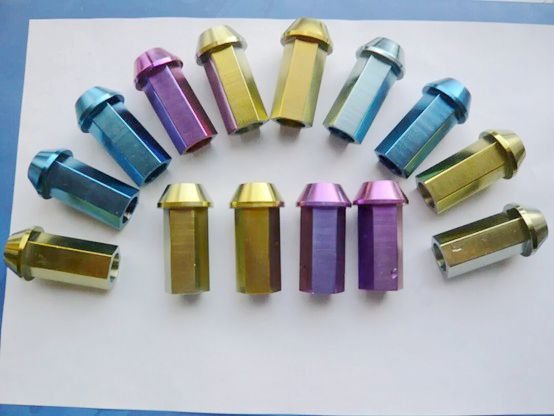
The titanium screws available on the market mainly come in two types: pure titanium and titanium alloy. Pure titanium has better flexibility and oxidation resistance.
Titanium alloy, on the other hand, is a mixture of titanium and other metals to enhance its specific properties. When choosing and using screws, one should determine the appropriate material based on their actual needs.
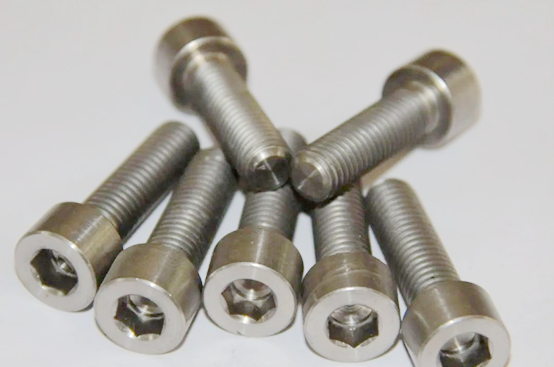
Eight Advantages of Titanium Alloy Fasteners
(1) Low density. The density of titanium alloys is significantly lower than that of steel materials, so titanium alloy fasteners are lighter in material weight than steel fasteners.
(2) High specific strength. Titanium alloys are among the metal materials with relatively high specific strength. By taking advantage of this high specific strength, titanium alloys can also be used to replace the lighter aluminum alloys. Under the same external load, the geometric dimensions of titanium alloy components are smaller, which can effectively save space. This material utilization concept is of great significance to the aerospace field.
(3) High melting point. The melting point of titanium alloys is significantly higher than that of steel materials, so the heat resistance of titanium alloy fasteners is better than that of steel fasteners.
(4) Small coefficient of thermal expansion and elastic modulus. The coefficient of thermal expansion and elastic modulus of titanium alloys are smaller than those of nickel alloys and steel materials. Within the same temperature change range, the thermal stress generated by titanium alloys is very small, so titanium alloys have high thermal fatigue performance.
(5) Non-magnetic. The magnetic permeability of titanium alloys is extremely low and can be almost ignored. Therefore, titanium alloy fasteners are non-magnetic and can effectively prevent magnetic field interference. Austenitic stainless steel is also non-magnetic, but subsequent cold working will increase its magnetic property.
However, neither hot nor cold working of titanium alloys will change their magnetic property, which makes titanium alloys applicable in avionics equipment.
(6) High yield-to-tensile strength ratio. For fasteners subjected to tensile loads, the design critical strength standard is the yield strength, followed by the tensile strength. This is because once a fastener undergoes yield deformation, it loses its fastening function.
(7) The electrode potential is compatible with that of carbon fiber composite materials. One of the major reasons for the extensive use of titanium alloys in fasteners is that the electrode potential of titanium alloys is compatible with that of carbon fiber composite materials, effectively preventing the occurrence of galvanic corrosion.
Titanium alloys also have excellent corrosion resistance and relatively high creep resistance, among other advantages.
Titanium alloy materials used in fasteners
Titanium alloy materials for fasteners are mainly classified into three categories: industrial pure titanium, (α+β) type and β type titanium alloys.
Industrial pure titanium mainly includes TA1 and TA2; (α+β) type titanium alloys mainly consist of TC4, TC6 and Ti-662, etc.; β type titanium alloys are mainly metastable β type titanium alloys, because the molybdenum equivalent of metastable β type titanium alloys is generally around 10%.
To determine whether a screw is made of titanium, you can refer to the following methods:
1. Appearance identification: Observe the appearance of the screw. Pure titanium screws and titanium alloy screws are similar to traditional stainless steel, copper, and iron screws, but high-end titanium screws can reach a higher level. Its appearance is beautiful, sometimes like a handicraft, emitting a cold and clear luster. Compared with iron screws and copper screws, titanium screws appear brighter, with a cold and clear luster.
2. Scratch test: In case of uncertainty, you can gently scratch the screw on a white ceramic surface. If the screw is made of titanium, it will leave a gray scratch on the white porcelain. However, stainless steel will not leave a scratch on white porcelain. But it should be noted that some titanium products nowadays undergo special hardening treatment on the head for a better user experience, making them less likely to leave scratches.
3. Chemical testing: This is a more accurate method. Through chemical reactions, the composition of the material can be determined. For example, when using nitric acid for testing, pure titanium will produce bubbles instantly.
4. Price judgment: Since titanium is relatively expensive as the raw material for screws, price is also a basis for judgment. If the price of the screw is abnormally low, it may not be a genuine titanium screw.
If you are looking for quality screws, please visit us here https://hktl-fastener.com/screws/.