The Short Answer
Use a chemical anchor bolt when you need high load capacity, close edge distances, reduced concrete splitting risk, vibration resistance, or anchoring into cracked or uncertain concrete. Select the resin according to substrate condition, temperature, load type, and installation speed. Select the threaded rod according to strength, corrosion exposure, fire requirements, and whether the connection is structural.
For most general indoor installations, a qualified vinylester or polyester resin with a zinc-plated or stainless-steel rod may be sufficient. For structural connections, seismic applications, cracked concrete, high temperature, or long-term external exposure, specify a certified system, matched components, and documented installation procedures.
What a Chemical Anchor Actually Does
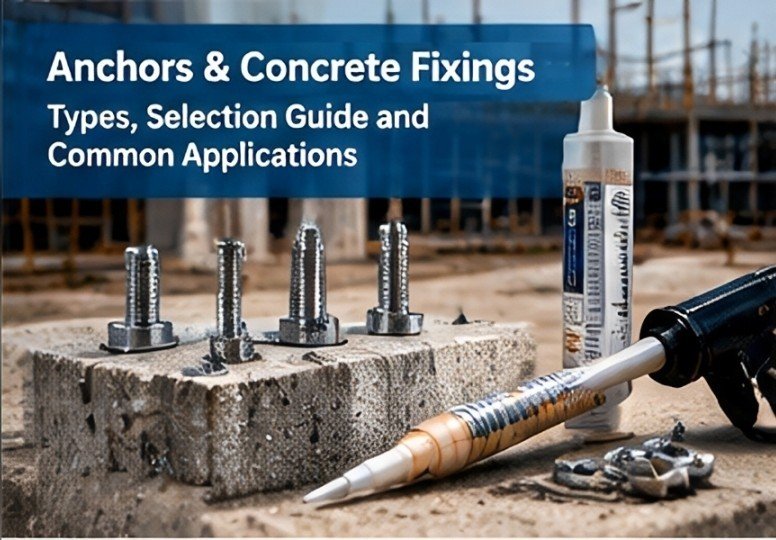
A chemical anchor, also called a bonded anchor or resin anchor, uses an injected adhesive to bond a threaded rod, rebar, or specialized stud into a drilled hole. As the resin cures, it locks the metal element into the concrete. Load is transferred through the adhesive layer into the surrounding substrate.
This differs from a mechanical expansion anchor, which relies on friction and expansion pressure against the hole wall. That difference explains why chemical anchors are often preferred near edges, in shallow concrete, or where expansion forces could crack the base material.
However, chemical anchors are not automatically superior. Their performance depends heavily on hole preparation, resin quantity, curing time, temperature, and installer technique. A poorly cleaned hole or an under-filled injection can reduce capacity dramatically.
When to Use a Chemical Anchor Bolt
| Application Condition | Why Chemical Anchoring Helps | Key Caution |
| Close to a concrete edge | Lower expansion pressure reduces splitting risk | Still verify edge distance and load direction |
| Cracked concrete | Certified systems can be qualified for cracked concrete | Use only products tested for the relevant condition |
| Heavy static or seismic loads | Bonded systems can achieve high capacity | Design must account for concrete failure modes |
| Vibrating equipment | Adhesive bond can reduce loosening risk | Confirm fatigue and sustained-load suitability |
| Retrofit or renovation | Useful where original fixings are absent or inadequate | Check rebar, embedment depth, and substrate strength |
| Overhead installations | Suitable when correctly designed and installed | Curing and hole preparation are critical |
| Water-filled or damp holes | Some resins tolerate moisture | Do not assume all resins work underwater |
Choose by Substrate First
The concrete is not merely a background material; it is part of the anchoring system.
Before selecting a product, establish:
- Concrete compressive strength class.
- Whether the concrete is cracked or uncracked under service conditions.
- Concrete thickness and available embedment depth.
- Distance from edges and spacing between anchors.
- Presence of reinforcement, post-tensioning ducts, hollow sections, or deteriorated concrete.
- Moisture condition: dry, damp, water-filled, or submerged.
- Temperature during installation and in service.
For example, a chemical anchor installed near a slab edge must be checked for concrete breakout, edge failure, and splitting. A deep embedment in thin concrete does not guarantee better performance if the anchor can break out through the far side.
Resin Selection Guide
Different resin chemistries suit different jobs. Do not select resin based on price per cartridge alone.
| Resin Type | Typical Strengths | Best Use Cases | Limitations |
| Polyester | Economical, easy to use | Light-to-medium duty, dry indoor holes | Lower temperature and load performance than premium systems |
| Vinylester | Good all-round performance, fast curing options | Machinery, racking, pipework, general construction | Check cracked-concrete and seismic approvals |
| Epoxy | High bond strength, good for larger holes and rebar | Structural retrofit, rebar connection, heavy loads | Slower curing; more sensitive to mixing and temperature |
| Hybrid / vinylester hybrid | Balanced handling and performance | Versatile construction applications | Confirm qualification for the specific substrate |
| Cementitious / specialty mortar | Useful for certain masonry or oversized holes | Specific retrofit scenarios | Not interchangeable with structural resin systems |
For structural applications, use a system that has been tested and qualified for the intended concrete condition, load direction, and installation temperature. A resin and rod sold separately may not be an approved matched system.
Threaded Rod, Stud, or Rebar?
A chemical anchor bolt can use several metal elements. The correct choice depends on whether the connection is a new fixing, a retrofit connection, or a reinforcement extension.
| Metal Element | Typical Use | Selection Focus |
| Threaded rod | New equipment, brackets, rails, machinery bases | Strength class, corrosion protection, thread tolerance |
| Stud bolt / anchor stud | Permanent structural or industrial fixings | Weldability, material grade, certified mechanical properties |
| Reinforcing bar | Rebar extension or concrete-to-concrete connection | Bar diameter, grade, lap length, structural design |
| Specialty internally threaded sleeve | Adjustable or removable connections | System compatibility and load rating |
For a typical equipment base, a threaded rod with nuts and washers is common. For a column base or structural steel connection, the engineer may specify a stud or rebar element instead.
Material and Corrosion Choices
The metal element must survive the environment for the design life of the installation.
| Environment | Practical Material Choice | Notes |
| Dry indoor | Carbon steel, zinc-plated | Lowest cost for protected conditions |
| Humid indoor or sheltered outdoor | Hot-dip galvanized steel or higher-grade coating | Check coating thickness and cut ends |
| External atmospheric exposure | Stainless steel A4/316 or qualified coated system | Consider chlorides and washing exposure |
| Coastal or marine | 316 stainless steel, duplex, or engineered protection | Crevice corrosion and salt spray need attention |
| Chemical plant | Alloy selection based on chemical exposure | Consult corrosion data, not generic assumptions |
| High temperature | Heat-resistant alloy or approved high-temperature system | Resin performance also has temperature limits |
A frequent mistake is specifying stainless-steel rods while ignoring the resin’s temperature limit, or specifying a premium coating but allowing installers to cut the rod after coating. Cutting can expose unprotected steel; if cutting is unavoidable, define how the cut end will be protected.
The Four Installation Variables That Control Performance
1. Hole Diameter and Depth
Hole diameter and embedment depth must follow the manufacturer’s approved data for the specific resin, rod diameter, substrate, and load condition. A larger hole is not always better. Excess clearance can reduce bond performance, while an undersized hole can prevent proper resin injection.
2. Hole Cleaning
Dust is one of the most common causes of reduced anchor performance. Follow the approved brushing and blowing sequence. In many systems, this means drilling, blowing, brushing, and blowing again—but always use the manufacturer’s specified method and equipment.
Do not rely on compressed air alone if the approval requires a specific brush size and cleaning cycle.
3. Resin Injection
Inject from the back of the hole toward the front to avoid air pockets. Fill approximately the specified proportion of the hole, then insert the rod slowly with a twisting motion until it reaches the required depth. Excess resin should appear at the mouth of the hole.
Underfilling leaves voids; overfilling wastes material and can contaminate the surrounding surface.
4. Curing Time
Do not load, torque, or adjust the anchor before the resin has cured. Curing time changes with temperature: cold conditions slow the reaction, while high temperatures can shorten working time. Follow the published cure schedule for the actual site temperature.
Specification Checklist for Procurement
A purchase specification should make the system unambiguous. Include:
- Project name, location, and responsible engineer.
- Concrete strength and cracked/uncracked condition.
- Substrate thickness and edge distances.
- Anchor type: threaded rod, stud, or rebar.
- Rod diameter, length, embedment depth, and projection.
- Resin type, cartridge size, and approved system reference.
- Required certifications or approvals.
- Corrosion protection and material grade.
- Installation temperature range.
- Hole diameter, cleaning method, and injection volume.
- Curing time before loading.
- Inspection and torque requirements.
- Quantity, packaging, and delivery schedule.
- Required submittals: datasheets, approvals, installation instructions, and test reports.
This prevents a supplier from substituting an unmatched resin, rod, or installation method.
Design Considerations
Chemical anchor design is not only about tensile capacity. Depending on load direction and geometry, the governing failure mode may be:
- Steel failure of the rod or stud.
- Adhesive bond failure.
- Concrete cone breakout.
- Concrete splitting.
- Edge failure.
- Pull-out failure.
- Combined tension and shear interaction.
For grouped anchors, spacing and edge distance affect whether anchors act independently or as a group. For shear loads, the position relative to an edge can be decisive. For seismic applications, ductility, crack movement, and cyclic performance matter.
Do not copy a previous project’s anchor size without checking the new slab, load path, edge distances, and environmental conditions.
Quality Control on Site
A strong installation process includes more than the final torque check.
Recommended controls:
- Verify concrete strength and condition before drilling.
- Scan for reinforcement or post-tensioning where required.
- Confirm hole diameter, depth, and spacing against the drawing.
- Use calibrated drilling and cleaning equipment.
- Record resin batch numbers and expiry dates.
- Check ambient and substrate temperature.
- Train installers on the approved system.
- Mark cured anchors before loading.
- Inspect resin overflow and rod projection.
- Retain installation records and photographs.
For critical connections, consider proof loading or destructive testing on sacrificial anchors, but only when designed and interpreted by a qualified engineer.
Common Failure Causes
| Failure Cause | Typical Symptom | Prevention |
| Dust left in hole | Reduced pull-out capacity | Follow brushing and blowing sequence |
| Resin expired or poorly mixed | Soft adhesive, incomplete cure | Check shelf life and mixing ratio |
| Hole too large or too shallow | Low bond area | Follow approved geometry |
| Loading before cure | Movement or bond failure | Enforce curing time |
| Wrong resin for cracked concrete | Unpredicted capacity | Use qualified cracked-concrete system |
| Edge distance too small | Concrete edge breakout | Engineer the layout, not just the anchor |
| Excessive torque | Rod damage or resin disturbance | Use specified torque and tools |
| Water in hole with unsuitable resin | Poor adhesion | Select moisture-tolerant approved resin |
Cost Versus Risk
Chemical anchors usually cost more than basic mechanical anchors because they require resin, cleaning, curing time, and trained installation. But the total cost calculation should include:
- Failure or rework cost.
- Concrete repair cost.
- Project delay.
- Inspection and documentation.
- Long-term corrosion protection.
- Safety and liability exposure.
For a light bracket in dry concrete, a mechanical anchor may be more economical. For a heavy machine base, seismic connection, edge fixing, or retrofit into cracked concrete, a properly specified chemical anchor system can be the lower-risk option.
FAQ
What is a chemical anchor bolt?
A chemical anchor bolt is a threaded rod, stud, or rebar element bonded into a drilled hole using an injected adhesive or resin. After curing, the system transfers load from the metal element into the surrounding concrete.
When should I use a chemical anchor instead of an expansion anchor?
Use a chemical anchor when expansion forces are undesirable, when loads are high, when the fixing is close to an edge, or when the design requires anchoring into cracked concrete. Always compare both options using the actual substrate and load conditions.
Can chemical anchors be used in cracked concrete?
Some systems are qualified for cracked concrete, but not all. Check the product’s approval, concrete condition, seismic requirement, and installation temperature. Never assume a general-purpose resin is suitable for a cracked-concrete structural application.
What resin should I choose?
Choose resin based on load, substrate, temperature, moisture, curing speed, and approval requirements. Polyester may suit light-duty dry conditions; vinylester is a common general-construction choice; epoxy is often selected for heavy structural or rebar connections.
How deep should a chemical anchor be embedded?
Embedment depth depends on rod diameter, resin system, concrete strength, load, edge distance, and spacing. Use the manufacturer’s approved design data and the project engineer’s calculation. There is no universal depth rule.
Can I install chemical anchors in wet holes?
Only if the resin system is approved for damp or water-filled holes. Standard products may lose performance in wet conditions, so specify a moisture-tolerant system where water is present.
What documents should a supplier provide?
Request product datasheets, performance approvals, installation instructions, material certificates for rods or studs, resin batch information, and, where required, fire, seismic, or cracked-concrete qualification documents.
Final Recommendation
Specify a chemical anchor bolt as a complete system: concrete condition, resin chemistry, metal element, hole geometry, cleaning method, curing regime, and inspection plan. For ordinary dry indoor fixings, a standard qualified system may be enough. For structural, seismic, cracked-concrete, wet, high-temperature, or corrosion-exposed applications, use certified matched components and enforce installation controls.
The strongest chemical anchor is not the one with the highest advertised load. It is the one whose approved installation method can be followed exactly on your site.
Discuss Your Fastener Fequirement
If you are evaluating a fastener for an industrial project, prepare the drawing, material requirement, quantity, operating environment and target delivery schedule before contacting a supplier. HKTL-Fastener can be invited to review the inquiry details and confirm whether the requested item falls within its verified product scope. Please share the drawing and relevant specification for a quotation discussion; final design suitability should remain with the responsible engineering team.