
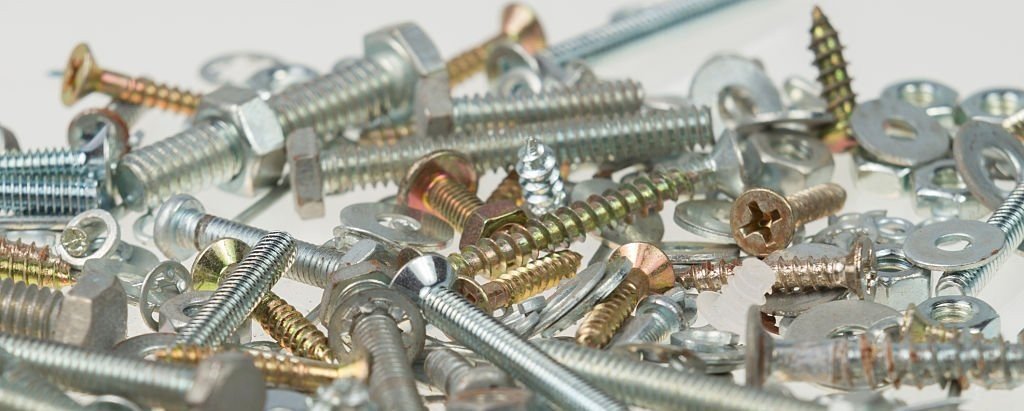
The structure and dimensions of threaded fasteners have been standardized. In mechanical design, there is no need to draw their individual drawings separately. The required structural dimensions can be found from the corresponding national standards according to the design requirements.
The unified dimension codes and markings for fastener products can facilitate the search and purchase by designers, purchasers, suppliers, manufacturers and sales personnel. Moreover, it can avoid misunderstandings and errors caused by different naming conventions.
Dimension codes and contents of bolts, screws and studs
Common types of threaded fasteners
(1) Bolt
The bolt is composed of two parts: the bolt head and the bolt shaft. The most commonly used shape of the head is the hexagonal one. The common grades are A and B. Besides, there are differences in terms of full thread, partial thread and thick/thin shaft.
The dimensions that determine the bolt specification are the nominal diameter d of the bolt and the length l of the bolt. Once a bolt is selected, other dimensions can be obtained according to relevant national standards (see the attached table).
(2) Double-ended screws
The two ends of the double-ended stud are processed with threads. One end is inserted into the pre-drilled screw hole of the connected component, which is called the insertion end; the other end is screwed with a nut to fix another connected component, which is called the tightening end.
In terms of structure, there are two types: A grade and B grade. The A grade type should be marked with “A” before the specification, while the B grade type does not need to be marked. The length of the insertion end bm of the double-ended stud is related to the material of the component with the screw hole:
1) Bronze, steel, take bm = d
2) Cast iron, with bm equal to 1.25 times the diameter (d)
3) Aluminum alloy, with bm = 1.5d
4) For non-metallic materials, set bm equal to 2d.
The dimensions that determine the specification of the double-ended bolt are the bolt diameter d and the length of the fastening end l. Once a double-ended bolt is selected, the other dimensions can be obtained according to relevant standards.
(3) Screws
Screws can be classified into two types based on their usage: connection screws and locking screws. The former are used for connection, and they come in various shapes such as slotted cylindrical head screws, slotted countersunk screws, and slotted flat head screws.
The latter are mainly used to prevent relative movement between two mating parts, and they include slotted flat-ended locking screws, slotted conical-ended locking screws, and hexagonal flat-ended locking screws. The dimensions that determine the specifications of screws are the screw diameter d and the length l. Other dimensions can be found according to relevant standards.
(4) Nut
The nut is used in conjunction with the bolt or stud to achieve a connection. There are various forms of nuts, including hexagonal, circular, and square. The hexagonal head nut is the most commonly used. Circular nuts are often used for axial fixation of parts on the shaft.
Hexagonal head nuts are classified into types I, II, A, B, and C, and they also have distinctions in terms of thickness and thickness. The size that determines the nut specification is the nominal diameter of the thread D. After selecting a type of nut, other dimensions can be obtained according to relevant standards.
(5) Gasket
The washer is installed between the nut and the connected component. Its purpose is to increase the contact area between the nut and the connected component, and to protect the surface of the connected component from being scratched when the nut is tightened. Besides flat washers, there are also spring washers and locking washers, which can prevent the nut from loosening due to vibration.
The size that determines the specification of the gasket is the diameter d of the bolt. Once the gasket is selected, the other dimensions can be obtained by referring to relevant standards.
Fastener size symbols and their meanings comparison table
| Sign | Meaning |
| A | nominal diameter of hexalobular socket |
| a | distance from the bearing face to the first full form(full profile)thread(screw) |
| b | thread length |
| bm | thread length of the stud metal end |
| C | nominal diameter of triple square socket |
| c | height of the washer-faced portion or thickness of the flange or collar |
| d | basic major diameter(nominal diameter)of thread |
| da | inner diameter of the bearing face |
| dc | flange or collar diameter |
| df | diameter of the face(set screw) |
| dg | diameter of the undercut(groove) |
| dk | diameter of the head |
| dl | diameter of the split pin hole or wire hole |
| dn | diameter of the scrape point |
| dp | diameter of the flat or dog point or drilling point |
| dr | width of the scrape |
| ds | diameter of the unthreaded shank |
| dt | diameter of the truncated cone point |
| dw | outer diameter of the washer face(bearing face) |
| dx | diameter of pilot point |
| dz | diameter of the cup point |
| e | width across corners |
| f | height of the raised(oval)portion of a raised countersunk head |
| fn | length of the square neck |
| g | width of the undercut |
| h | total depth of intendation of triple square socket |
| k | height of the head |
| kw | wrenching height |
| l | nominal length |
| lc | length of thread cutting point |
| le | distance from the centre line of split pin hole to the thread end |
| lf | transition length |
| lg | distance from the bearing face to the first full form(full profile)thread(bolt) |
| lh | distance from centre line of split pin hole to bearing surface |
| lk | length of the cone part of the scrape point |
| lm | usable thread length of drilling screws |
| ln | length of the scrape point |
| lr | length of thread rolling(thread forming)point |
| ls | length of unthreaded shank |
| lt | overall length |
| m | wing diameter of cross recesses |
| n | width of the slot |
| r | radius of curvature under head |
| re | radius of rounded thread end |
| rf | radius of the raised portion of a head |
| s | width across flats |
| t | depth of the internal driving feature or slot |
| u | Incomplete thread end |
| v | head chamfer or radius |
| vn | width of square neck |
| vu | depth of indentation under the head |
| w | thickness between driving feature and bearing face |
| x | length of the thread run-out |
| y | length of threaded end of tapping screw |
| z | length of dog point or pilot point |
| α | angle of countersunk head |
| β | angle of the chamfer(hexagon head) |
| γ | angle of the cone end |
| δ | angle of the flange |
| Φ | bottom angle in the recess |
| φ | angle of the underhead |
If you are looking for quality fasteners, please visit us here https://hktl-fastener.com/.