Core Findings
Fastener service durability is jointly determined by mechanical‑strength, corrosion‑resistance, ambient medium, temperature and surface‑treatment. Carbon‑steel relies heavily on anti‑corrosion coatings; stainless‑steel grades (304 / 316) differ greatly in chloride‑resistance; titanium delivers outstanding comprehensive performance but at high‑cost. Material selection must balance load‑requirement, service‑environment and whole‑life‑cycle‑cost.
| Material Type | Representative Grade | Mechanical Durability | Corrosion‑resistance Performance | Cost | Typical Application |
|---|---|---|---|---|---|
| Carbon‑steel / Alloy‑steel | 4.8‑12.9 | High strength; adjustable via heat‑treatment | Poor base‑corrosion‑resistance; depends on galvanizing / Dacromet coating | Low | General‑structure, machinery, power‑tower anchor‑bolts |
| Austenitic stainless steel | 304(A2‑70) | Medium strength; strength improved by cold‑working | Good for ordinary‑humid environment; poor anti‑chloride performance | Medium | Indoor‑outdoor non‑coastal general‑purpose assembly |
| Molybdenum‑bearing stainless steel | 316(A4‑80) | Medium‑high strength | Excellent chloride‑resistance; suitable for coastal / salt‑containing medium | Medium‑high | Seawater‑contact, chemical‑industry, seafood‑processing equipment |
| Martensitic stainless steel | 410 | High‑hardness after heat‑treatment | Weak corrosion‑resistance | Medium | Dry‑indoor steel‑plate self‑drilling‑screws |
| Titanium‑alloy | TA2 / TC4 | High‑specific‑strength; light‑weight; non‑magnetic | Outstanding corrosion‑resistance, galvanic‑corrosion compatibility with carbon‑fiber composite | Very high | Aerospace, avionics, special‑corrosion‑resistant equipment |
Main comparative points
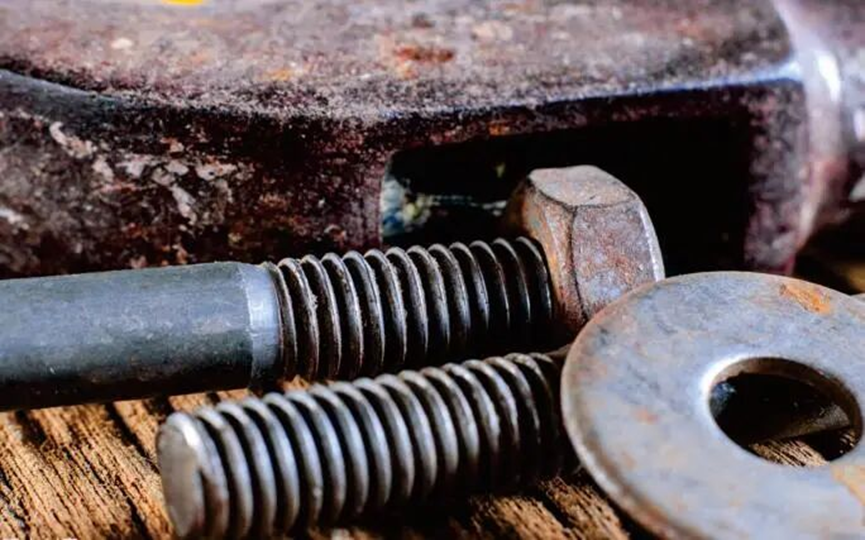
- Carbon‑steel & alloy‑steel: High‑strength grades (8.8,10.9,12.9) achieve durability via quenching‑and‑tempering. Bare carbon‑steel rusts rapidly; service‑life depends entirely on surface‑treatment. Hot‑dip‑galvanizing and Dacromet greatly extend outdoor service‑life. Coating damage will sharply reduce durability.
- Stainless‑steel series: 304 fails quickly in coastal chloride‑rich atmosphere. 316 with molybdenum resists pitting‑corrosion. Austenitic stainless‑steel risk thread‑galling under repeated disassembly, which impairs connection durability. Martensitic 410 has high‑hardness but is prone to rust in humid‑environment, needing additional surface‑protection.
- Titanium‑alloy: Light‑weight, non‑magnetic, excellent anti‑corrosion. Expensive; mainly used for high‑end special‑scenarios.
Practical selection guidance
- For indoor‑dry‑condition: carbon‑steel with proper surface‑treatment offers good cost‑performance.
- For ordinary outdoor‑non‑coastal: choose 304 stainless‑steel or coated high‑strength carbon‑steel.
- For coastal, salt‑fog and chemical‑medium: prefer 316 stainless‑steel or titanium‑alloy.
- Durability is not only material‑driven; installation‑preload, anti‑loosening‑measures, operating‑temperature and regular‑inspection also affect actual service‑life.
Highly durable fasteners can maintain the integrity of equipment structures for a longer period, reduce early failures caused by fatigue, thereby lowering the frequency of machine and equipment replacement and cutting down on maintenance cost expenditures.
Selecting appropriate fasteners can enhance assembly efficiency and simultaneously minimize production halts due to fastener quality issues.
It can be said that the durability of fasteners not only relates to the reliability and safety of equipment, but also affects the technological level and economic benefits of the entire manufacturing industry.
Of course, the durability of fasteners is also easily influenced by a variety of factors, including the inherent properties of the material, the usage environment, the stress state, and whether appropriate surface treatment has been carried out or not.
Today, let’s explore together the durability comparison of fasteners made of different materials.
No.1 Stainless Steel

Corrosion resistance:
Stainless steel has excellent corrosion resistance and can be used for a long time in damp and corrosive environments without damage, which is an important manifestation of its durability.
Strength and Toughness:
The strength and toughness of stainless steel are relatively good, enabling it to withstand certain loads and stress variations while maintaining the firmness of the connection.
Aesthetic appeal:
The stainless steel surface has a high degree of smoothness and a beautiful and elegant appearance, making it suitable for occasions with high aesthetic requirements.
Application scenarios:
Stainless steel fasteners are widely used in fields such as chemical engineering, medicine, and food, where high corrosion resistance is required, as well as in high-end equipment and precision instruments where appearance is of great importance.
No.2 Carbon Steel

Strength and hardness:
Carbon steel fasteners have high strength and hardness, making them suitable for applications that require withstanding heavy loads.
Wear resistance:
The surface of carbon steel fasteners has good wear resistance and can withstand a certain degree of wear.
Corrosion resistance:
However, carbon steel has poor corrosion resistance and is prone to rusting, especially in damp and highly corrosive environments.
Application scenarios:
Carbon steel fasteners are suitable for general industrial equipment, mechanical equipment and other fields, especially in cost-sensitive situations where high strength is required. However, it is necessary to take anti-corrosion measures to extend their service life.
No.3 Alloy Steel

High strength and corrosion resistance:
Alloy steel enhances its strength and corrosion resistance by adding other elements such as chromium and molybdenum, making it suitable for applications that require high strength, high temperature and high pressure.
Wear resistance:
The wear resistance of alloy steel is also good, and it can resist a certain degree of wear.
Application scenarios:
Alloy steel fasteners are widely used in fields such as aerospace, automotive manufacturing, and heavy machinery, where high strength and corrosion resistance are required.
No.4 Brass

Corrosion resistance:
Brass has relatively good corrosion resistance, but it is not as good as stainless steel, and it is prone to damage in highly corrosive environments.
Conductivity and Thermal Conductivity:
Brass has good electrical and thermal conductivity and is suitable for applications that require these properties.
Strength and hardness:
The strength and hardness of brass are relatively low and are inferior to those of steel and alloy steel.
Application scenarios:
Brass fasteners are suitable for low-corrosion environments, such as watch parts, pipes, valves, etc., but it should be noted that they have relatively weak durability.
No.5 Aluminum Alloy

Corrosion resistance:
Aluminum alloys have a certain degree of corrosion resistance, but it is not as good as that of high-strength materials such as stainless steel and titanium alloys. Under appropriate conditions, their corrosion resistance can be enhanced by the formation of an aluminum oxide layer.
Lightweight and high strength:
Aluminum alloy features lightweight and high strength, making it suitable for applications where weight reduction is required.
Durability:
The durability of aluminum alloy is influenced by factors such as usage conditions, treatment methods, and production quality. It is prone to aging and deformation in high-temperature or high-humidity environments.
Application scenarios:
Aluminum alloy fasteners are widely used in aerospace, automotive, construction, electronics and other fields, but they need to be selected based on specific usage conditions.
No.6 Titanium Alloy
High strength and corrosion resistance:
Titanium alloys possess outstanding strength and corrosion resistance, enabling them to be used for long periods in extreme environments such as high temperatures, low temperatures, high pressure, and strong magnetic fields.
Lightweight:
Titanium alloy has a low density and is a lightweight fastener material.
Non-magnetic:
Titanium alloy is non-magnetic and is suitable for applications where magnetic properties are a concern.
Application scenarios:
Titanium alloy fasteners are widely used in high-tech fields such as aerospace, nuclear industry, and electronics industry, as well as in the manufacturing of medical devices and artificial organs.
In conclusion, fasteners made of different materials have their own characteristics in terms of durability. When making a choice, comprehensive considerations should be given to specific usage environments, stress conditions, cost requirements and other factors.
In damp and highly corrosive environments, stainless steel and titanium alloys are better choices; in situations where weight reduction is needed, aluminium alloys have an advantage; and in fields with high requirements for strength and wear resistance, alloy steel and carbon steel are more applicable.
If you are looking for quality screws, please visit us here https://hktl-fastener.com/screws/.