
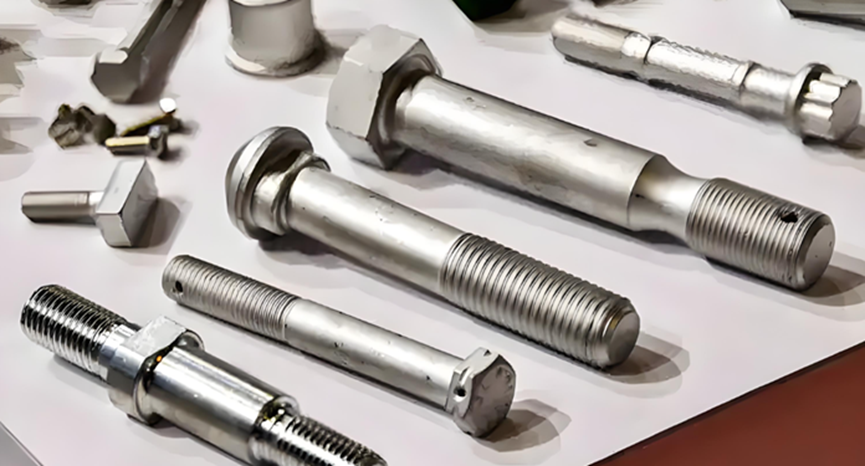
Regarding the issue of loose bolts, many people still don’t know what causes them to become loose. Let’s first understand the hazards of loose bolts.
The Hazards of Loose Bolts
In a bolt connection, tightening the nut actually elongates the bolt, much like pulling a spring. This tension, or tensile force, generates an opposing clamping force that tightly secures the two parts of the connected components together. If the bolt loosens, the clamping force will weaken.
A loose bolt is not merely a bothersome nuisance. If the joint is not promptly retightened, it may start to leak liquids or gases, the bolt may break, the equipment may be damaged, or a catastrophic accident may occur.
Five Reasons for Loose Bolts
01 Insufficient tightening
Loosely tightened or falsely tightened bolts originally have insufficient preload. If they become loose again, the joint will not have enough clamping force to hold the parts together. This may cause the two parts to slide laterally, subjecting the bolt to unnecessary shear stress, which may eventually lead to bolt fracture.
02 Vibration
Tests on bolted connections under vibration have shown that many small “lateral” movements cause the two parts of the connection to move relative to each other, while the bolt head or nut and the connected parts also move.
These repetitive movements will counteract the friction between the bolt and the connected parts. Eventually, the vibration will cause the bolt to “unscrew” on its threads, and the joint will lose its clamping force.
03 Embedding
Engineers who design and develop bolt tension allow for a break-in period during which a certain amount of preload loss occurs, and during this period, the tightness of the bolt will become loose.
This looseness is caused by the embedding between the bolt head and/or nut, the thread and the mating surface of the connected parts, and it can occur in both soft materials (such as composites) and hard polished metals.
If the joint is improperly designed or the bolts are not tightened to the specified tension at the beginning, the embedding of the joint may cause a loss of clamping force and fail to reach the required minimum clamping force.
There are microscopic unevennesses between the mating surfaces. Under the action of the preload of the bolt after tightening, the protrusions will be crushed and undergo permanent plastic deformation, thereby reducing the clamping length of the bolt and ultimately leading to a decrease in the preload of the bolt.
04 Gasket creep and thermal expansion
Many bolted joints include a thin, soft gasket between the bolt head and the joint surface to seal the joint and prevent the leakage of gas or liquid. The gasket itself also acts as a spring, rebounding under the pressure of the bolt and the mating surface.
Over time, especially when exposed to high temperatures or corrosive chemicals, gaskets may “creep”, which means they lose their elasticity and result in a loss of clamping force.
If the materials of the bolts and joints are different, due to excessive temperature differences caused by rapid environmental changes or industrial cycle processes, the bolt material may expand or contract rapidly, which may cause the bolts to loosen.
05 Impact
Impact – A relatively large impact load exceeds the frictional force when the bolt is pre-tightened, causing sliding.
Dynamic or alternating loads from machinery, generators, wind turbines, etc. can cause mechanical shock – the impact force applied to bolts or joints – which can lead to relative sliding of the bolts.
Just like vibration, this sliding will eventually cause the bolt to loosen. Even impact is often not taken into account when designing the joint connection for such a large load.
Summary
The best way to prevent loosening is to ensure that the preload is sufficient to prevent the joint from sliding, opening, or other problems.
The above analysis shows that there are three reasons for loosening due to insufficient or reduced preload. Therefore, it is necessary to strictly control the preload of the bolts to control the risk of loosening.
As long as the preload is sufficient to meet the requirements and the clamping length is not too short (such as lk ≥ 3d), even if there is a certain vibration load, the bolt generally will not loosen by itself.
A well-designed bolt connection, combined with the development of appropriate clamping force and suitable bolt anti-loosening devices, can reliably secure the bolt connection to address many of the loosening challenges presented here.
A good bolted connection will be designed with appropriately sized and type bolts and nuts, and specify the optimal tension to achieve the clamping force required to maintain the integrity of the connection.
In applications, the appropriate clamping force requires that the tension (pre-tightening force) in each bolt reach the correct level and remain at that level throughout its service life.
Therefore, maintaining appropriate tension on the bolts is of vital importance. During the design phase, ultrasonic waves can be utilized to measure the axial force of the bolts to ensure that the preload of the bolts meets the design requirements. The ultrasonic axial force measuring instrument is specifically designed for measuring the axial force of bolts and also features a QR code function, enabling real-time traceability of the axial force of the bolt.
If you are looking for suitable bolts and nuts, please visit us here https://hktl-fastener.com/bolts-and-nuts/.