Cold heading is widely used in the processing of fasteners such as bolts, studs, screws and nuts.
It features smooth operation, high precision, high production rate and easy automation.
The multi-station automatic cold heading machine uses the cold heading method to process the blank or bar stock through several processes including feeding by roller transmission, sequential feeding, cutting, ball pressing, corner pressing and punching, all completed in one machine.
The cold heading stations are arranged horizontally, featuring accurate positioning, stable operation and convenient maintenance. Now let’s briefly introduce the precautions for processing fasteners by cold heading.
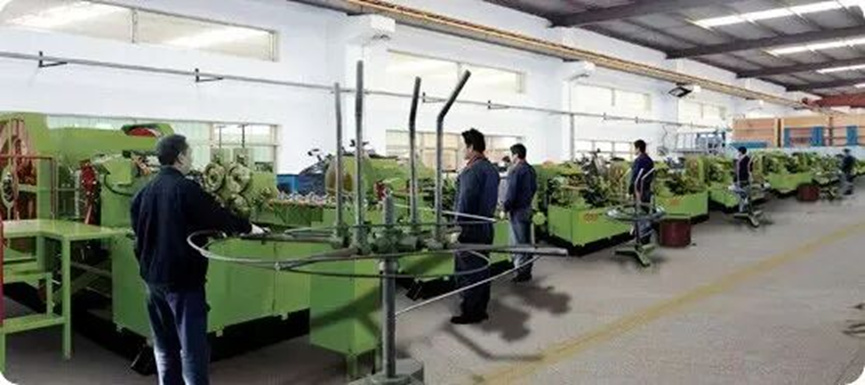
I. Performance requirements of each component of the multi-station cold heading machine
The crankshaft is connected to the engine block and the impact connecting rod by high-wear-resistant alloy copper bushings, which have a large load-bearing capacity, a long service life and low maintenance costs.
(2) The body is cast from ductile iron with added alloys, featuring high tensile strength and good wear resistance.
(3) A two-stage gear transmission system is adopted, featuring high transmission efficiency and large transmission torque.
(4) Equipped with a pneumatic clutch brake to reduce the power consumption of the motor.
(5) The cutting system uses a guide plate to drive the cutting knife rod. The guide plate moves back and forth, transmitting the cutting force in a straight line. The force is large, stable, and has good dynamic balance.
(6) The clamping system can be flipped or translated, which is conducive to the arrangement of the forming process.
It is equipped with a variable frequency speed regulation device, allowing for stepless speed regulation within a certain range.
(8) It is equipped with a fault detector and safety protection devices. When a fault occurs in the equipment, it will automatically shut down to provide maximum protection for the equipment and the molds.
(9) Install thrust devices on the feeding box to improve feeding accuracy.
The lubrication system’s oil circuit design is simple and efficient. It can effectively protect the ram and workpiece while ensuring circulation and filtration.
II. Selection of Raw Materials for Workpieces
The raw materials must undergo spheroidizing annealing treatment, and their metallographic structure should be spheroidal pearlite.
(2) To minimize the tendency of material cracking as much as possible and increase the service life of the die, it is also required that the cold-drawn material has as low a hardness as possible to enhance its plasticity.
(3) The dimensional accuracy of raw materials is generally determined based on the specific requirements of the product and the process conditions. For multi-station cold heading machines, the dimensional accuracy requirements for necking and strong necking are usually lower.
(4) The surface quality requirements for raw materials are that there should be a lubricating film with a dull dark color, and at the same time, the surface must not have any defects such as scratches, folds, cracks, roughness, rust, oxide scale, or pits and dents.
(5) The total thickness of the decarburization layer in the radial direction of the raw material shall not exceed 1% of the diameter of the raw material.
(6) To ensure the cutting quality during cold forming, it is required that the raw material has a relatively hard surface and a relatively soft core.
(7) Raw materials should undergo cold heading tests. Due to cold working hardening, the deformation resistance increases. It is required that the material’s sensitivity to cold working hardening be as low as possible.
III. Selection of Cold Heading Forming Oil
It features excellent extreme pressure lubrication performance, high-temperature resistance, extreme pressure anti-wear property, rust prevention and high-temperature oxidation stability.
It enhances the precision and smoothness of processed parts, prevents mold sintering, and meets the multi-station forming processing requirements of standard and non-standard parts. It is fully capable of cold heading stainless steel parts processing.
(2) It can minimize the oil fumes and “drifting mist” to the lowest extent, meeting the strict requirements of multi-mode press processing of nuts with strong shrinkage molds.
(3) It has excellent processing performance for products with large deformation, such as hollow, high-strength bolts, sleeves, stainless steel hollow and semi-hollow rivets, etc. in the forming process.
(4) It can effectively protect the punch (pin) and the mold, extend their service life and reduce the overall cost.
(5) It has a good heat dissipation effect, avoiding the local overheating of the workpiece and the mold during the cold forming process.
(6) It has excellent high-temperature resistance and is less likely to produce sludge. It has low odor and low smoke, protecting the operating environment.
It has certain anti-rust properties and can meet the anti-rust requirements between processing procedures.
(8) It can meet the requirements of severe cold heading forming processing of stainless steel and large deformation carbon steel forming processing.
IV. Precautions for Operating Multi-Station Cold Forging Machines
Before starting work, make sure to:
Check that the knife plate, cutting knife bar, punch, die, etc. are intact without any cracks, and are installed correctly and securely fastened.
After adjusting the cutting mechanism, it is necessary to check the gap between it and the die holder. It is strictly forbidden to start the equipment without checking.
(3) When the cutting knife bar is broken, the roller in the cam groove must be removed before the equipment can be jogged.
(4) Carefully check whether the safety protection devices of the equipment are in good condition to prevent them from loosening due to severe vibration and causing malfunctions.
(5) Check whether the oil passage of the lubrication and cooling system of the cold heading machine is unobstructed. If there are any foreign objects, they should be cleared immediately. When the cold heading forming oil is insufficient, it should be added in time.
2. At work, achieve:
When starting the equipment, the main motor can only be started to drive the flywheel to rotate after disconnecting the feeding device. Only after the flywheel has reached full speed can the feeding device be connected. When stopping the equipment, the feeding device should be disconnected first, and then the main motor should be stopped.
(2) It is not allowed to stop the slider at the “dead point”. If the slider stops at the “dead point”, it can only be corrected by manually turning the flywheel. It is not permitted to start the equipment.
(3) The processed bar stock or coil stock must be clean. The burrs at the ends of the stock should be ground off. Flat stock is not allowed.
(4) Always pay attention to the working condition of the coil material rack. If disorder is found, stop the machine immediately. When the coil material processing is nearly completed, remove the material tail from the rack.
3. After starting work, one should achieve:
Shut down each system of the multi-station cold heading machine in sequence, and then cut off the power supply.
(2) Clean the cold heading machine thoroughly and apply anti-rust oil to the workbench surface.
(3) Keep a record after each operation or maintenance.
In case of a malfunction, the multi-station cold heading must be stopped immediately to identify the cause and eliminate the potential hazard.
If you are looking for quality fasteners, please visit us here https://hktl-fastener.com/.