Key Findings
Automotive fasteners fall into two broad material families: metal and plastic. Eleven major functional‑type fasteners cover both detachable and permanent connections for engine, chassis, interior‑trim and body‑sheet‑metal assemblies. Material choice is driven by load‑level, vibration‑resistance requirements, cost and corrosion‑demands.
| Category | Main Sub‑types | Core Function & Typical Automotive Use‑case |
|---|---|---|
| Nuts | Hex, cap, cylindrical, flange, knurled | Mate with bolts; flange nuts remove need for washers; for chassis and wheel assemblies. |
| Bolts | Hex, hex‑flange, positioning bolt, stud‑bolt | Partial‑thread shank for precision; secure engine, suspension and dashboard components. |
| Screws | Countersunk, cap, pan‑head, self‑tapping, coach screw | Work without nuts; fasten interior parts, sheet metal and plastic components. |
| Studs | Double‑ended stud (wheel‑stud typical) | Often pre‑welded onto components; wheel‑studs for wheel mounting. |
| Washers | Flat / spring variants | Spread contact pressure, mitigate loosening, reduce friction at bolt‑nut joints. |
| Rivets | Solid, blind, hollow, self‑piercing rivets | Permanent non‑detachable joining; self‑piercing rivets widely used for car body sheet‑metal. |
| Blind threaded inserts | Single‑side mount | Create durable female threads on thin panels for pipe and extrusion assemblies. |
| Clips | Metal / plastic | Retain interior trims, bumpers, hoses; reusable or disposable. |
| Springs | Spring‑washers, R‑clips | Elastic pre‑load; prevent axial displacement e.g. wheel‑axle end‑fixing. |
| Pins | Split‑pin, U‑pin, key‑pin | Positioning and anti‑displacement; used for braking, wheel‑hub assemblies. |
| Special‑purpose fasteners | SMT fasteners, broaching fasteners, SI® inserts | For PCBs, plastic‑part strong threads, press‑in mounting for special substrates. |
Material selection guidance
- Metal fasteners (iron, aluminium‑alloy, copper): High strength, durable and reusable. Apply galvanizing / anodizing for corrosion‑protection. Deploy for heavy‑load engine, suspension and chassis joints.
- Plastic fasteners (vinyl‑based): Low‑cost, non‑conductive, rust‑free, but lower mechanical strength. Fit interior trims, door‑cards, plastic bumpers and replaceable cosmetic components.
Key conceptual distinctions
- Bolt: Has shank, must pair with nut / washer.
- Screw: Full‑conical thread, installs directly into tapped or pre‑drilled holes, nut‑free.
- Stud: Mostly head‑less double‑external‑thread component; frequently welded into base‑parts.
Fasteners in the Automotive Industry
Some parts manufactured in the automotive industry only function when connected with other parts during the assembly process. Therefore, the manufacturing of automotive parts relies on designs with high tolerances and incorporates connection mechanism features, among which fasteners are very common.
Fasteners are crucial in the automotive parts manufacturing industry as they facilitate the assembly and operation of automotive parts. There are different types of automotive fasteners based on materials, composition, and intended functions. This article will discuss various fasteners, their functions, and possible applications.
Automotive Fasteners Classified by Material
The most common method of classifying automotive fasteners used in automobiles is by the constituent material. Generally, they are divided into two major categories: metal and plastic. Depending on the material’s properties, each category has different attributes and functions.
- Metal Automotive Fasteners

Typically, metal automotive fasteners are made from iron, aluminum alloys, and copper. Depending on the selected material, they can exhibit varying degrees of mechanical properties, such as strength, durability, and corrosion resistance.
Metal automotive fasteners come in different forms, including bolts, nuts, springs, and screws. They are durable, reusable, and suitable for connecting and securing heavy-duty automotive, suspension, and engine components.
Metal automotive fasteners also undergo surface treatment processes to enhance their functionality and aesthetic appeal. Common examples used in automotive parts manufacturing include galvanization and anodization to improve rust resistance and durability.
- Plastic automotive fasteners
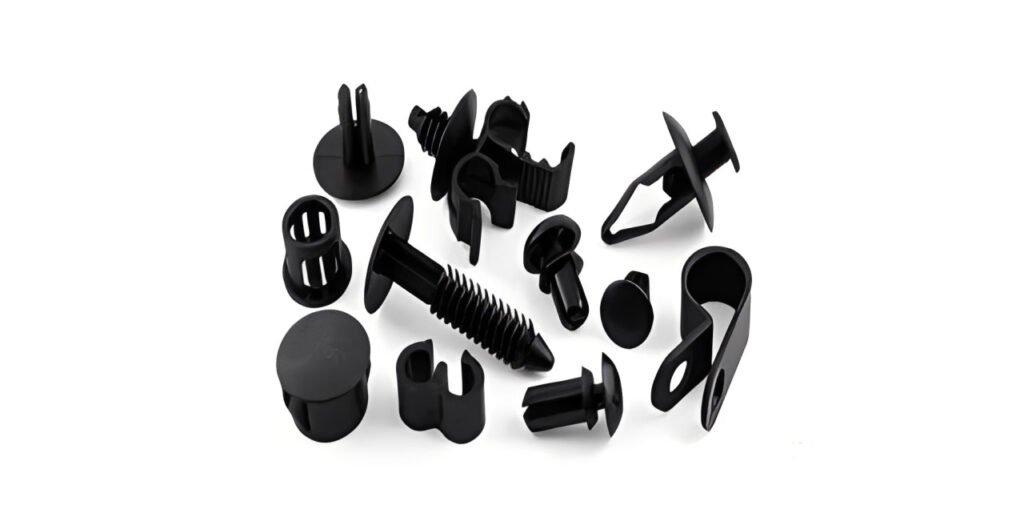
When seeking the best mechanical performance with a more refined aesthetic, plastic automotive fasteners are a better choice. They are a common option for manufacturing fasteners (including pins, washers, connectors, and gaskets) as well as other composite materials like rubber.
Plastic fasteners mainly come from vinyl, which is known for its tensile strength and brittleness. Therefore, they are suitable for manufacturing replaceable or disposable fasteners. Additionally, they are less expensive than metal fasteners and do not conduct electricity or rust.
11 Common Types of Automotive Fasteners
In addition to being classified by material, automotive fasteners can also be categorized by function. Here are the common types you need to know:
Nuts

A nut is a small metal component made of iron or aluminum alloy. It has a helical thread cut through its center using 3D printing and is installed on both sides of a bolt. Along with washers, nuts and bolts help secure automotive parts.
Although there are various types of nut fasteners, the most common is the hex nut, which is characterized by its hexagonal shape. Other types of nut fasteners used in the automotive industry include:
• A cap nut can only be accessed from one side. The other side has a smooth domed surface to prevent injury.
• A cylindrical nut is cylindrical and can be inserted into a hole perpendicular to the bolt’s axis.
• A flange nut has a hexagonal head with an increased diameter at the bottom. Therefore, they do not require washers.
• A knurled nut has a larger textured diameter, allowing you to tighten them by hand.
Bolts

A bolt is a fastener with a long partially threaded shaft and a non-conical end. The unthreaded part is called the shank, which provides accuracy and reduces wear. Additionally, depending on the surface on which the bolt is placed, the rod can extend beyond the interface of the parts.
Bolts are made of metals such as iron and aluminum alloy, and are a simple yet indispensable choice. Like nuts, the most common type is the hex bolt with a hexagonal head. It is used with nuts or washers to secure automotive parts such as engine components, dashboards, and suspension arms. Different types of automotive bolts include:
• Hex flange bolts have a washer beneath the hex head. This helps distribute force and secure parts.
• Stud bolts have a dome and an enlarged head.
• Positioning bolts have a self-locking and freely rotating hex head to prevent loosening due to vibration.
Screws

A screw is a fastener with a fully conical shaft that can hold two parts together. It can cut its own thread in a hole (self-tapping screw) or fit into a threaded hole in a part (machine screw). Unlike bolts, it does not require washers or nuts as its threads can hold and secure it in place.
Just like automotive nuts and bolts, the most common type of screw is the hex screw. It is similar to a hex bolt but without a shank. Other types of screw fasteners used in the automotive industry include:
• Countersunk screws: Machine screws with a conical head that sits flush with the surface of the part.
• Cap screws: Automotive screws with a barrel-shaped head and a socket for a driver.
• Pan head screws: Machine screws with a hemispherical head and a socket.
• Wood screws.
• Self-tapping screws.
• Coach screws: Large self-tapping screws with a hex head that provide high torque during installation.
Fasteners for automotive design
There are several types of fasteners used in automobiles. Each has a different level of performance and reliability. The following are commonly used fasteners in automotive design.
– Self-piercing fasteners

Self-piercing rivets are one-time and permanent fasteners used for joining automotive sheet metal parts. They feature serrated interlocking rings to prevent rotation and come in various styles and functions, including pins, nuts, studs, slotted and support fasteners.
– Riveting fasteners

A rivet is a fastener with its head and tail located at opposite ends. It is mainly made of steel or aluminum and is used to achieve permanent assembly of parts. There are several types of rivets, including solid rivets, blind rivets, hollow rivets and open-end rivets, which are suitable for connecting two or more automotive parts.
– Blind threaded inserts

Blind threaded inserts have blind threads and can be installed on one side of a panel. These inserts are suitable for connecting pipes, extrusions, etc.
Studs

Studs are fasteners with external threads that look like screws without heads (some have heads). They are usually permanent fasteners and are typically welded into the components you want to connect. Additionally, you can pass a stud through both ends, allowing it to pair with nuts.
A common type of double-ended stud used in automobiles is the wheel stud, which is used to secure the wheels of a car.
Washers

A washer is a thin, circular disc with a hole in the middle. When used with a nut and bolt, it helps distribute the bolt’s load/pressure and prevent the nut from loosening. It comes in various shapes and styles, and its function depends on the automotive parts you are connecting. In automotive parts assembly, washers are used in axle bearings or connection points to prevent loosening, reduce friction, prevent leakage, or distribute pressure.
Clips

Clips are important fasteners made of plastic or metal, with both automotive and non-automotive functions. They come in various designs but offer more direct solutions. In automotive parts manufacturing, they are used to position or secure different parts, including interior panels, door cards, or plastic bumpers (plastic). Clips can be either reusable or non-reusable.

Clips are common automotive fasteners, suitable for fixing components such as hoses and pipes that are connected to the engine. They are usually made of metal, although a few can be made of plastic. They have a classic design and screws that are suitable for tightening fasteners, thereby tightening the components.
Springs

Springs are elastic deformable metal fasteners, such as spring clips, pins and washers. Therefore, they generate tension between two automotive components.
Their elastic deformation performance ensures a firm connection while allowing for easy assembly and disassembly of parts. An example of the application of spring fasteners in the automotive industry is the use of R-clips to prevent wheels from coming off the axle ends.
Pins

Pins can hold automotive parts in place but allow for some movement. They can be made of plastic or metal and come in various types.
In the automotive industry, common types include split pins, which prevent shafts from moving axially and are thus used in wheels. Another example is the key pin used in off-road vehicles and the U-shaped pin used in vehicle braking systems.
Special fasteners
These types of automotive fasteners have special designs that make them suitable for certain industries, materials, and applications. They are applicable in automotive parts manufacturing when part manufacturers require a special design due to the uniqueness of the part’s shape, material composition, or application. Before using special fasteners, tests need to be conducted to ensure their good performance.
– Surface mount fasteners

These fasteners use surface mount technology to directly adhere the fasteners to the pads on the surface of the printed circuit board. Surface mount technology eliminates damage to automotive parts during installation, increases assembly speed, and reduces scrap/waste.
– Broaching fasteners

Reaming fasteners come in forms such as studs, nuts, and brackets, which are pressed and connected to non-ductile or ductile materials, with a maximum hardness of aluminum. They are easy to install and suitable for applications where surface mounting is not appropriate.
– SI® Fasteners

SI® inserts are a special type of fastener, suitable for connecting plastic components that require a strong and permanent thread. Additionally, they are applicable to units that need frequent assembly and disassembly.
FAQ
Q: What is the difference between a bolt, a screw and a stud in automotive applications?
A: A bolt has a partially threaded shaft (shank) and a non-conical end, and is used with a nut or washer to secure parts such as engine components, dashboards and suspension arms. A screw has a fully conical shaft that holds parts by cutting its own thread (self-tapping) or fitting a threaded hole — it does not require a nut or washer. A stud has external threads like a headless screw and is usually permanently welded into a component, allowing a nut to be paired on either end, such as wheel studs for securing car wheels.
Q: When should I use metal fasteners versus plastic fasteners in automotive design?
A: Metal fasteners (iron, aluminum alloy, copper) offer high strength, durability and reusability — suitable for connecting heavy-duty automotive, suspension and engine components, and can be galvanized or anodized for rust resistance. Plastic fasteners (vinyl-based) are lighter, cheaper, non-conductive and rust-free, making them ideal for replaceable or disposable parts like interior panels, door cards and plastic bumpers, though they have lower mechanical strength.
Q: What are the most common fastener types used in automotive assembly?
A: The most common types include nuts (hex, flange, cap, cylindrical, knurled), bolts (hex, hex flange, stud, positioning), screws (hex, countersunk, cap, pan head, self-tapping, coach), washers, clips, springs, pins, rivets (solid, blind, hollow, open-end), blind threaded inserts, wheel studs, and special fasteners such as self-piercing rivets, surface mount and SI® inserts for plastic components.
HKTL Fastener supplies the full range of automotive fasteners — nuts, bolts, screws, studs, washers, clips, rivets and special inserts — in metal and plastic, engineered for the strength, durability and assembly reliability of modern vehicles.
If you are looking for quality fasteners, please visit us here https://hktl-fastener.com/.