Core Findings
Fastener material selection must balance mechanical‑strength requirements, operating‑environment corrosion risk and budget. Carbon‑steel grades are defined by carbon content; alloy elements modify hardness, hardenability and corrosion performance. Among austenitic stainless steels, molybdenum‑bearing 316 out‑performs 304 under chloride‑rich coastal conditions. Note cold‑worked stainless steel may turn slightly magnetic and is prone to thread seizing under excessive torque.
| Material Family | Typical Grades | Main Advantages | Primary Application |
|---|---|---|---|
| Low‑carbon carbon steel | 1015,1022 | Low‑cost, good cold‑formability | 4.8‑grade bolts, self‑tapping screws |
| Medium‑carbon / alloy steel | 1035, SCM435 | High strength via quenching‑and‑tempering | 8.8‑12.9 high‑strength bolts |
| Austenitic stainless steel | 304(A2),316(A4) | Corrosion‑resistant; 316 resists chloride pitting | Outdoor, food‑grade, marine hardware |
| Brass copper alloy | H62, H65 | Good electrical conductivity | Electrical terminal fasteners |
Carbon content governs carbon‑steel performance: low‑carbon steel suits low‑strength cold‑formed parts, while medium‑carbon and chromium‑molybdenum alloy steel deliver 8.8‑12.9 strength grades. Alloying elements including C, Mn, Cr, Mo and B adjust hardenability, toughness and anti‑corrosion capability.
304 and 316 austenitic stainless steels are non‑magnetic in original condition yet develop weak magnetism after cold forming. Stainless‑steel fasteners roughly match carbon‑steel 6.8‑grade strength; ductile metal chips easily stick to threads and trigger galling. Apply lubrication and controlled tightening torque. For coastal or chloride‑exposed service, select 316 rather than 304 for improved pitting‑corrosion resistance.
Fastener Materials
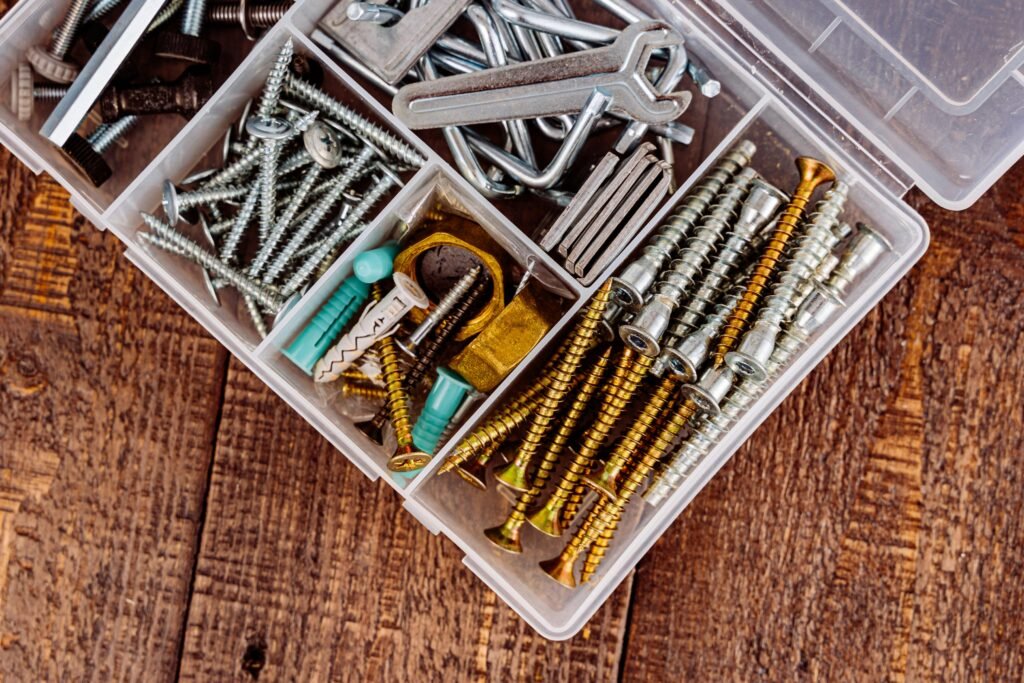
I. Currently, the main materials for standard parts in the market are carbon steel, stainless steel, and copper.
(1) Carbon steel. We distinguish low-carbon steel, medium-carbon steel, high-carbon steel, and alloy steel based on the carbon content in carbon steel materials.
1. Low-carbon steel C% ≤ 0.25% is usually called A3 steel in China and 1008, 1015, 1018, 1022, etc. abroad. It is mainly used for 4.8 grade bolts and 4 grade nuts, small screws, and other products without hardness requirements. (Note: 1022 material is mainly used for self-tapping screws.)
2. Medium-carbon steel 0.25% < C% ≤ 0.45% is usually called 35# and 45# steel in China and 1035, CH38F, 1039, 40ACR, etc. abroad. It is mainly used for 8 grade nuts, 8.8 grade bolts, and 8.8 grade hexagon socket products.
3. High-carbon steel C% > 0.45%. Currently, it is rarely used in the market.
4. Alloy steel: Alloy elements are added to carbon steel to enhance some special properties of the steel, such as 35, 40CrMo, SCM435, 10B38. Fangsheng screws mainly use SCM435 chromium-molybdenum alloy steel, with main components of C, Si, Mn, P, S, Cr, Mo.
(2) Stainless steel. Performance grades: 45, 50, 60, 70, 80
Mainly divided into austenitic (18%Cr, 8%Ni), with good heat resistance, corrosion resistance, and weldability. A1, A2, A4
Martensitic, 13%Cr, with poor corrosion resistance, high strength, and good wear resistance. C1, C2, C4 ferritic stainless steel. 18%Cr has good upsetting ductility and better corrosion resistance than martensitic. Currently, the imported materials in the market are mainly from Japan. According to the grade, they are mainly SUS302, SUS304, SUS316.
(3) Copper. Common materials are brass… zinc-copper alloys. H62, H65, H68 copper are mainly used for standard parts in the market.
II. Coil materials used for carbon steel products:
| No. | Type | Available Materials |
| 1 | Grade 4.8 Hex Bolt | 1008K, 1010, 1015K |
| 2 | Grade 6.8 Hex Bolt | 1032, 1035, 1040, CH38F, 1039 |
| 3 | Grade 8.8 Hex Bolt | 1035ACR (below M10), 1040ACR (above M12), CH38F, 1045ACR, 1039, 10B21, 10B33, 10B38 |
| 4 | Grade 8.8 Socket Head Cap Screw | CH38F, 1039, 10B21 (M10-M12), 10B33 (M14), 10B38 (M12-M24), 10B21 |
| 5 | Grade 10.9 Hex Bolt | 1045ACR, 10B38 |
| 6 | Grade 8 Nut | 1008K, 1010 |
| 7 | Grade 8 Nut | 1015 (M<16), CH38F (M≥16) |
| 8 | Grade 10 Nut | CH38F, 1039, 10B21, 10B33 |
| 9 | Grade 12 Nut | 1039, 10B21, 10B33, 10B38 |
| 10 | Carriage Bolt | 1008, 1010, 1015 |
| 11 | Hex Flange Bolt | CH38F, 1039, 10B21, 10B33, 10B38 |
| 12 | Hex Lag Screw | 1008K, 1010 |
| 13 | Self-drilling Screw, Drywall Screw, Chipboard Screw | 1018, 1022, CH22A |
| 14 | Machine Screw, Furniture Screw | 1008, 1010 |
III. The influence of various elements in the material on the properties of steel:
1. Carbon (C): Enhances the strength of steel parts, especially its heat treatment performance. However, as the carbon content increases, plasticity and toughness decrease, and it also affects the cold heading performance and welding performance of steel parts.
2. Manganese (Mn): Increases the strength of steel parts and to some extent improves hardenability. That is, it increases the strength of hardened penetration during quenching. Manganese can also improve surface quality, but too much manganese is detrimental to ductility and weldability, and it also affects the control of the coating during electroplating.
3. Nickel (Ni): Enhances the strength of steel parts, improves toughness at low temperatures, enhances resistance to atmospheric corrosion, and ensures stable heat treatment effects, reducing the effect of hydrogen embrittlement.
4. Chromium (Cr): Improves hardenability, enhances wear resistance, improves corrosion resistance, and helps maintain strength at high temperatures.
5. Molybdenum (Mo): Helps control hardenability, reduces the sensitivity of steel to temper brittleness, and has a significant impact on tensile strength at high temperatures.
6. Boron (B): Improves hardenability and helps low-carbon steel respond as expected to heat treatment.
7. Vanadium (V): Refines austenite grains and improves toughness.
8. Silicon (Si): Ensures the strength of steel parts. An appropriate content can improve the plasticity and toughness of steel parts.
IV. A brief introduction to the characteristics of stainless steel materials (304, 316)
(I) These three materials are all austenitic stainless steels of the 300 series, and their chemical compositions are as follows:
| Name | C | Si | Mn | P | S | Ni | Cr | Mo | Cu |
| 304M | ≤0.06 | ≤1.0 | ≤2.0 | ≤0.045 | ≤0.03 | 8.91-10.0 | 18.0-20.0 | 0 | 0 |
| 316 | ≤0.03-0.06 | ≤1.0 | ≤2.0 | ≤0.045 | ≤0.03 | 10.0-14.0 | 16.0-18.0 | 2.0-3.0 | 0 |
| 304HC | ≤0.08 | ≤1.0 | ≤2.0 | ≤0.045 | ≤0.03 | 8.0-10.5 | 17.0-19.0 | 0 | 1.0-3.0 |
(II) Relationship between Main Chemical Components and Stainless Steel Properties
1. Carbon (C): Increases hardness and strength. Excessive content reduces ductility and corrosion resistance.
2. Chromium (Cr): Enhances corrosion resistance and oxidation resistance, refines grain structure, and increases strength, hardness, and wear resistance.
3. Nickel (Ni): Increases high-temperature strength and corrosion resistance, and reduces the rate of cold working hardening.
4. Molybdenum (Mo): Enhances strength and has excellent resistance to oxidation and seawater corrosion.
5. Copper (Cu): Facilitates cold working and reduces magnetic properties.
(III) Other Properties of Materials
1. The materials are non-magnetic in their normal state. 304M becomes slightly magnetic after cold working (about 1.6u – 2.0u); 304HC has a magnetic property of about 1.01u – 1.6u; 316 material has a magnetic property of less than 1.01u after cold working.
2. All materials have good ductility, are easy to cold work, and their tensile strength (Ts) and yield strength (Ys) can meet the requirements (Ts min 700N/mm, Ys min 450N/mm).
(IV) Conclusion
1. 304M, 304HC, and 316 are among the most widely used materials in the 300 series austenitic stainless steel. The significant differences among them are: the magnetic property after cold working is 316 < 304HC < 304M. 316 material has better resistance to chemical corrosion, pitting corrosion, and seawater corrosion compared to 304M and 304HC.
2. In summary, the characteristics of stainless steel fasteners are corrosion resistance, aesthetics, and hygiene. However, their strength and hardness are normally equivalent to carbon steel (grade 6.8). Therefore, stainless steel products should not be impacted or struck, and their surface finish and precision should be maintained.
They should not be treated with the same force as carbon steel products, nor should excessive force be applied. Additionally, due to the good ductility of stainless steel, steel shavings produced during use can adhere to the threads of nuts, increasing friction and potentially causing lock-up. In contrast, iron shavings from carbon steel will fall off and are less likely to cause lock-up.
FAQ
Q: What is the difference between 304 and 316 stainless steel fasteners?
A: Both are austenitic stainless steels of the 300 series, but 316 adds molybdenum (2.0–3.0%) and higher nickel content, which gives it better resistance to chemical corrosion, pitting and seawater corrosion than 304. For coastal and marine environments, 316 is the preferred choice; 304 is sufficient for general outdoor and food-related applications. Note that stainless steel strength and hardness are normally equivalent to carbon steel grade 6.8, so stainless fasteners should not be treated with the same force as carbon steel parts.
Q: Are stainless steel fasteners magnetic?
A: They are non-magnetic in their normal state, but become slightly magnetic after cold working. The magnetic property after cold working ranks as: 316 (< 1.01u) < 304HC (about 1.01u – 1.6u) < 304M (about 1.6u – 2.0u). So a slightly magnetic stainless fastener is normal and does not indicate poor quality.
Q: Why do stainless steel fasteners seize or lock up during use?
A: Because stainless steel has good ductility, steel shavings produced during use can adhere to the threads of nuts, increasing friction and potentially causing lock-up. In contrast, iron shavings from carbon steel fall off and are less likely to cause lock-up. Use proper lubrication and controlled torque when assembling stainless steel fasteners.
HKTL Fastener supplies fasteners in the right material for every application — from 4.8 to 12.9 carbon steel, 304 to 316 stainless, with professional guidance on grades, corrosion resistance and performance.
If you are looking for quality fasteners, please visit us here https://hktl-fastener.com/.