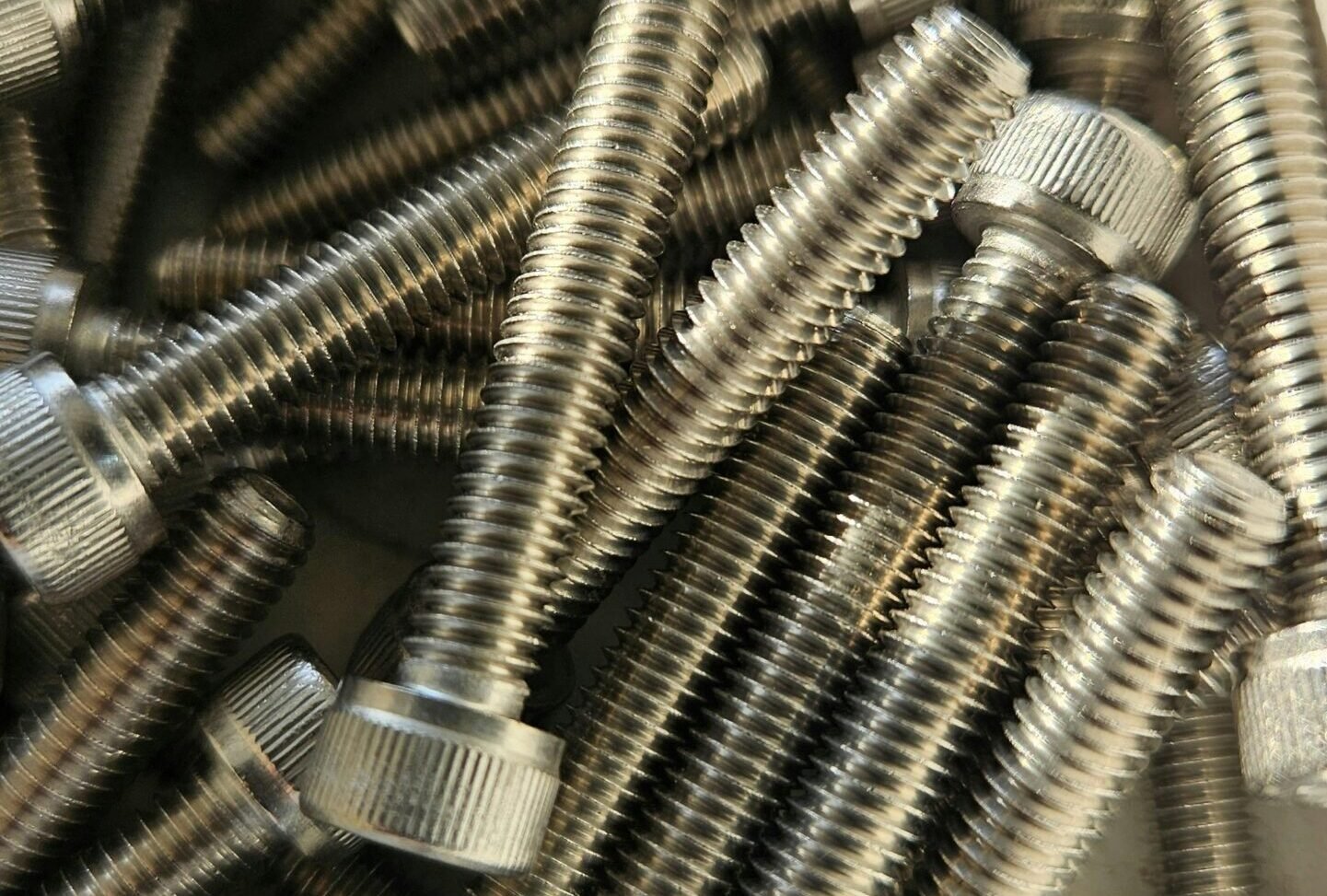
I. Cold Heading VS Hot Heading
The processing methods for screws mainly include cold heading and hot heading. Now, let’s share with you the specific technical knowledge of these two processing methods.
Cold heading: It is a process that utilizes the plasticity of metals and applies cold mechanical pressure or cold drawing to achieve solid-state deformation of metals. (Basic definition) It is a forging method that thickens the top of rods or wires at room temperature. Cold heading is mainly used to manufacture parts such as bolts, nuts, nails, rivets, and steel balls.
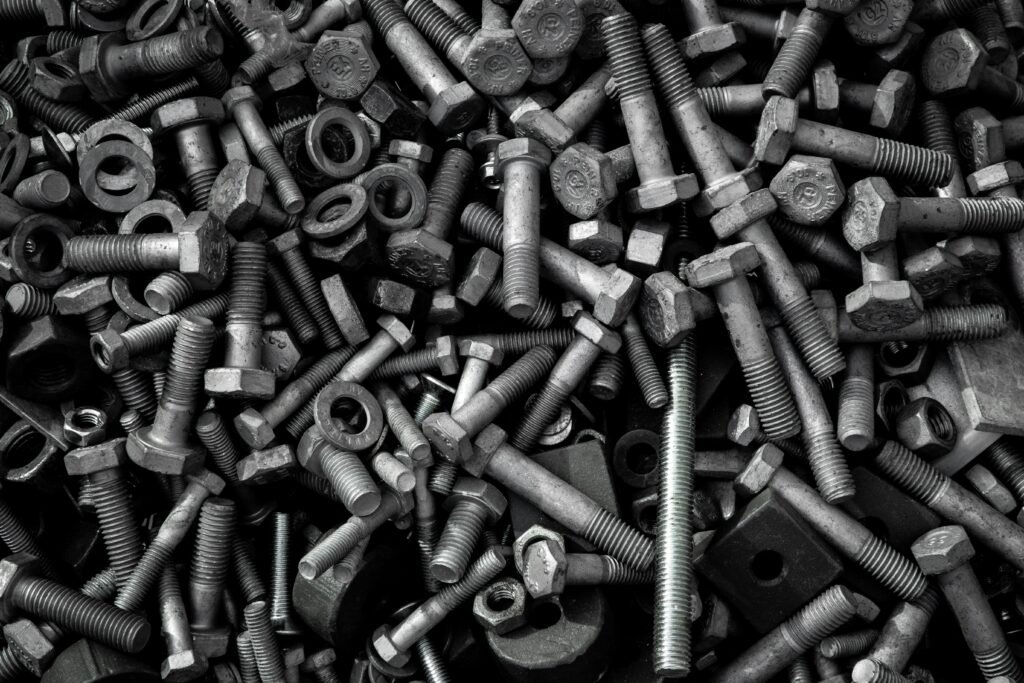
The forging materials can be copper, aluminum, carbon steel, alloy steel, stainless steel, and titanium alloys, etc., with a material utilization rate of up to 80-90%. Cold heading is mostly carried out on dedicated cold heading machines, facilitating continuous, multi-station, and automated production.
On a cold heading machine, processes such as cutting, heading, gathering, forming, chamfering, threading, reducing diameter, and trimming can be sequentially completed. The production efficiency is high, reaching over 300 pieces per minute, and the maximum diameter of cold heading workpieces can be up to 48 millimeters. The schematic diagram of the cold heading process for bolts shows the typical processes of cold heading bolts.
The multi-station automatic cold heading machine for nuts is a multi-station automatic cold heading machine. The bar stock is automatically fed to a certain length by the feeding mechanism, then cut into blanks by the cutting mechanism, and then sent to the gathering and forming and punching stations in sequence for forming.
Hot heading: Forging the head, also known as hot heading, involves heating the head to a red-hot state and then squeezing it into shape.
Cold heading refers to the process of pressing the raw material at room temperature, while hot heading refers to pressing the raw material after heating. There are no specific requirements for the specific application, but generally, cold heading is preferred because it results in a smoother surface and a more compact material structure. Additionally, larger workpieces are often processed by hot heading.
- Is the hexagonal head of a screw formed by heading?
The majority are formed by heading because it saves material. Depending on the tonnage of the heading machine and the diameter of the bolt, cold heading or hot heading processes can be adopted.
For small batches of special or dedicated bolts, the hexagonal head is often formed by turning and milling.
- How are the threads made?
For single-piece or small-batch production, methods such as threading with a die, threading on a lathe, and threading with a rotary milling machine can be used.
In large-scale production, threading machines and rolling machines are commonly used, which are highly efficient. Since the forming methods of the bolt shank include cold drawing and reducing diameter, the diameter of the non-threaded part of such bolts is not necessarily slightly smaller (as mentioned above, this is incorrect).
When cold drawing is used, it is slightly smaller; when reducing diameter is used, it can be the same as the threaded diameter or slightly larger.
- Is the entire bolt made by die casting?
If the material of the bolt is low-melting-point alloys or metals such as aluminum alloy, zinc alloy, or copper alloy, die casting can be used for forming. Steel bolts are not made by die casting. The formation of the hexagonal head of a bolt cannot be generalized; it can be formed by cold heading, hot heading, directly produced after heading, or formed after heading through machining, or entirely machined.
The heads of bolts formed by heading have processing marks, and there are marks of the clamping device at the root.
The threads of bolts can be mechanically threaded, similar to manual threading with a die. They can also be machined on a lathe, which is necessary for larger diameter bolts. There is also “threading” where a “threading machine” uses a “threading die” to extrude the threads. The diameter of the non-threaded part of such bolts is slightly smaller.
There are smooth bolts (cold heading) and rough bolts (hot heading).
Cold heading mainly involves heading and threading the drawn wire directly. As the name suggests, cold heading is performed at room temperature.
Hot heading, also known as red heading, is used for larger bolts. The material is heated before heading.
The surface of cold-headed bolts is generally more beautiful, while the surface of hot-headed bolts has oxide scale and is not as good-looking.
The inspection of bolts mainly checks their external dimensions, thread accuracy, and whether there are cracks. These inspections require the use of flaw detectors and microscopes.
The production of common screws involves two main processes: the first is the heading process, where the head of the screw is formed on the wire and the wire is cut. The second is the threading process, which involves forming the thread section based on the previous process using two threading dies.
The equipment used is consistent with the process names: heading machines and threading machines. Currently, most domestic companies use machines from Taiwan.
In terms of technology, the selection of the heading die must comply with the usage standards, such as T10, etc. When cutting, the length of the thread section must be considered. The threading dies used in the threading process must take into account the pitch of the thread, and the outer diameter of the thread is adjusted by the distance between the two threading dies. These basically cover the geometric dimension requirements of the screw.
I forgot to mention that most screws undergo surface treatment and heat treatment after production. Finally, a full inspection machine is used to inspect the outer diameter of the screw head.
By the way, the heading process I mentioned here is the same as the “dishing” process you supplemented. Due to different requirements, the various post-treatment processes for screws also vary.
Take a small screw as an example. The basic specifications of the product are: T10, M3. The process flow is: heading – threading – heat treatment – electroplating. The heading process is to form the head, which is the small cross or slotted shape used when tightening the screw.
The threading process forms the thread section. Heat treatment is to increase the hardness of the product and remove stress. Electroplating is to prevent the product from rusting.
As for other processes, such as tail milling: this process is usually required for smaller or higher-precision screws because in the threading process, the thread is formed by the principle of plastic deformation of the metal material through extrusion.
At this time, the last circle of the thread may have burrs or other deformations that affect the flatness of the screw interface due to the lack of subsequent support. Therefore, this process is added to make the product interface flat.
Regarding surface treatment, in addition to electroplating, there are also oxidation, blackening, etc. The purpose is to prevent the product from rusting. Generally, the choice of this process is determined through salt spray tests. The best option is the one that can pass the test under the specified experimental environment and requirements and has the lowest cost.
II. Complete Process Of A Bolt
Bar stock – annealing – pickling – drawing – heading – threading – heat treatment – electroplating – packaging
Bar stock: refers to the wire you purchase.
Annealing: increases the hardness of the wire itself. (This process is also quite important. Currently, high-temperature spheroidizing annealing furnaces are used.)
Pickling: removes rust, impurities, and other substances from the surface of the wire.
Drawing: reduces the wire to the diameter required for bolt production.
Heading: cold forging to form the head of the bolt. (For bolts larger than M20, red heading is required, which involves heating before heading. However, the surface of such bolts is not very nice because of the oxide scale.)
Threading: determines the pitch and thread profile required.
Heat treatment: This process is quite important as it determines the performance grade of the bolt.
Electroplating: treats the surface to the desired color.
Cold drawn wire (screw wire, nail wire, steel ball wire)
Material: 200CU, 201CU, 204CU, D667, D668, 304ES, 304HC, 304HCM, 305J1, 302HQ, 316C, 410, 420, 430
Application: Stainless steel cold drawn wire is mainly used in the manufacturing of various fasteners and basic parts. For example, it can be used for cold heading various precision screws, bolts or other non-standard parts, and can also be used to make row nails, coil nails, mechanical parts and electronic application parts, etc.
If you are looking for quality screws, please visit us here https://hktl-fastener.com/screws/.