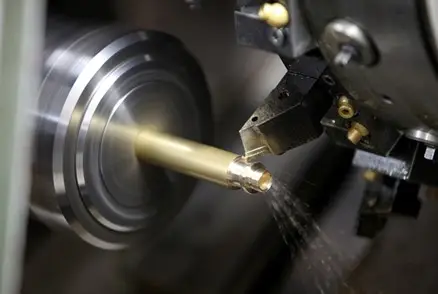
Machining refers to the process of changing the shape, size or performance of a workpiece through a mechanical device.
Various mechanical processing techniques
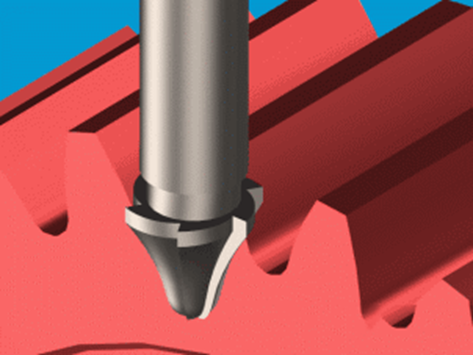
▲ Finger-shaped milling cutters for gear cutting
Milling is a highly efficient machining method that uses a rotating multi-edge cutting tool to cut the workpiece. During operation, the cutting tool rotates (as the main motion), and the workpiece moves (as the feed motion). Alternatively, the workpiece can be fixed, but in this case, the rotating cutting tool must also move (simultaneously performing both the main motion and the feed motion).

▲ Gear cutting with face milling cutters
The milling method can be used to process spur gears, helical gears, herringbone gears, cylindrical gears, as well as racks and sector gears, etc. The productivity of gear milling is low and the processing accuracy is relatively low, usually at grade 9.

▲ Milling
Milling is a process where the raw material is fixed and a high-speed rotating milling cutter is used to cut the required shape and features on the raw material. Traditional milling is mostly used for milling simple shapes and features such as contours and slots. CNC milling machines can be used to process complex shapes and features.

▲ Spherical surface turning
In this process, the workpiece rotates while the turning tool moves in a straight line or along a curve in a plane. Turning is usually performed on a lathe and is used to machine the inner and outer cylindrical surfaces, end faces, conical surfaces, formed surfaces, and threads of the workpiece.
Turning operations are generally divided into rough turning and finish turning (including semi-finish turning). In rough turning, a large cutting depth and feed rate are used to increase the turning efficiency without reducing the cutting speed, but the machining accuracy can only reach IT11. In semi-finish turning and finish turning, high speeds and smaller feed rates and cutting depths are adopted, and the machining accuracy can reach IT10 to IT7.

▲ Turning
Turning is the most fundamental and common cutting process and holds a very important position in production. Turning is suitable for processing rotary surfaces. Most workpieces with rotary surfaces can be processed by turning methods, such as inner and outer cylindrical surfaces, inner and outer conical surfaces, end faces, grooves, threads, and rotary formed surfaces, etc. The main cutting tools used are turning tools.

▲ Stamping
Stamping is a forming process in which a press and dies are used to apply external forces to sheet metal, strip, tube, and profile materials, causing them to undergo plastic deformation or separation, thereby obtaining workpieces (stamped parts) of the desired shape and size.
Stamping can produce parts with reinforcing ribs, flanges, undulations or flanges that are difficult to manufacture by other methods, thereby enhancing their rigidity. Due to the use of precision molds, the accuracy of the parts can reach the micron level, with high repeatability and consistent specifications.

Stamping forming process holds an important position in the manufacturing process of automotive body, especially for the large-sized covering parts of the automotive body. Most of them have complex shapes, large structural dimensions, some are even spatial curved surfaces, and the surface quality requirements are high.

▲ Steel rolling process
Rolling is a pressure processing method in which metal billets pass through the gap between a pair of rotating rolls (of various shapes), and the cross-section of the material is reduced and its length is increased due to the compression by the rolls. This is the most commonly used production method for steel, mainly used to produce sections, plates and pipes.
If you are looking for a reliable CNC processing solution, please visit us here https://hktl-fastener.com/cnc-machining-parts/.