Main Takeaways
Automotive bolt performance directly bears vehicle safety. Select bolts strictly by strength grade, thread specification and working‑environment corrosion requirement. Never reuse yielded critical fasteners. Assembly must adopt calibrated torque wrenches, follow cross‑pattern multi‑stage tightening, and distinguish dry vs lubricated‑thread torque values to avoid bolt fracture, thread stripping or joint loosening caused by incorrect preload.
| Process Stage | Key Requirements | Common Risks |
|---|---|---|
| Bolt Selection | Match strength grade (8.8 /10.9 for most auto parts); verify thread pitch, length and surface treatment | Mismatched strength; insufficient thread‑engagement; improper anti‑rust finish |
| Pre‑assembly Inspection | Clean threads & mounting seats; discard stretched / corroded bolts; hand‑thread all nuts first | Cross‑threading; residual grit distorting real torque reading |
| Tightening Operation | Calibrated torque wrench; cross‑star sequence; follow OEM dry/lubricated torque specs | Over‑torque yielding; under‑torque loosening; uneven clamping deformation |
| Post‑installation | Re‑check torque after initial vehicle run‑in; use thread‑locker for high‑vibration positions | Loosening under road vibration |
For automotive assemblies, 8.8‑grade bolts apply for general brackets, while 10.9‑grade alloy‑steel bolts are mandatory for high‑load positions such as chassis, wheel hubs and engine connections. Surface finishes include electro‑galvanizing and Dacromet for anti‑corrosion against road‑salt.
Hand‑start every nut to eliminate cross‑threading. Multi‑bolt joints require incremental cross‑pattern tightening rather than sequential circumferential tightening. Lubricant changes friction coefficient; torque figures must be adjusted accordingly. Discard fasteners once they sustain plastic deformation. Periodic re‑inspection is required for vibration‑exposed joints to sustain long‑term vehicle safety.
The quality of bolt assembly and the effectiveness of tightened connections have a significant impact on the safety and reliability of the entire vehicle.
This article briefly analyzes the selection of bolts and tightening processes during vehicle assembly in response to abnormal situations in automotive bolt assembly and rectification.
How to select and tighten bolts
01 Mechanical Analysis of Bolt Tightening
During the process of tightening a bolt, the bolt is stretched and deformed under tensile force, and it and the connected parts are squeezed against each other under the action of the threaded fastener. The forces they receive are equal in magnitude but opposite in direction.
At this point, the force exerted by the bolt on the connected parts is called the axial preload of the bolt. During the process of tightening the bolt, the change in force can be divided into several stages. Firstly, when the head of the bolt has not yet come into contact with the fastened part, the compressive force is 0 and the torque is very small.
When the head of the bolt is in contact with the fastened part and continues to be tightened, the clamping force and torque gradually increase. If it continues to be tightened, the clamping force and torque will not increase further, but the bolt will reach its yield point.
If it is tightened beyond the yield point, the clamping force and torque will decrease, and the bolt may deform or break. Figure 1 shows a schematic diagram of bolt connection, and Figure 2 shows a schematic diagram of bolt force.
02 On the Selection of Bolts
2.1 Principles for Selecting Bolts
(1) Priority Principle
The priority levels for bolt selection are divided into four grades. Under the condition of meeting the design requirements, standard parts currently in production and use should be given priority. See Table 1.
(2) Generalization Principle
During the early design stage, the development and use of new types of bolts should be minimized. When developing new bolts, those not recommended in the standards and those that are not commonly used should not be selected.
Especially in the chassis assembly section, such as the rear axle sub-assembly, front component sub-assembly, and brake hard pipe layout, the variety and specifications of bolts should be reduced and compressed as much as possible to improve the assembly efficiency of the operators and reduce the error rate of the operation.
(3) Reliability Principle
For the selected bolts, it is ensured that no abnormal conditions will occur under normal operating conditions, especially in critical parts such as the braking system, suspension system, and steering system. The causes of bolt connection failure are roughly as follows. Figure 3 shows a schematic diagram of bolt failure situations.
1) Looseness. ① Looseness and torque attenuation failure occur when the bolt/nut does not reverse (the assembly paint mark remains unchanged). ② Looseness and loosening failure occur when the bolt/nut reverses (the assembly paint mark is misaligned).
2) Hydrogen embrittlement: During the production process of fasteners, H atoms are absorbed on the surface. When the fastener is tightened, hydrogen migrates towards the stress concentration area, causing the pressure to increase beyond the strength of the base metal and resulting in tiny surface cracks. Hydrogen is particularly active and quickly penetrates into the newly formed cracks until the fastener breaks.
3) Fatigue.
4) Excessive torque.
(4) Applicability and economy principle.
Make full use of the performance of standard parts. Under the premise of meeting the design function and product quality, rationally select the size, performance and other indicators of standard parts.
2.2 Selection of Bolt Head Structure
The following is the selection of bolt heads:
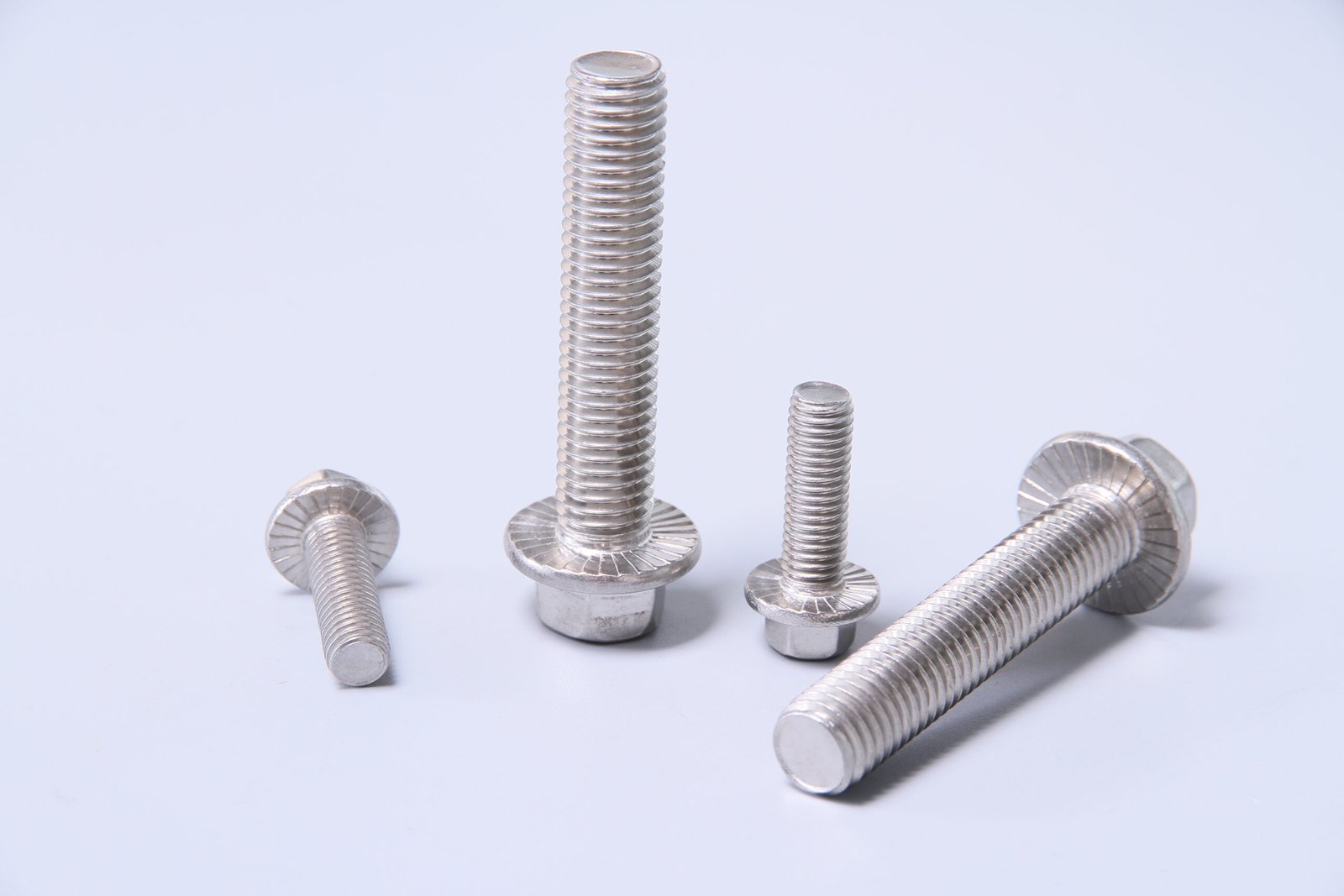
(1) For M10 and above bolts: Hexagonal flange head + flat washer > Hexagonal flange head > Hexagonal head + flat washer. Spring washers are not used.
(2) For M6 – M8 bolts: Hexagonal head + flat washer + spring washer ≥ Hexagonal flange head > Hexagonal head + flat washer.
2.3 Selection of Bolt Pitch
Fine-threaded bolts have a stronger anti-loosening effect than coarse-threaded bolts.
2.4 Selection of Bolt Materials
In combination with the used fasteners and their materials, Table 2 is the selection table for bolt materials.
During actual use, attention should be paid to the material of the components. Under the condition of meeting the working requirements, the material properties of the fasteners, such as surface hardness and strength, should not exceed those of the components.
2.5 Selection of Bolt Strength Grades
Considering the repeated disassembly and assembly of bolts during vehicle assembly and subsequent maintenance, as well as various installation torque methods, the rational selection of bolt strength is of critical importance, directly influencing the surface condition and thread accuracy of the bolt after assembly. Table 3 presents the selection table for bolt strength.
2.6 Selection of Surface Treatment Methods for Bolts
(1) Oil coating for rust prevention: for welding nuts and bolts.
(2) Electroplating: suitable for welding studs, bolts with performance grades no greater than 8.8, and grade 8 nuts, cover nuts, and wheel nuts.
(3) Dacromet: suitable for bolts with performance grades greater than 8.8 and grade 8 nuts, as well as appearance parts. Among them, zinc-aluminum-chromium coating is used for non-passenger vehicles, while zinc-aluminum coating is used for environmentally friendly and passenger vehicles.
03 On Anti-loosening Methods for Threaded Connections
The fundamental method to prevent loosening of threaded connections is to prevent the relative rotation of the threaded pair. According to its principle, it can be divided into frictional anti-loosening, mechanical anti-loosening, riveting and punching anti-loosening, etc.
(1) Riveting and punching anti-loosening: riveting with rivets, spot welding, etc.
(2) Frictional anti-loosening: including double nuts, spring washers, lock nuts, toothed lock washers, etc.
(3) Mechanical anti-loosening: including cotter pins and slotted nuts, stop washers, series steel wires, etc.
(4) Anti-loosening with thread adhesive: applying epoxy resin, anaerobic adhesive and other adhesives on the threaded surface, mainly to increase the loosening torque.
(5) Anti-drop screws: generally used in door locks.
04 On Bolt Tightening Process
4.1 Torque Control Method (T)
The torque control method is the most initial and simplest control method. It is based on the proportional relationship between the axial clamping force F during the tightening of a threaded connection and the tightening torque T, which can be expressed by the formula T = K·F, where K is the torque coefficient.
The advantage of the torque control method is that it is low-cost and the tightening quality can be checked with a simple tightening tool, the torque wrench.
Its drawback is that the tightening accuracy is not high enough, which cannot fully exploit the material’s potential, and it is greatly affected by the environment (such as temperature, bolt threads, impurities, and knocks).
4.2 Torque-Angle Control Method (TA)
The torque-angle control method involves first tightening the bolt to a relatively small torque, typically 40% to 60% of the final tightening torque. From this point, the bolt is tightened through a specified angle. This method is based on the principle that a certain angle of rotation will cause a specific axial elongation of the bolt and compression of the connected parts.
The purpose of doing this is to screw the bolt onto the tight contact surface and overcome some uneven factors such as surface concavity and convexity, while the axial clamping force required later is generated by the rotation angle.
Its advantages are high control accuracy and the ability to obtain a large axial clamping force. The disadvantages are that its control system is relatively complex, requiring the measurement of two data points: preload torque and rotation angle. The quality department finds it difficult to identify an appropriate method to inspect and follow up on the tightening results.
4.3 Yield Point Control Method: Tighten the bolt to the yield point.
4.4 Quality Assurance Method, Torque Slope Method, Elongation Method.
At present, only a few manufacturers of high-end brand car engines are using these four types of methods, as the required equipment costs are too high. Therefore, we will not discuss them in detail here.
05 Dynamic/Static Torque of Bolts
5.1 Dynamic Torque
Both wrenches and power tools can apply dynamic torque, which is measured during the fastening process. The axial preload force generated by dynamic torque meets the engineering requirements for preload force.
The measurement methods are as follows:
(1) Measurement is conducted by adding a sensor between the fastening tool and the fastened component.
(2) Measurement is carried out using the torque sensor built into the fastening tool itself.
Figures 4 and 5 show two devices for detecting dynamic torque.
5.2 Static Torque
The torque required at the moment when a fastener is further rotated in the tightening direction after it has been tightened. Static torque is measured after the fastener has been tightened. Static torque standards are used to monitor the stability of the production process.
The measurement method is as follows:
Use a torque wrench (including types such as dial-type and digital display-type, with SGM mostly adopting the dial-type), and within 5 minutes after tightening, the value obtained by turning the fastener in the tightening direction by an angle of less than 5°. Figure 6 shows the static torque detection tool.
06 Tool Selection for Bolt Assembly
6.1 Determine the general direction of tool selection based on the annual production capacity of the new product in the product planning stage and the complexity of the product’s assembly itself.
Based on the planning and design scheme, combined with the actual process layout and the number of workstations, calculate the production cycle time of the entire vehicle. Then, according to the process characteristics of the product itself and the difficulty of assembly, determine the general direction and category of the tools to be selected and matched for the new project through discussion, so as to determine whether power tools or manual tools are dominant.
This will provide a clear guidance direction for the subsequent on-site substantive selection and matching. Of course, the prerequisite for determining such a tool selection guidance direction is that it must meet the actual needs of the production process.
6.2 Determine the investment in tool selection in consideration of the overall investment planning requirements of the project
The selection and matching of assembly tools is an integral part of the entire new project. When selecting and matching, the overall investment of the entire project should be taken into account. If there are restrictions and requirements on the overall investment of the project, the selection and matching of assembly tools for the entire project need to be considered.
If the investment in tool selection and matching is too large, it will inevitably affect the overall requirements of the new project. Therefore, when selecting and matching tools for the new project, on the basis of meeting production conditions, product quality requirements, process requirements, etc., the investment cost of the project should be reduced as much as possible to achieve the goal of small input and big output.
07 Conclusion
The selection of bolts and the tightening process should be carried out simultaneously with the early design stage of the product. This ensures that no abnormal situations such as assembly interference occur during the trial production and small-batch production stages of the product later on.
It can effectively promote the stable operation of the production line, greatly improve economic benefits, and achieve the goals of enhancing product quality, reducing development costs, and shortening the development cycle.
If you are looking for suitable bolts and nuts, please visit us here https://hktl-fastener.com/bolts-and-nuts/.