Principal Findings
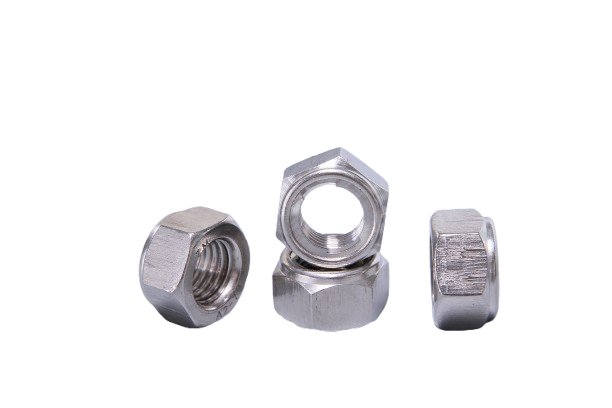
Self‑locking nuts widely used in aviation achieve anti‑loosening by radial‑deformation‑generated friction, yet prevailing‑torque decays after repeated assembly. Three major anti‑loosening categories include thread‑deformation locking, mechanical auxiliary locking and frictional locking. Torque attenuation is governed by material‑heat‑treatment, locking‑structure geometry and dimensional parameters. Three‑point crimp structures deliver more uniform stress compared with elliptical flattened designs.
| Lock‑nut Type | Lock‑in Principle | Main Limitation | Typical Application |
|---|---|---|---|
| Nylon‑insert nut | Elastic deformation of non‑metallic insert | Torque drops sharply above 100 °C | Moderate‑temperature aviation assemblies |
| Elliptical‑flattened all‑metal nut | Two‑point radial crimp interference | Uneven force, fast torque decay | General domestic aviation parts |
| Slotted radially‑contracted nut | Multi‑point contact by multiple slots | Complex manufacturing process | High‑reliability engine connections |
| Three‑point crimp nut | Even three‑point interference contact | Optimized novel structure | Improved‑performance plate‑nut assemblies |
Three general anti‑loosening technical routes are thread‑destroying/deformation locking, mechanical‑element locking (cotter pins, lock washers), and friction‑based locking represented by self‑locking nuts. After about 15 re‑assembly cycles, self‑locking nuts approach the lower torque limit.
Nylon‑insert nuts perform well at low temperature but degrade under heat. Among all‑metal nuts, slotted‑contracted and three‑point‑crimp designs outperform elliptical‑flattened types for stress distribution. Lock‑zone axial length, wall‑thickness and crimp‑deformation amount strongly affect service life; excessive crimp deformation accelerates torque attenuation instead of improving performance. Optimized 12‑corner plate nuts adopting three‑point crimp improve contact uniformity and locking stability for compact aerospace components.
At present, in the manufacturing, production and maintenance of aircraft engines, the safety of threaded connections has received great attention. Especially for self-locking nuts, due to their excellent anti-vibration and anti-loosening properties and reusability, they have become widely used threaded connection components in the aviation industry.
Self-locking Nuts
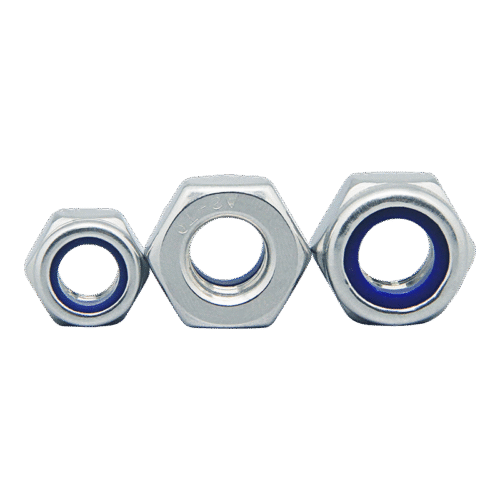
Self-locking nuts prevent loosening of the thread pair by generating friction through plastic deformation. However, the self-locking torque between the thread pairs gradually decreases with repeated use, especially when there are impacts or significant load changes in the engine.
1. Service Life of Self-locking Nuts
From the principle of self-locking nuts, to ensure the function of threaded connections and the ability to be loosened, it is required that there be a certain gap between the threaded mating surfaces. According to the research on the loosening mode of structures, mainly under dynamic loads, there is relative vibration between the threads, which reduces the friction coefficient of the threaded pair, causing the nut to rotate or even loosen.
In aviation components, threaded connections are important elements, and the design of anti-loosening for threads is of great significance to the product.
The common anti-loosening methods include three types:
- The first type of anti-loosening mode that disrupts the motion relationship of the screw pair mainly utilizes welding or filling to cause local deformation of the threads on the nut and bolt, thereby achieving the effect of anti-loosening for the threads.
- Second, mechanical relaxation refers to the use of additional locking elements after tightening the nut to prevent relative rotation between the nut and the bolt. Commonly used ones include split pins and lock washers, which can increase the weight of the threaded pair and the difficulty of disassembly.
- Thirdly, frictional force anti-loosening mainly achieves the anti-loosening effect of the nut by increasing the friction force of the contact surface. For self-locking nuts, the anti-loosening effect can be achieved by realizing radial deformation in the locking area of the nut.
When the bolt is screwed into the self-locking nut’s mouth-deformation position, the mouth-deformation position of the nut will exert a radial squeezing force on the bolt, thereby generating static friction force on the thread and providing the thread surface with anti-loosening torque.
The production of anti-loosening nuts does not require the assistance of other auxiliary locking components. It is also an important anti-loosening measure for components in the aviation field at present. However, with the use of self-locking nuts, their self-locking torque will gradually decrease.
Based on existing research, after 15 repeated experiments, the self-locking nut will approach the limit value of the self-locking torque. During use, due to issues such as the locking area of the thread pair, equipment status, and processing quality, the products produced cannot reach the expected service life. Therefore, effective measures need to be taken to reduce the torque decay of the self-locking nut during use and extend its service cycle.
2. Analysis of Factors Affecting Torque Decay of Self-locking Nuts
2.1 Material Selection and Heat Treatment Methods
For fasteners in the aviation field, considering the design conditions of the engine assembly position, various materials such as stainless steel, structural steel, or titanium alloys can be selected for fastener materials. The selection trend is gradually towards high strength and high temperature resistance.
In the design of self-locking nuts for engines, some high-temperature alloy materials are widely used. Reasonable material selection is the key to ensuring product quality. The service life of self-locking nuts and existing experimental research have proved that both the material of the nut and the heat treatment method will affect the torque decay of the self-locking nut. At the same time, attention should also be paid to the material, hardness, and coating compatibility of the thread.
2.2 Locking Structure
The selection of appropriate materials and the control of heat treatment methods have a significant impact on improving the locking system of nuts. However, since self-locking nuts mainly rely on friction to prevent loosening, the form and size of the anti-loosening structure, as well as the movement of the threaded connection during loading, have a relatively obvious influence on the loosening of the threads.
Therefore, the service life of self-locking nuts is affected by the characteristics of the nut’s locking structure and the deformation in the locking area.
First, typical locking structures: currently, the commonly used self-locking nut locking structures in the aviation field are the elliptical flattened structure, the non-metallic insert structure, and the slotted and crimped structure.
The non-metallic insert structure utilizes the elastic properties of non-metallic materials to achieve a film anti-loosening effect, while the others rely on the self-locking effect of the crimping deformation in the locking area to prevent loosening.
The actual application results of self-locking nuts in engines show that the usage effects and the stability of repeated use of self-locking nuts in different locking areas of structures vary significantly.
By using finite element software to simulate and analyze different locking structures of the thread pair, it is found that the force and deformation of the mating part in the thread pair will affect the contact area and force uniformity of the locking area, and have a direct connection with the stability of the locking performance.
3. Experimental Analysis
3.1 Materials of Self-locking Nuts
To further analyze the influence of structural deformation in the locking area on the decay of locking torque, in this study, torque performance analysis was conducted in groups of 10 products. Torque experiments were carried out on non-metallic insert nuts and self-locking nuts with elliptical, slotted, and three-point crimping under indoor conditions, as shown in the following experimental results.
Through research, it was found that the insert self-locking nut relies on the elastic performance of non-metallic materials, and the external thread profile has a relatively large inclusion area throughout the process. Theoretically, the degree of self-locking torque attenuation is relatively small. However, in actual use, the self-locking performance of the nylon insert self-locking nut was better in the first and second experiments.
Due to the significant influence of temperature, the torque will rapidly decline after assembly heating. The usage temperature should be below 100℃. Therefore, the performance of this type of self-locking nut is greatly affected by the temperature of the non-metallic material.
For metal self-locking nuts, the main reliance is on the deformation of the locking area’s mouth.
The interference generated by the extrusion contact of the threaded pair is relatively small compared to non-metallic self-locking nuts. The service life of this material is less affected by temperature, while the deformation of the locking area and the control of the deformation amount have a relatively significant impact.
There are two deformation methods for self-locking nuts: slotted and elliptical flattened. The latter is simpler in process and is also a common form of self-locking nuts in China. Since this deformation method only relies on two-point contact for force application, its deformation amount has a relatively significant impact on the attenuation of the self-locking torque.
- The slotted and radially contracted end mainly refers to the uniform slots of 6 to 8 being made at the tail end of the nut, followed by radial contraction deformation, enabling it to achieve multi-point interference contact with the external thread. Through research and analysis, this deformation method is more evenly stressed compared to the elliptical compression deformation method, and the locking torque is relatively stable. For standard inquiries, visit Chinese Screw Network.
- The design method of the new self-locking nut without slotting and with three-point sealing is a novel approach that can overcome the technological drawbacks of traditional slotted nuts and ensure uniform force distribution throughout. Existing research indicates that the three-point deformation method is of great significance for extending the service life of nuts.
3.2 Locking Structure Dimensions
For the typical structure nut, the self-locking area can be realized as a thin-walled cylindrical shape. Therefore, its dimensions include the axial length of the locking area, the outer diameter, and the deformation of the locking area.
- Through research, it was found that under certain deformation conditions, appropriately increasing the axial length of the locking area can increase the contact area of the thread pair. After multiple bolt insertions, the slope of the torque decay when removing the bolt decreases, which can extend the service life of self-locking nuts. However, this method will also increase the weight of the thread pair to a certain extent, which is inconsistent with the concept of actual product quality control.
- Secondly, under the same variable conditions, the outer radius of the locking area can be appropriately changed, but the overall attenuation slope remains basically the same. It is necessary to ensure that the initial tightening torque does not exceed the rated range and appropriately increase the wall thickness of the necking area to improve the service life of the nut.
- The deformation of the locking area can reflect the size of the radial interference in the thread pair to a certain extent and is also an important factor affecting the locking performance of the entire nut. To obtain the minimum locking torque for self-locking nuts, they need to have sufficient interference. When the interference is small and the locking torque test is unqualified, the deformation of the necking area can be appropriately increased to improve the product qualification rate.
- Through research, it has been found that the deformation of the closed mouth and the increase in the locking torque do not simply present a linear relationship. Especially for the elliptical flattened closed-mouth nuts, if the deformation is large, it will increase the torque attenuation slope and reduce the service life of the nut.
- From the perspective of structural optimization, although self-locking nuts have different connection structures and methods and can be designed in various forms, for aviation engines, the requirement is for compact components. The conventional nut structure is a twelve-sided plate screw structure, and the self-locking tapering area can achieve the function of a self-locking nut.
To ensure the normal operation of the plate nut structure, it is required that the locking area has a large containment area and the axial dimension of the nut is relatively long. The existing process can use a simple elliptical mouth reduction to achieve the self-locking effect.
After the optimized design, the original independent deformation elliptical section for the locking is cancelled, and the twelve-corner plate nut area at the axial position is appropriately extended.
In this area, the tight plate nut area of the nut can adopt a three-mouth reduction method to form a self-locking area.This structural design can appropriately enhance the assembly stability of the plate screw structure and also increase the stability of the self-locking area.
After optimization, the nut’s mouth-reduction area is a 12-corner assembly surface, which can ensure its self-locking performance without affecting the use of the plate screw structure. The mouth-reduction position adopts a three-point method, and its deformation is relatively smaller than that of the elliptical mouth-reduction.
The contact area with the bolt increases, and the self-locking area’s included area increases. Due to the uniform force distribution in the mouth-reduction area, the stability of the self-locking performance will be improved to a certain extent.
4. Summary
In conclusion, at present, self-locking nuts, as an important anti-loosening product, their self-locking performance stability will affect the connection performance of the product. In this study, by analyzing the service cycle of self-locking nuts, it is expounded that the goal of optimizing and improving the service cycle of self-locking nuts is targeted.
After experimental optimization, the locking performance of self-locking nuts has been significantly improved, further demonstrating that this method is of great significance for enhancing the maintainability and reliability of fasteners.
If you are looking for quality nuts, please visit us here https://hktl-fastener.com/bolts-and-nuts/.