As one of the indispensable parts in our daily life, how are screws made? Let’s learn about it together below.
An introduction to the manufacturing process of screws.
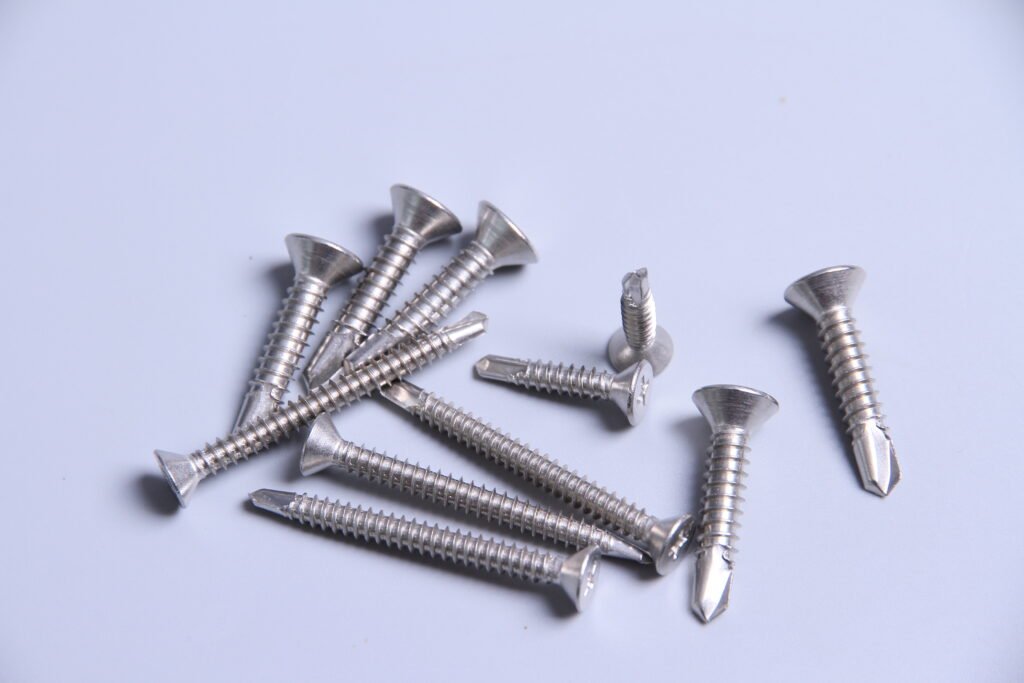
I. Terminology Related to Screws
1. The differences between screws, nuts, bolts, and studs: The standard term does not include “screws” and “nuts”. “Screw” is a colloquial term, and any part with an external thread can be called a “screw”.
2. Nuts are usually hexagonal in shape, with an internal thread, used in conjunction with bolts to fasten related components. “Nut” is a colloquial term; the standard term should be “nut”.
3. The head of a bolt is generally hexagonal, and the shank has an external thread. Screws are smaller, with heads that can be flat or cross-shaped, and the shank has an external thread.
4. Studs should actually be called “double-ended studs”, with external threads at both ends and a smooth shank in the middle. The longer end with the thread is used to connect to a deep hole, and the shorter end is connected to a nut.
5. Common names: Screw / Bolt / Fastener (Screw) (Bolt) (Fastener)
6. Definition of thread: A thread is a shape with a uniform spiral line protrusion on the outer or inner surface of a solid.
II. Functions of Threads
1. Fastening and Connecting Function: Applicable to the majority of screw products at present.
2. Transmission Function (Displacement Function): Such as the micrometer used for QC dimension inspection.
3. Sealing Function: Such as the sealing of pipe connections.
III. Development History of Threads
Machine Threads: During assembly, a hole is drilled and tapped on the assembly object first, and the inner thread tapped is of the same specification as the outer thread of the screw. Assembly is carried out with a smaller torque.
Self-tapping Threads: During assembly, a hole is drilled on the assembly object first, and no inner thread tapping is required. Assembly is carried out with a larger torque.
Self-drilling Threads: Directly used on the assembly object, where the screw drills and taps the hole in one operation.
IV. Processing Methods of Screws
1. Turning, which shapes the material by removing material. Advantages: High processing accuracy, no mold restrictions; Disadvantages: High production cost, slow processing speed.
2. Forging, which deforms the material by applying external force to achieve the desired shape. Advantages: Fast production speed, low cost, suitable for mass production; Disadvantages: Shaping is limited by molds, and molds for complex products are expensive.
3. Cold heading: It is a process of deforming metal wire without heating by using molds and external force. Cold heading is just one type of forging process.
V. Introduction to Basic Configurations of Screws
To understand screws and bolts, it is necessary to know their types, features and functions:
- Drive system
- Head
- Threaded section and transition section
- Entry and tapping section
VI. The screw manufacturing process is as follows:
Coil process
It refers to the raw material coil purchased by the raw material manufacturer. A coil mainly includes the following parameters: A. Brand B. Name C. Specification D. Material E. Furnace number or batch number F. Quantity or weight.
The main chemical components of carbon steel coils are: C, Mn, P, S, Si, Cu, Al. The content of Cu and Al should be as low as possible.
Drawing process
To achieve the required wire diameter (e.g., drawing to 3.5mm).
Cold heading (forming the head) process
Through the interaction between the molds, it is formed. First, the wire is cut, then headed into a screw blank, forming the head, cross slot (or other head types), thread blank diameter, shank length, and fillet under the head, etc.
Note: It can be designed according to customer requirements. Common head types include P head, B head, F head, T head, etc. Common slot types include cross slot, single slot, star slot, and hexagonal socket, etc.
The cold-headed blanks are threaded by the interaction between the movable die and the fixed die to form the thread.
VII. Heat Treatment Process
1. Purpose: To achieve higher hardness and strength of screws after cold heading.
2. Function: To enable self-tapping and locking of metals, and improve mechanical properties of metal parts, such as torsional resistance, tensile strength, and wear resistance.
3. Classification:
A. Annealing: (700℃ x 4hr): Lengthen the structure – polygonalization.
Cold working microstructure
B. Carburizing heat treatment (adding carbon to metal parts to enhance their surface hardness, suitable for low-carbon metal materials).
C. Quenching and tempering heat treatment (without adding elements to the metal, the internal structure of the metal is changed by temperature variations to achieve better mechanical properties).
The electroplating process
The surface of the product after electroplating can present the desired color effect and surface anti-oxidation plating layer effect.
If you are looking for quality screws, please visit us here https://hktl-fastener.com/screws/.