Key Learnings
Bolts are detachable threaded fasteners used with mating nuts. Their overall performance depends on structure, material, strength grade, surface finish and manufacturing workflow. Multiple head‑style variants match diverse application scenarios. ISO 898‑1 defines strength‑grade calculation rules; proper material‑coating selection solves common field failures including thread stripping, loosening and rust.
| Dimension | Main Information |
|---|---|
| Basic structure | Thread (full‑thread / partial‑thread), unthreaded shank (shear‑resistant), torque‑transfer head, chamfered tip |
| Typical head types | Hex, flange, square‑head, carriage, countersunk, eye, T‑head, U‑bolt, anchor, Torx®, 12‑point |
| Main raw materials | Carbon‑steel, alloy‑steel, stainless‑steel(A2‑70/A4‑70), titanium‑alloy |
| ISO 898‑1 strength grades | 4.8(400 MPa tensile), 8.8(800 MPa), 10.9(1000 MPa), 12.9(1200 MPa) |
| Common surface treatments | Electro‑galvanizing, hot‑dip galvanizing, black‑oxide, Dacromet, nickel‑chrome plating |
| Core manufacturing steps | Cold/hot forging, thread rolling, quenching‑and‑tempering heat‑treatment, surface finishing |
Key material‑application matching
- Carbon‑steel(Q235, 35#, C45): Low‑cost general‑purpose connections.
- Alloy‑steel(40Cr, 35CrMo): High‑strength for engineering‑machinery heavy‑load joints.
- Stainless‑steel A2‑70(304) / A4‑70(316): Corrosion‑resistant for food‑processing, pharmaceutical and marine‑environment equipment.
- Titanium‑alloy: Light‑weight, high‑corrosion‑resistance for aerospace and deep‑sea projects.
Strength‑grade rule: First digit × 100 = minimum tensile strength(MPa); product of two digits × 10 = minimum yield strength(MPa). Head stamps show grade plus manufacturer mark; stainless‑steel bolts are marked A2/A4 plus strength suffix.
Manufacturing workflow highlights
- Cold heading: Mass‑volume small‑medium bolts, high material utilisation.
- Hot forging: Large‑size / high‑strength bolts for stable mechanical‑properties.
- Thread rolling: Extruded threads deliver superior toughness vs cut threads.
- Quench‑temper: Optimises strength‑toughness for high‑strength grades.
Common field‑problems & counter‑measures
- Thread stripping: Apply correct torque; avoid frequent repeated disassembly.
- Loosening under vibration: Deploy lock‑washers, thread‑locking adhesive.
- Rusting: Select stainless‑steel or high‑performance coatings such as Dacromet.
- Difficult assembly: Verify hole‑thread fit; add proper lubrication.
Standards & marking
Available specifications: ISO, DIN, ANSI, JIS, GB. Two major thread systems: metric(M‑series) and imperial UNC/UNF. Real‑world examples: hot‑dip‑galvanized M20 for steel‑structures; grade‑10.9 bolts for automotive‑engines; A2‑70 socket‑head bolts for stainless‑steel furniture.
Fastener Core – Bolts
I. Basic Definition
A bolt is a standard fastener with external threads that needs to be used with a nut, serving to detachably connect two or more components.
Features: High strength, easy installation, reusable disassembly, and reliable connection.
II. Basic Structural Components
| Structural Part | Description |
| Thread | Used to screw into nuts or internally threaded holes for locking purposes Divided into fully threaded and partially threaded structures |
| Unthreaded Shank | The unthreaded part bears shear force to enhance structural strength |
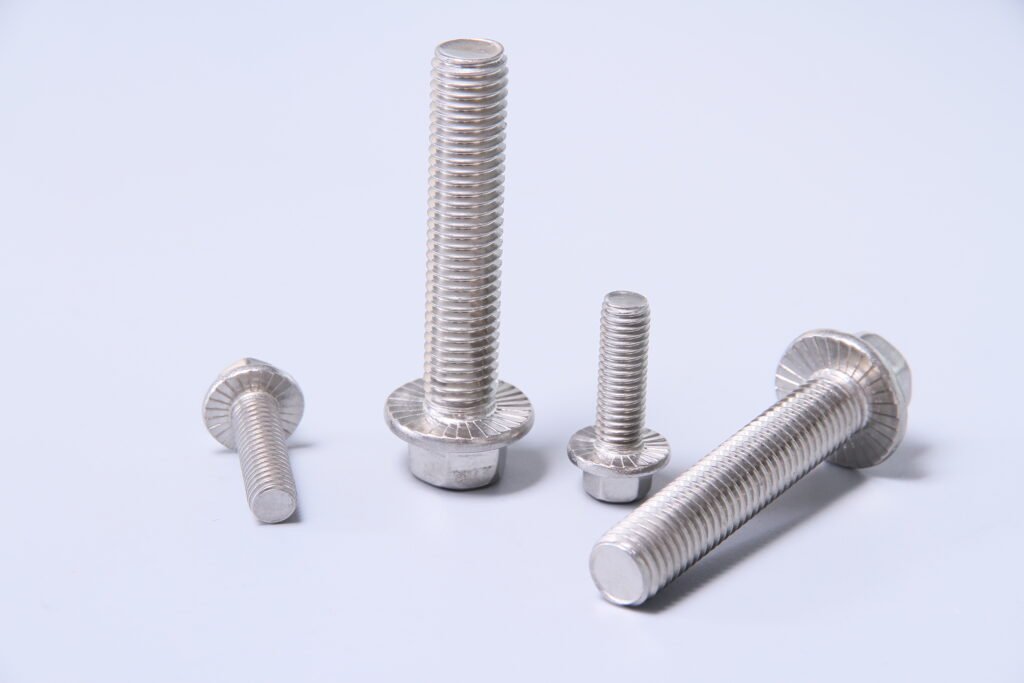
| Head | Used to apply torque Common shapes: Hexagonal head, flange head, round head, socket head cap, etc. |
| Tip | Flat or chamfered design, facilitating installation alignment |
III. Common Types and Characteristics
| Bolt Name | English Name | Feature Description | Application Scenarios |
| Hexagonal Head Bolt | Hex Bolts | The most common type with a hexagonal head, suitable for tightening with a wrench | Mechanical structures, construction installation |
| Flange Bolt | Hex Flange Bolts | Equipped with a washer – like flange face to increase force – bearing area and prevent loosening | Automobiles, heavy – duty equipment |
| Square Head Bolt | Square Head Bolts | Has a square head for easy clamping and locking, suitable for old – style structures | Railways, maintenance of old equipment |
| Cup Head Square Neck Bolt (Carriage Bolt) | Cup Head Bolts / Carriage Bolts | Round head with a square neck to prevent rotation, mostly used in wood structures | Woodworking connections, furniture |
| Countersunk Head Bolt | Countersunk Head Bolts | Tapered head that can sink into the surface of connected objects without protruding | Precision equipment, thin plate connections |
| Eye Bolt | Eye Bolts | Features a ring at the top for lifting or traction | Lifting devices, transportation hanging points |
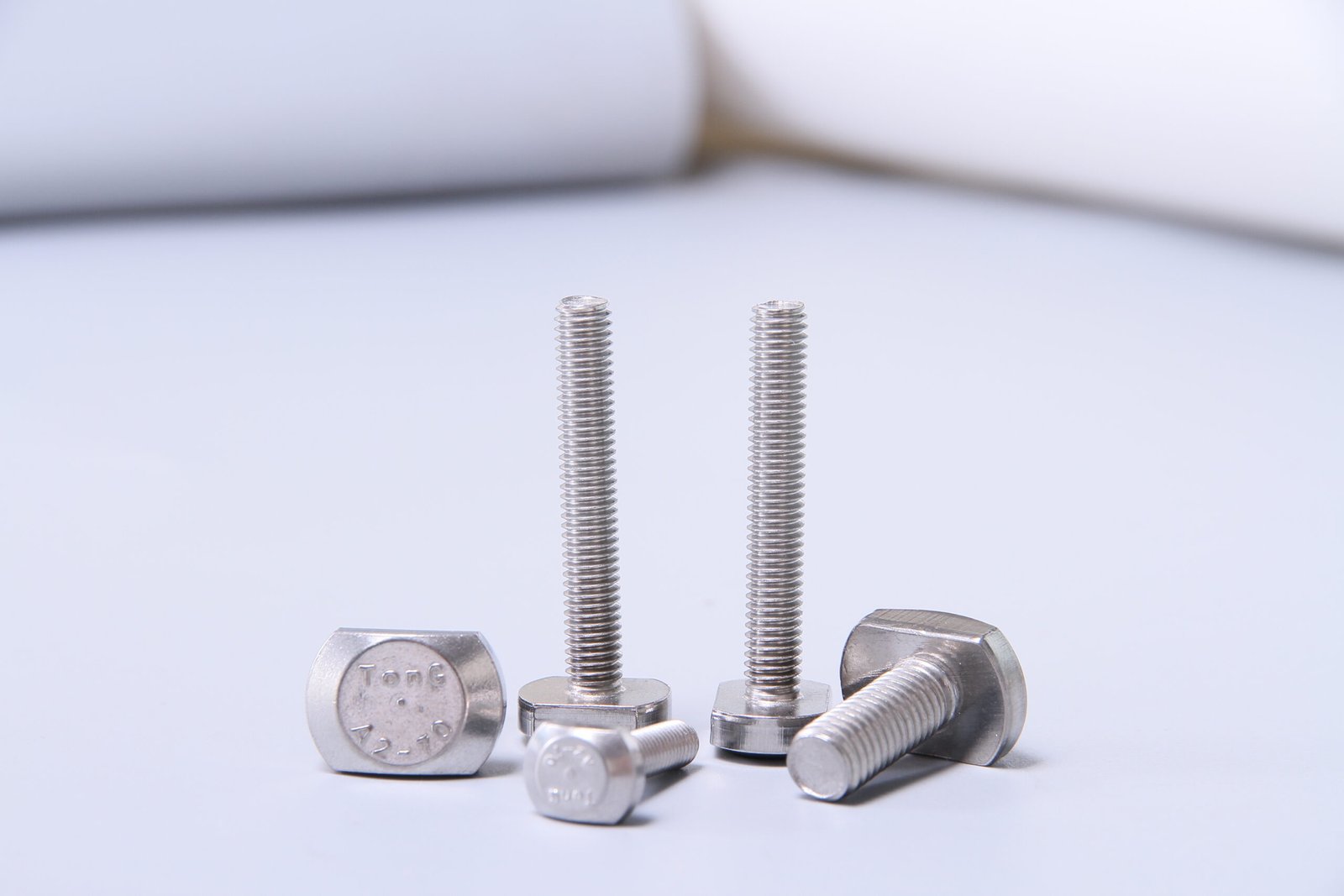
| T – head Bolt | T – head Bolts | T – shaped head that can be embedded into T – slots | Aluminum profile structures, fixture systems |
| U – bolt | U – bolts | U – shaped with threads at both ends, used to clamp round pipes or rods | Pipeline fixing, vehicle chassis |
| Bent Anchor Bolt | Bent Anchor Bolts | One end is bent and embedded in concrete, and the other end is connected to equipment | Fixing of building foundations |
| Straight Anchor Bolt | Anchor Bolts | Connected to equipment flanges after being embedded in concrete | Foundation installation, equipment anchoring |
| Wheel Bolt | Wheel Bolt | Specifically designed for connecting wheels and wheel hubs, requiring high strength | Automobiles, engineering machinery |
| Hexalobular Head Bolt | Hexalobular Head Bolts | Hexalobular (Torx®) head for slip – resistance and high torque | Automobiles, electronic products |
| 12 – Point Head Bolt | 12 – Point Head Bolt | 12 – point head design, compatible with special sockets, suitable for high – precision and high – torque connections | Engines, aerospace, racing cars |
IV. Materials
| Material | Characteristics | Typical Applications |
| Carbon Steel (C45, Q235, 35#) | Low cost, easy to process | General – purpose connectors |
| Alloy Steel (40Cr, 35CrMo) | High strength | Engineering machinery |
| Stainless Steel (304, 316) | Corrosion – resistant, aesthetically pleasing | Food, pharmaceutical, marine engineering equipment |
| Titanium Alloy | Ultra – light, high corrosion resistance | Aerospace, deep – sea engineering |
Note: Stainless steel marking such as A2 – 70 means austenitic 304 stainless steel with a tensile strength of ≥ 700 MPa.
V. Mechanical Properties
Carbon steel strength grades (common standard: ISO 898 – 1):
| Grade | Tensile Strength (MPa) | Yield Strength (MPa) |
| 4.8 | 400 | 320 |
| 8.8 | 800 | 640 |
| 10.9 | 1000 | 900 |
| 12.9 | 1200 | 1080 |
Calculation rule:
- First digit × 100 = Tensile strength
- Second digit × First digit = Yield strength
VI. Surface Treatment Methods
| Surface Treatment | Features | Application Scenarios |
| Galvanizing (White Zinc / Blue – white Zinc) | Corrosion – resistant, cost – effective | Indoor applications |
| Hot – Dip Galvanizing | Thick coating, durable | Outdoor, steel structures |
| Black Oxide Coating (Blackening) | Rust – proof, aesthetically pleasing | Mechanical equipment |
| Dacromet | High corrosion resistance (up to 1000 hours of salt spray test) | Automobile chassis, heavy industry |
| Nickel Plating, Chrome Plating | Highly decorative | Household appliances, electronic products |
VII. Standards and Marking
- International Standards: ISO, DIN, ANSI, JIS, GB (China National Standard)
Example: DIN 933 (fully threaded hexagon head bolt)
- Thread Standards:
- Metric (M): M6, M8, M10…
- Imperial (UNC/UNF): 1/4″, 5/16″, 3/8″…
- Marking Method (Stamping):
- Mark the strength grade (e.g., 8.8) and manufacturer code.
- Stainless steel bolts are marked with A2/A4 + grade.
VIII. Brief Introduction to Manufacturing Processes
- Cold Heading Forming: Commonly used for mass – produced bolts, featuring high speed and high material utilization rate.
- Hot Forging Forming: Applied to high – strength and large – size bolts, ensuring more stable mechanical properties.
- Thread Rolling: Threads are formed by extrusion, which is tougher than cutting.
- Heat Treatment: Quenching and tempering processes to improve strength and toughness.
- Surface Treatment: For rust prevention, corrosion resistance, decoration, etc.
IX. Common Usage Problems and Suggestions
| Problem | Suggestion |
| Bolt Thread Stripping | Use appropriate torque and avoid repeated assembly and disassembly |
| Bolt Loosening | Add lock washers, threadlocker, or spring washers |
| Surface Rusting | Select stainless steel materials or adopt Dacromet treatment |
| Difficult Installation | Check hole diameter/thread matching and perform lubrication treatment |
X. Practical Application Examples
- Building steel structure connectors (M20 hot – dip galvanized bolts)
- Automobile engine fixing bolts (Grade 10.9 high – strength bolts)
- Stainless steel furniture connectors (304 socket head cap bolts)
- Pipeline flange bolts (stud bolts + nuts + washers)
FAQ
Q: What do metric bolt strength grades 4.8 / 8.8 /10.9 /12.9 stand for?
A: Under ISO 898‑1, the first digit ×100 gives minimum tensile strength in MPa. The product of two digits gives yield‑strength value. 4.8 is general‑purpose; 8.8‑12.9 are high‑strength for heavy‑load machinery, engines and steel structures.
Q: How do I select bolt material and matching surface‑treatment for my environment?
A: Carbon‑steel bolts are low‑cost for general indoor use, apply galvanizing / hot‑dip galvanizing / Dacromet for corrosion protection. Pick 304(A2‑70) /316(A4‑70) stainless steel for humid, coastal or food‑grade scenarios. Titanium alloy suits aerospace and deep‑sea projects.
Q: What common issues happen during bolt installation and how can I avoid them?
A: Thread stripping arises from over‑torque and frequent disassembly. Loosening occurs under vibration; use lock washers or thread‑locker. Rusting needs proper material or coating. Verify hole‑thread fit and add lubricant for difficult assembly.
HKTL Fastener supplies diverse‑type bolts with qualified material, strength grades and surface‑treatments for global industrial fastening projects.
If you are looking for suitable bolts and nuts, please visit us here https://hktl-fastener.com/bolts-and-nuts/.