Key Takeaway
Stainless‑steel fasteners rely on chromium‑rich passivation film for anti‑corrosion performance, graded under ISO 3506. Five main metallurgical families deliver distinct strength and corrosion‑resistance levels. Avoid common misapplication mistakes; verify chemical composition, mechanical metrics and salt‑spray performance for quality control instead of only judging by surface appearance.
| Material Family | Representative Grade | Core Trait | Typical Application |
|---|---|---|---|
| Austenitic | A2‑70(304), A4‑80(316) | Non‑magnetic, excellent corrosion resistance | Food‑processing, general‑purpose hardware |
| Ferritic | F1‑45 / F1‑60 | Non‑heat‑treatable, low‑cost | Construction & automotive decoration |
| Duplex | 2205 | High yield strength, chloride‑resistant | Offshore platforms, chemical equipment |
| Martensitic | C1‑110(410) | Heat‑hardenable, magnetic | Tools, shafts, moderate‑corrosion parts |
| Precipitation‑hardening | PH series | Age‑hardened high strength | High‑performance specialty assemblies |
Chromium (minimum 10.5 wt%) forms the protective passive layer; molybdenum in 316 greatly boosts chloride‑resistance. Austenitic grades cannot gain strength via heat‑treatment, while martensitic types achieve high strength through quenching‑and‑tempering. Duplex stainless steel doubles the yield strength of common austenitic stainless steel.
Common pitfalls include improper welding wire selection and wrong surface finishes for marine settings. For quality validation, carry out chemical‑composition checks, mechanical‑property testing and ISO 9227 neutral salt‑spray tests. Harsh coastal projects demand long‑duration salt‑spray verification up to 2000 hours to secure long‑term connection reliability.
Stainless steel, also known as non-rusting acid-resistant steel or water copper iron, is an alloy steel that remains passive, corrosion-resistant and does not rust in the atmosphere and corrosive media such as acids, alkalis and salts. It usually contains high chromium (typically 12% to 30%) and may also contain nickel, molybdenum, vanadium, manganese, tungsten and other elements.
The most important metal element that determines the rust resistance of stainless steel fasteners is chromium.
Internationally, it is defined by weight as an alloy steel with a minimum chromium content of 10.5 wt% and a maximum carbon content of 1.2 wt%, or an “iron alloy” with a chromium content of more than 10%.
This name comes from the fact that it is not as prone to corrosion and rust as ordinary steel. In the industry, material types are usually indicated by grades such as SUS304 and SUS316, and the ISO 3506 dedicated grade system is used, such as A2-70, A4-80, C1-110, etc.
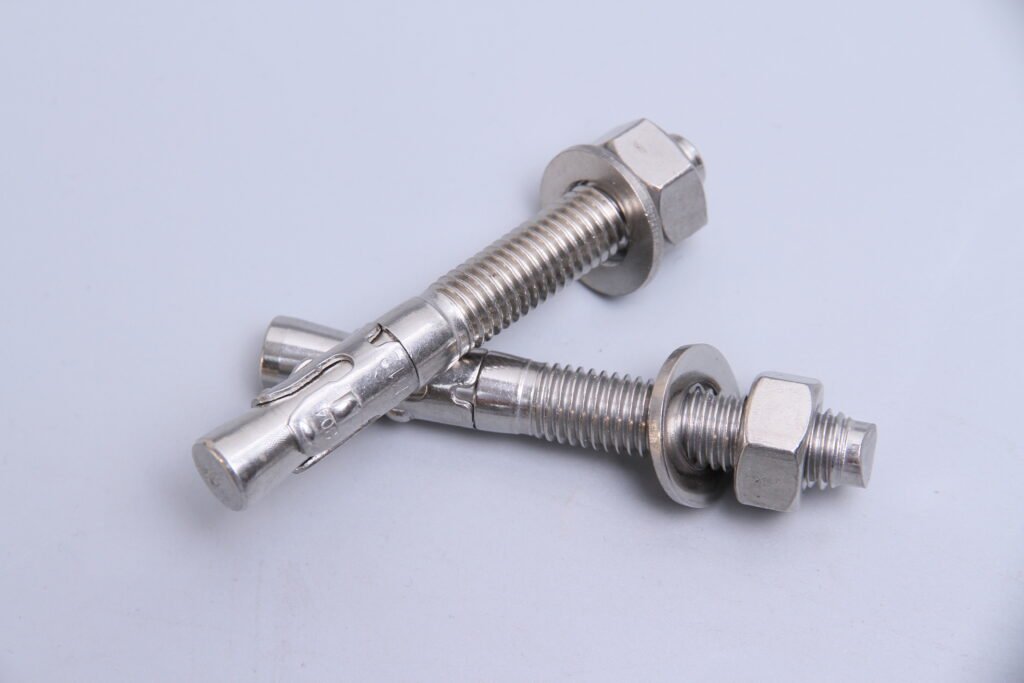
I. Strength System of Stainless Steel Bolts
The strength of stainless steel bolts is indicated by special codes, such as:
A2-70: Austenitic stainless steel (such as 304), minimum tensile strength 700 MPa, yield strength ≥ 450 MPa (ISO 3506)
A4-80: Austenitic stainless steel (such as 316), minimum tensile strength 800 MPa, yield strength ≥ 600 MPa
C1-110: Martensitic stainless steel (such as 12Cr13 quenched and tempered), tensile strength 1100-1400 MPa, yield strength ≥ 820 MPa
II. Stainless steel is classified into five major categories based on crystal structure
Austenitic stainless steel contains 16% – 26% chromium and less than 35% nickel. It usually has the highest corrosion resistance, cannot be strengthened by heat treatment, and is non-magnetic. The most common type is 18/8, or 304 grade, which contains 18% chromium and 8% nickel.
Typical applications include the aircraft industry, dairy and food processing industries. Austenitic stainless steel (A*-50 is softer / A*-70 is suitable for cold working / A*-80 has high strength)
Typical grades: 304 (06Cr19Ni10), 316 (022Cr17Ni12Mo2)
Characteristics: Non-magnetic, excellent corrosion resistance
Applications: General fasteners (hex bolts, nuts, etc.)
Ferritic stainless steel contains 10.5% – 27% chromium and no nickel. Due to the low carbon content (less than 0.2%), it cannot be strengthened by heat treatment and is only used in situations with low corrosion resistance requirements, such as in construction and automotive decoration. Ferritic stainless steel (F1-45 is softer / F1-60 is suitable for cold working)
Duplex stainless steel combines the microcrystalline structures of austenitic and ferritic stainless steel, with an ideal ratio of 50:50, although commercial products may use a ratio of 40:60. It is distinguished by a higher proportion of chromium (19% – 32%) and molybdenum (up to 5%) compared to austenitic stainless steel, and a lower proportion of nickel.
Duplex stainless steel has approximately twice the yield strength of austenitic stainless steel. Its mixed crystal structure provides better resistance to chloride corrosion compared to 304 and 316 stainless steel.
Typical grades: 2205 (UNS S31803/S32205/022Cr23Ni5Mo3N)
Characteristics: Tensile strength ≥ 640 MPa (ISO 3506-1:2020), long-term service temperature ≤ 250°C, resistance to stress corrosion
Applications: Chemical equipment, offshore platforms
Standard basis: ISO 3506-1:2020 Martensitic stainless steel (English: martensitic stainless steel) typically contains 11.5% – 18% chromium and less than 1.2% carbon, and sometimes nickel. It can be strengthened through heat treatment and has moderate corrosion resistance.
Typical grades: 410 (12Cr13), 420 (20Cr13)
Characteristics: Heat-treatable, magnetic material. Surface treatment should be selected based on the environment (such as passivation or epoxy coating. Galvanizing/chromium plating may reduce corrosion resistance)
Applications: Cutting tools, surgical instruments, turbine blades, high-strength shafts
Precipitation hardening grade stainless steel has an austenitic or martensitic matrix and can be hardened through precipitation hardening (also known as age hardening) treatment.
III. Key Elements of Material Properties
1. Nickel content: 304 nickel content: 8-10%, 316 nickel content: 10-14% (national standard 022Cr17Ni12Mo2 nickel content is 10.0-14.0%). Molybdenum (316 contains 2-3%) significantly improves resistance to chloride ion corrosion.
2. Carbon content: Austenitic stainless steel carbon content ≤ 0.08% (ultra-low carbon type such as 304L carbon content ≤ 0.03%). Martensitic stainless steel carbon content 0.15-0.40%.
3. Chromium content: All stainless steels have a chromium content of ≥ 12%. Chromium is the basis for the formation of the passive film.
IV. Common Misconceptions
1. Strength and corrosion resistance balance:
316 (A4-80) has a higher strength (800 MPa) than 304 (A2-70, 700 MPa), and due to the presence of molybdenum (2-3%), its resistance to chloride ion corrosion is significantly improved.
2. Welding process:
Low-carbon welding wire (ER308L carbon content ≤ 0.03%) should be used, and carbon steel welding wire (carbon content 0.06-0.15%) is prohibited.
3. Surface treatment:
In marine environments, passivation treatment or chromium-free Dacromet (zinc-aluminum coating) is recommended. The traditional Dacromet process containing chromate has been gradually phased out.
Strict salt spray test: It is recommended to follow ISO 9227:2017 NSS (neutral salt spray) for 2000 hours, rather than CASS (copper-accelerated salt spray).
V. Key Points for Quality Control
1. Chemical composition testing: Core elements: Cr (≥ 12%), Ni (316 ≥ 10%), Mo (316 ≥ 2%), C (austenitic ≤ 0.08%)
2. Mechanical property testing: Austenitic stainless steel: Yield strength ≥ 210 MPa (GB/T 3098.6)
Hardness range: A2-70 corresponds to HV 210-300
3. Corrosion resistance verification: Salt spray test: Neutral salt spray ≥ 480 hours (ISO 9227 standard), 2000 hours recommended for harsh environments (ISO 9227 NSS)
Intergranular corrosion test: ASTM A262
If you are looking for stainless steel fasteners, please visit us here https://hktl-fastener.com/.