Core Conclusion
Set screws (grub screws) are headless fully‑threaded fasteners that lock components onto shafts via tip compression rather than head‑clamping force. Select tip geometry, material and surface finish based on load magnitude, shaft‑surface protection and anti‑vibration requirements. Flat‑point types protect shaft surfaces for frequent disassembly; cup‑point and cone‑point deliver higher gripping force for semi‑permanent or permanent mechanical assemblies.
| Tip Style | Main Feature | Typical Working Scenario |
|---|---|---|
| Flat Point | No shaft indentation, minimal surface damage | Repeated disassembly, positioning adjustments |
| Cup Point | Creates shallow indentation, strong grip | General‑purpose semi‑permanent shaft locking |
| Cone Point | Deep penetration, maximum holding torque | Permanent fixed assemblies, hard‑material shafts |
| Dog Point | Locating shoulder for precise alignment | Position‑critical assemblies with matching recess |
Set screws mostly adopt hex‑socket drive for Allen‑key installation and conform to DIN913‑DIN916 standards. Common materials include 12.9‑grade alloy‑steel (black‑oxide finish for high strength), 304/316 stainless‑steel for corrosion‑prone environments, and brass for electrical‑contact parts. They fix gears, pulleys, collars and knobs to shafts to block rotational slip and axial movement, primarily for low‑to‑medium torque transmission.
Common application pitfalls include over‑torque causing thread stripping, cone/cup‑point scratching expensive shafts, and loosening under sustained vibration. Adding nylon‑patch thread‑locking treatment greatly improves vibration resistance. Always match set‑screw hardness with shaft material and control tightening torque to avoid shaft deformation or fastener fracture.
Set Screws, Big Roles: The Invisible Guardians of the Mechanical World!
In the vast realm of mechanical equipment, there are many seemingly insignificant yet crucial components, and set screws are among them. Despite their small size, they play a vital role in fixing the relative positions of machine parts. Today, let’s explore this “invisible guardian” of the mechanical world.
I. What is a Set Screw?
A set screw, also known as a socket head screw, locating screw, machine screw, or grub screw, is a type of screw specifically designed to fix the relative positions of machine parts. By being screwed into the threaded hole of the part to be fixed, its end presses against the surface of another part, thereby securing the former to the latter.
Apart from the most common name “set screw,” it has various other names depending on regional and industry practices: socket head screw, locating screw, machine screw, grub screw, or lock screw. All these names refer to the same function – fixing the relative positions of machine parts.
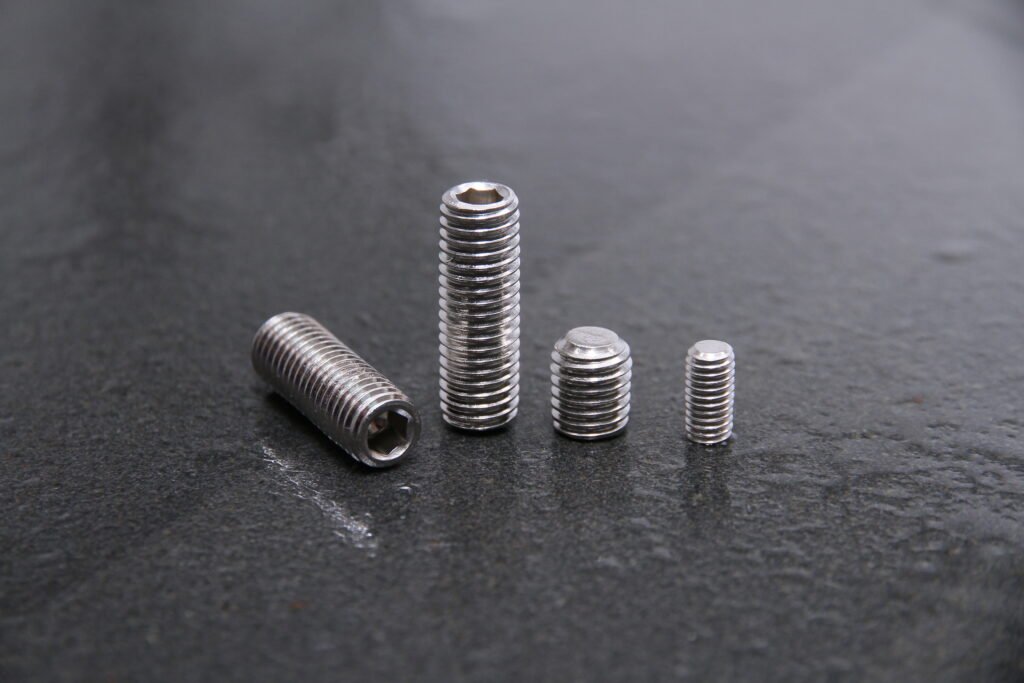
II. Types and Applications of Set Screws
Set screws can be classified into various types based on their head structure, end shape, and application characteristics. Each type has its specific application scenarios and advantages.
- Classification by Head Structure
Slotted set screw: Installed with a flat-head screwdriver, it provides relatively low clamping force.
Hex socket set screw: Compact in structure, easy to install and remove, often used in connections with limited space. The clamping force is between that of slotted and square head screws.
Square head set screw: Suitable for parts where the head can be exposed, providing the greatest clamping force. - Classification by End Shape (This is the most important classification method)
Flat end set screw (DIN913): The end is smooth, and it does not damage the surface of the part when tightened. It is used in connections that require frequent position adjustments and can only transmit small loads; - Tapered end set screws (DIN914): Suitable for use on machine parts with lower strength, the sharp end can bite into the surface of the part.
Cylindrical end set screws (DIN915): Applicable to tubular shafts (thin-walled parts), the cylindrical end enters the hole of the tubular shaft and can transmit a larger load. However, a device to prevent the screw from loosening should be provided during use.
Concave end set screws (DIN916): Suitable for machine parts with high hardness or those that need frequent position adjustments. - Special types of set screws
Self-tapping set screws: When used on the connected parts, the thread does not need to be pre-cut at the connection point. The thread is directly tapped out during connection. It is often used to connect thin metal plates. - Ball set screws: Composed of a spring, steel ball, and shell, suitable for fixture positioning, used for knob indexing or as various stops.
- The rubber-headed set screw: The rubber head of the screw is tightly pressed against the surface of another machine part to achieve the effect of fixing, preventing the surface from being scratched and providing insulation.

III. Selection Criteria for Set Screws
Selecting the appropriate set screw requires considering multiple factors. Here are some key selection criteria:
- Material Selection
The material of the set screw directly affects its strength and wear resistance: carbon steel set screws have high strength and toughness and are suitable for general mechanical connections; alloy steel set screws have higher strength and hardness and are suitable for applications with large loads and impacts; stainless steel set screws are widely used in humid and corrosive environments due to their excellent corrosion resistance. - For extremely demanding applications, such as 12.9 grade countersunk socket set screws, high-strength alloy steels like SCM435 and SCM440 are typically used as raw materials, with tensile strengths reaching approximately 1200 MPa to 1220 MPa.
- Hardness Requirements
The hardness of set screws is usually adjusted through heat treatment. Set screws are mainly classified into four grades: 14H, 22H, 33H, and 45H, with the 45H grade being equivalent to a 12.9 grade bolt. The hardness of 12.9 grade set screws is typically between HRC39 and HRC44. - Surface Treatment
Surface treatment not only enhances the aesthetic appeal but also improves the corrosion resistance of the screw. Common surface treatment methods include: galvanizing, blackening, nickel plating, chromium plating, etc. For stainless steel set screws, passivation treatment can also be applied. - Dimensional Parameters
The selection of set screw dimensions should be based on specific connection requirements and design specifications: the diameter range of national and international standard set screws is typically from M2 to M12, with lengths ranging from 6mm to 100mm.
For British and American standards, the diameter range is from 2# to 1 inch, and the lengths range from 4# to 4 inches.
In fact, the diameter and length specifications of set screws are more diverse, covering various sizes such as 2, 3, 4, 5, 6, 8, 10, 12, 16, 18, 20, 25, 30, 35, 40, 45, 50, and 60. - Performance Requirements
When selecting set screws, the following performance indicators should be considered:
Tensile strength: The maximum tensile force that can be withstood per unit area;
Yield strength: The stress at which significant plastic deformation begins;
Fatigue resistance: Performance under cyclic loading.
IV. Correct Use and Maintenance of Set Screws
- Installation Precautions
Use torque tools that match the material to prevent stripping or overloading;
Clean the oil and impurities in the threaded holes before installation;
Apply thread locking adhesive if necessary to prevent loosening;
For high-frequency vibration applications, it is recommended to use socket head cup point set screws with elastic washers. - Maintenance and Inspection
Regularly inspect the set screws, including checking for looseness, wear and corrosion.
Replace or repair set screws that are loose or severely worn.
For set screws with severe corrosion, take appropriate anti-corrosion measures to extend their service life.
Pay attention to the lubrication and maintenance of set screws. Choose the appropriate lubricant based on the material of the set screw and the working environment and apply it.

V. Application Examples: Selection of Set Screws in Different Scenarios
- Precision machinery: Choose hex socket countersunk or flat head set screws to avoid protruding parts interfering with other components and ensure precise positioning.
- Heavy equipment: Choose high-strength alloy steel set screws to provide sufficient clamping force.
- Wet environments: Choose stainless steel set screws with appropriate surface treatment (such as passivation treatment) to prevent corrosion.
- Frequently adjusted positions: Choose flat or countersunk head set screws for easy adjustment without damaging the surface of the parts.
- Although set screws are small, they play an indispensable role in the mechanical world. Choosing the right set screws not only ensures the stable operation of equipment but also extends its service life. We hope that through this article, you can better understand and select set screws, allowing this “invisible guardian” to play a better role.
- Next time you need to use set screws, take a little more time to consider factors such as type, material and surface treatment. We believe that this small effort will make a big difference!
If you are looking for set screws, please get more information here https://hktl-fastener.com/screws/.